4-3. Warehousing Business Act (Commercial Warehouse Registration)
The Warehousing Business Act governs and regulates businesses operating "Commercial Warehouses (Contract Storage)" that receive storage compensation for taking custody of third-party cargo[cite: 22, 23].
Unlike "Private Warehouses" that store proprietary goods exclusively, the act mandates official Registration Requirements with the Ministry of Land, Infrastructure, Transport and Tourism (MLIT) and enforces strict Facility Standards to protect customer assets[cite: 22, 23].
1. Commercial Warehouse Registration Criteria (Physical & Managerial)
Operating a commercial warehouse requires fulfilling all statutory requirements prescribed by MLIT ordinances to receive formal registration approval[cite: 22, 23].
① Physical & Structural Criteria (Hardware Requirements)
Structures must conform to specialized facility standards based on stored cargo classifications[cite: 22, 23]:
- Waterproofing & Moisture Resistance: Construction designed to prevent roof leaks and moisture ingress through walls or slab floors[cite: 22, 23].
- Floor Load Capacity: Verified floor slab and racking structural strength capable of bearing heavy cargo loads[cite: 22, 23].
- Security & Physical Protection: Lockable entry systems, CCTV surveillance, and intrusion detection sensors to prevent unauthorized access[cite: 22, 23].
- Fire Resistance & Fire Protection: Full compliance with Building Standard and Fire Service Acts, accompanied by official Building Inspection Certificates ("Inspection Certificate")[cite: 22, 23].
② Managerial & Personnel Criteria (Software Requirements)
- Appointment of Warehouse Management Director: Mandates appointing at least one qualified Warehouse Management Director per facility to oversee fire prevention, theft protection, and labor safety[cite: 22, 23].
- No Disqualification Grounds: Corporate officers must have no record of prior warehouse registration revocations under the Act[cite: 22, 23].
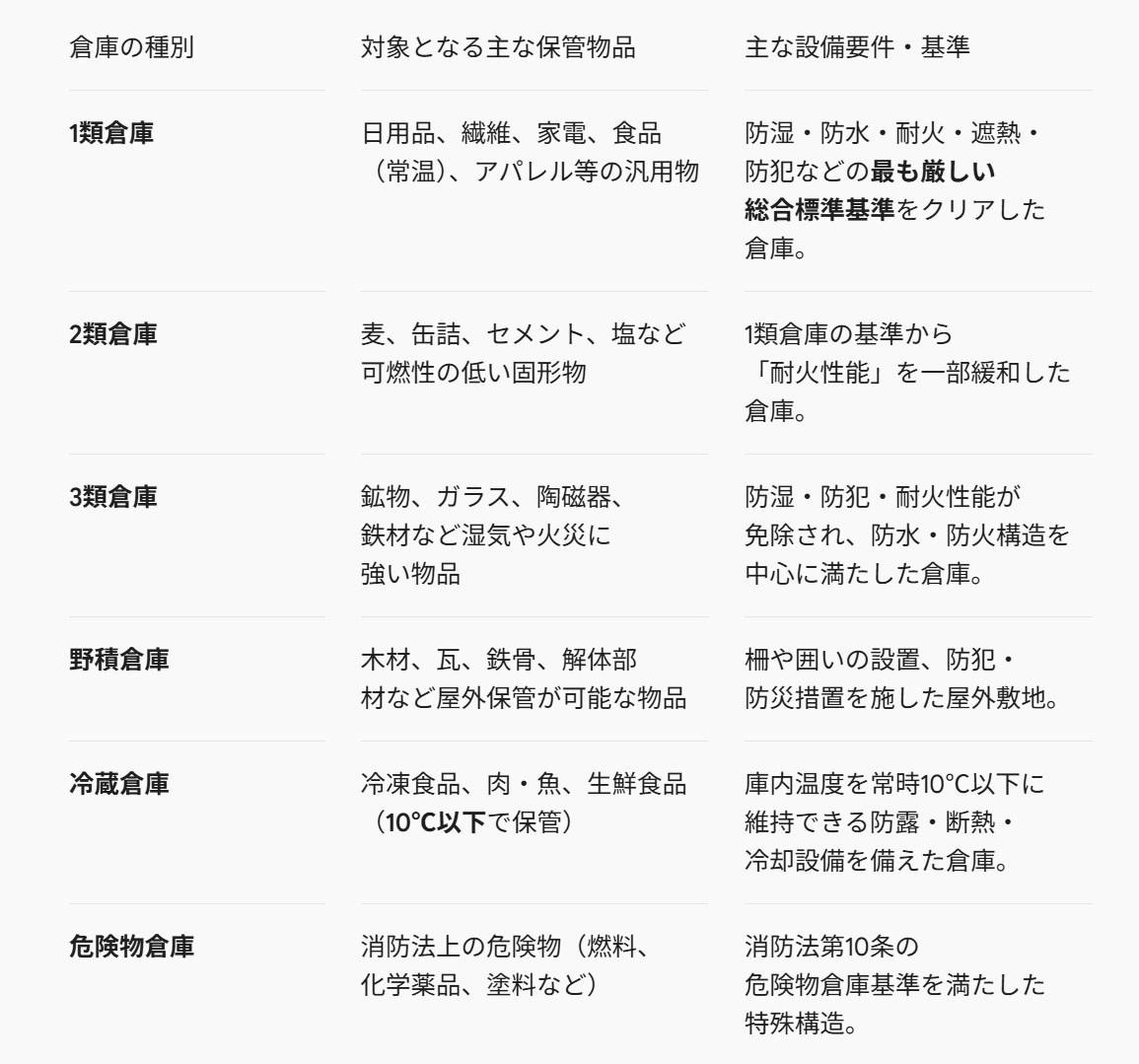
2. Warehouse Classifications & Permissible Cargo
Under the Warehousing Business Act, commercial warehouses are classified into primary categories based on cargo characteristics[cite: 22, 23]:
3. Registration Workflow & Application Process
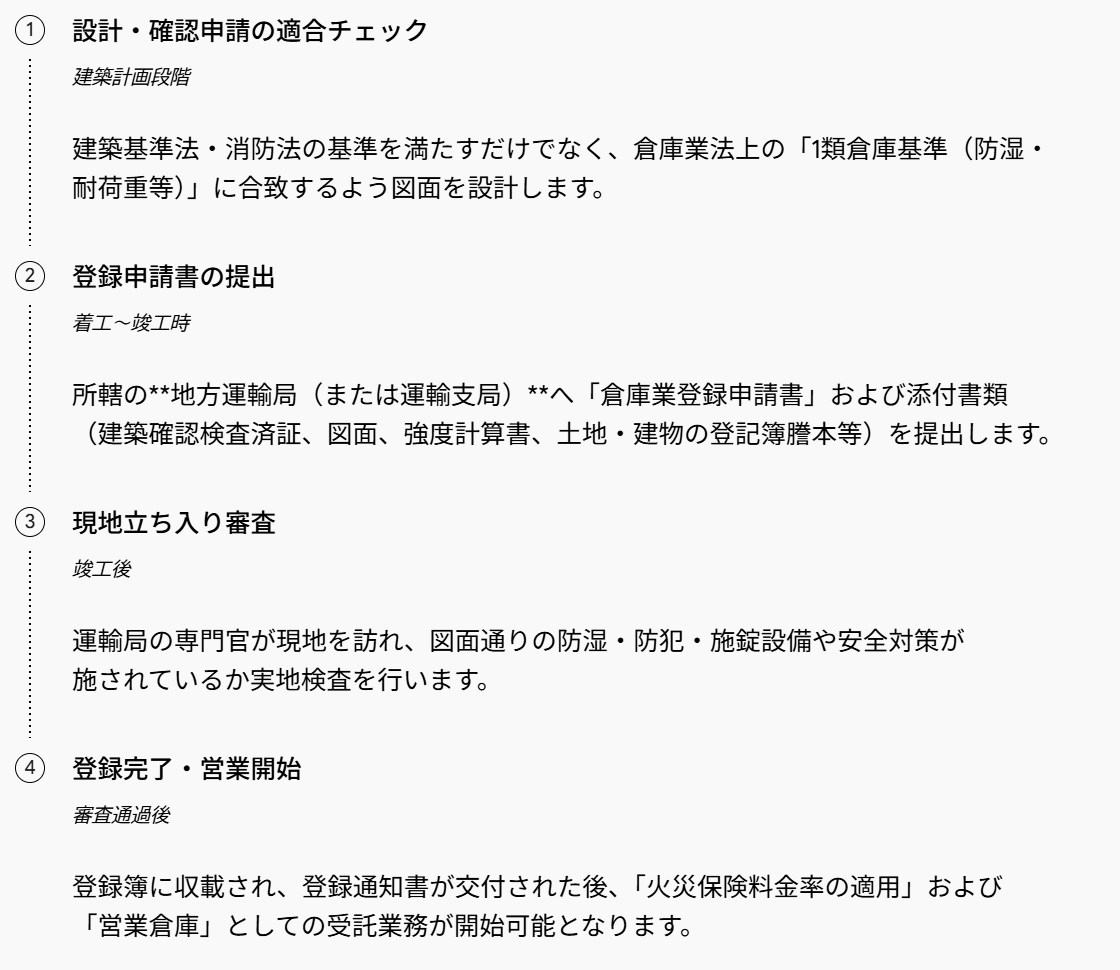
Because MLIT registration screening requires several months, commercial registration must be integrated during early facility architecture and site planning stages[cite: 22, 23].
4. Penalties for Unregistered Commercial Operations
⚠️ Penalties for Illegal Unregistered Operations ("White Warehousing"):
Storing third-party cargo for commercial compensation without MLIT registration constitutes illegal "Unregistered Operation," punishable by imprisonment up to 1 year or fines up to 1,000,000 JPY (or both) under the Warehousing Business Act[cite: 22, 23].When a 3PL logistics provider operates within a leased multi-tenant distribution center, the provider must independently complete commercial warehouse registration for its specific leased unit[cite: 22, 23].