Hazardous Material Warehouse Construction Requirements & Classifications
Hazardous material warehouses (designated as "Indoor Storage Facilities" under fire codes) store dangerous goods like alcohol, petroleum, paints, and chemicals. Unlike standard general warehouses, they are engineered and operated under strict technical standards enforced by the Fire Service Act[cite: 21].
Key Differences from General Warehouses & Structural Restrictions
-
Single-Story Structure Principle:
To prevent vertical fire spread during an ignition event, structures are strictly limited to single-story designs with eave heights under 6 meters[cite: 21]. -
Mandatory Safety Setback Yards (Open Space):
To prevent fire spread to adjacent properties during a blast or fire, designated open safety yards must be maintained around the building perimeter based on stored volume multiples[cite: 21]. -
Fireproof Shell & Blast Relief Roof Design:
Walls, columns, and floors require full fireproof construction. Roofs utilize lightweight, non-combustible materials (e.g., steel sheeting) designed to vent blast pressure upward in an explosion[cite: 21].
Core Safety & Equipment Requirements for Hazardous Warehouses
| Category | Primary Equipment & Engineering Requirements |
|---|---|
| Fire Suppression Systems | Systems matched to stored chemical classes (foam, inert gas, or dry chemical systems; water-based suppression is strictly forbidden for water-reactive chemicals)[cite: 21]. |
| Ventilation & Vapor Exhaust | Forced mechanical exhaust fans or low-level ventilation openings prevent heavy flammable vapors (e.g., gasoline) from pooling near the floor[cite: 21]. |
| Spill Containment Measures | Floor sloped toward catchment sumps, liquid-tight sills, and containment dikes prevent leaked liquids from escaping outside[cite: 21]. |
| Explosion-Proof Electrical Systems | Fixtures, switches, and wiring utilize certified explosion-proof specifications to prevent electrical spark ignition[cite: 21]. |
Specific equipment and isolation distance requirements vary significantly based on stored chemical classes (Class 1 to Class 6) and volume multiples[cite: 21].
Hazardous Material Classifications (Class 1 Through Class 6)
Under Japanese Fire Service Act regulations, "Hazardous Materials" are categorized into six distinct classes based on physical state and chemical hazard profiles[cite: 21]:
Classifications are divided by state (solids vs. liquids) and primary chemical risk (oxidizing, flammable, self-reactive)[cite: 21].
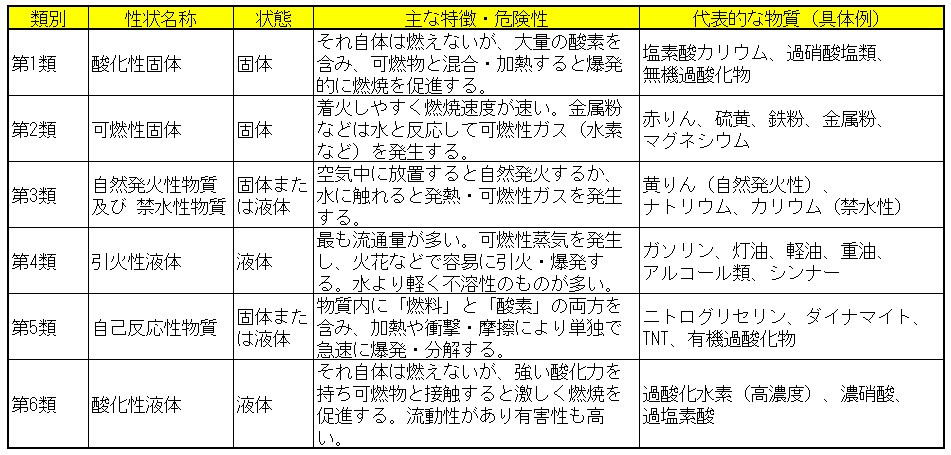
Key Classification Takeaways
-
Solid vs. Liquid States:
Class 1 and Class 2 contain "Solids" exclusively. Class 4 and Class 6 contain "Liquids" exclusively. Class 3 and Class 5 include both solids and liquids[cite: 21]. -
Non-Combustible (Oxidizing) Hazards:
Class 1 (Oxidizing Solids) and Class 6 (Oxidizing Liquids) are non-combustible themselves, but supply oxygen to intensely accelerate the combustion of other materials[cite: 21]. -
Class 4 Flammable Liquids (Most Common Category):
Encompassing gasoline, alcohols, paints, and oils, Class 4 represents the vast majority of commercial logistics storage and engineering consultations[cite: 21].