1. Background of Data Analysis
1-5. Knowledge & Tools Needed for Data Analysis
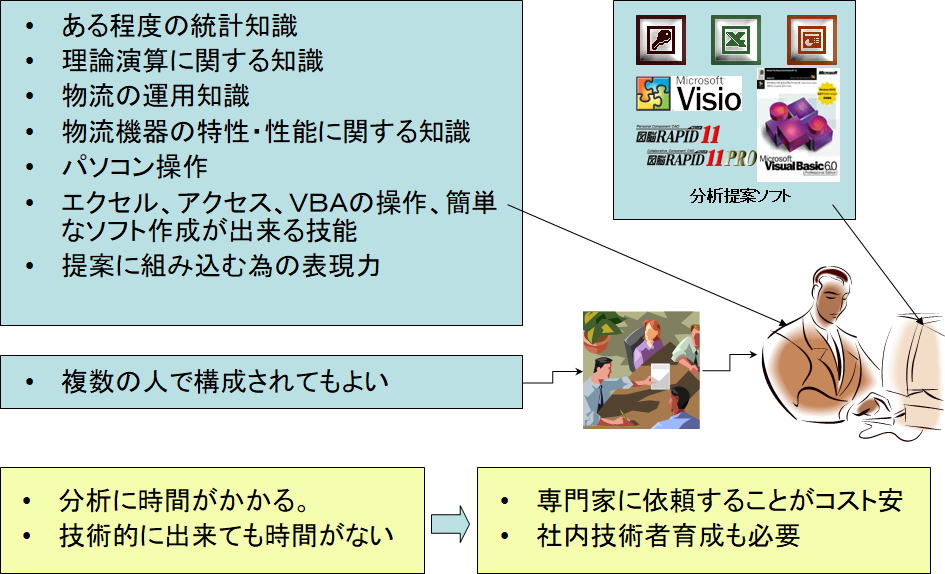
1. "5 Skill Sets" Required for Data Analysis
To conduct highly accurate logistics data analysis and link it to effective system proposals, multifaceted skills beyond simple computer operations are necessary:
- Basic Statistical Knowledge & Theoretical Calculation Skills: Fundamental academic ability to interpret trends and anomalies in massive data and make logically backed calculations.
- Logistics Operational Knowledge: Practical operational knowledge to determine if calculated results are genuinely feasible in warehouse operations.
- Knowledge of Material Handling Equipment Characteristics & Capacity: Ability to understand capabilities and constraints of material handling equipment (conveyors, sorters, racks, etc.) and align them with analytical findings.
- IT Tools & Programming Skills: Proficiency in utilizing Excel, Access, VBA, etc., to build custom aggregation tools and process large volumes of data at high speeds.
*About "Tera Calculation" provided by our institute:
To achieve high-speed processing of large datasets, Access is utilized as the database, heavily leveraging VB.NET and SQL for advanced analysis and aggregation. - Expressive & Presentation Skills for Proposals: Capacity to visualize analysis results via charts and diagrams (Visio, CAD, etc.) and deliver clear proposals to clients and stakeholders.
2. Team Composition & Utilizing External Experts
As outlined above, data analysis demands broad and specialized skills spanning statistics, field operations, IT, and presentation. It is extremely difficult for a single person to cover all these areas.
[Explanation] Team Organization & Outsourcing DecisionsThe diagram explicitly states that "these skills may be composed across multiple people." A practical approach involves building a team where sales representatives, IT engineers, and operational staff complement each other.
Conversely, organizations often face resource constraints like "in-house analysis takes too much time" or "we lack time due to daily operations despite having technical capability." As a solution, the diagram concludes that "hiring external specialists is ultimately more cost-effective." However, to maintain long-term competitiveness, a dual approach is encouraged: leveraging external experts while simultaneously "nurturing in-house technical talent."