2-5. Mechanization/automation return on investment (ROI) calculation
Calculating return on investment (ROI) in mechanizing and automating distribution centers"Initial/operating costs"and“Economic value that can be reduced and created”It starts with calculating correctly.
1. Identifying the elements necessary for calculation
First, make a list of all the items, ``money incurred (cost)'' and ``money gained (effect)''.
・Initial cost (CAPEX)
- Purchase cost of logistics equipment
- Distribution center side information management system (WMS) and upper system additional costs, equipment control system (WCS) costs
- Installation costs, electricity/network infrastructure maintenance costs
- Implementation consulting/project personnel costs
・Operating costs (OPEX: annual)
- Maintenance/maintenance contract fee (generally around 5-10%/year of the unit price)
- Software license fee/cloud usage fee
- additional electricity bill
- Contingency fee for replacement of malfunctions and consumables
・ Direct reduction effect (quantitative)
- Reduced labor costs:(Number of reduced staff x average annual salary) or (Reduced working hours x hourly wage)
- Reduction of overtime pay:Overtime reduction due to improved processing speed
- Cost reduction due to shipping errors:Reducing shipping costs, inspection labor costs, and waste loss due to incorrect shipments
・ Indirect effects (quantitative/semi-quantitative)
- Reducing base/rent costs by improving storage efficiency:Reducing space through high-rise and automated warehouses
- Sales increase due to expanded shipping capacity:Preventing opportunity loss by improving the ability to respond to waves
・ Qualitative effects (factors to consider)
- Improving resistance to recruitment difficulties, improving working environment (relieving heavy labor), and equalizing work quality
2. Main evaluation indicators and calculation formulas
Companies mainly use the following three indicators when making investment decisions.
A. Payback Period Method
This is the most intuitive and most commonly used method for calculating the number of years it will take to recover the investment amount.
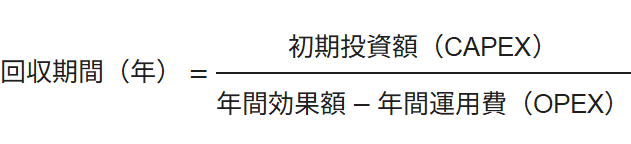
- guideline:In material handling robot investmentWithin 3 to 5 yearsThe general criteria for making a decision is to collect the waste.
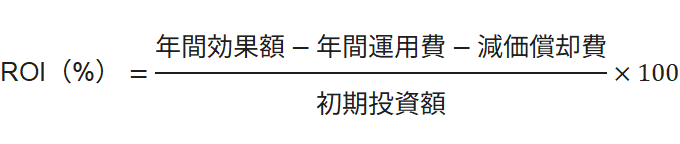
B. ROI (Return on Investment)
It shows how much profit you can get from the investment amount as a percentage (%).
C. NPV (Net Present Value)
When large-scale investments or long-term operations of 5 to 10 years are anticipated, evaluations are made by discounting future cash flows using a discount rate (weighted average cost of capital, etc.) and converting them to present value (NPV > 0investment grade).
3. Examples of specific calculation steps
- Equipment introduced:10 picking auxiliary AMRs (transfer robots)
- Initial investment (CAPEX):30 million yen (main unit + system linkage + construction)
- Annual operating expenses (OPEX):3 million yen / year (maintenance + system license)
- Operating conditions:8 hours a day, 250 days a year
- System before introduction:10 picking workers (hourly wage 1,400 yen, total annual labor cost approximately 28 million yen)
- Effects after implementation:By improving work efficiencyLabor saving for 4 people (approximately 40%)succeeded in
- Personnel cost reduction: 4 people × annual personnel cost 2.8 million yen =11.2 million yen / year
- Effects of reducing incorrect shipments and overtime:800,000 yen / year
- Total annual effect = 12 million yen / year
- Annual net effect = Annual total effect (12 million yen) - Annual operating cost (3 million yen) =9 million yen / year
- Payback period = 30 million yen ÷ 9 million yen =Approximately 3.3 years
The payback period is approximately 3.3 years, and it meets the general investment criteria (within 5 years).“Investment is justifiable”It can be determined that
4. Common mistakes and points when calculating
1. Averaging risk between “busy season” and “off season”
If you calculate based on the annual average workload, there are cases where the machine is idle during the off-season and you are not able to recover as calculated.Please make a trial calculation taking into account monthly and daily waves.
2. Maintenance costs increase over time
Since overhaul costs and battery replacement costs will be incurred after the warranty period ends, such as after the 5th year, the long-term simulation will include an increase in maintenance costs for the 6th and 7th years.
3. Consideration of on-site learning period (start-up lag)
Rather than assuming 100% operation rate from the first month of implementation, it is safe to estimate the effectiveness at a lower level (50-70%) for the first 3 to 6 months as a learning period.