3-8. Core Facility Planning: Logistics Hub Consolidation & Trade-offs
In modern supply chain management, executing optimal logistics facility planning represents a pivotal strategic decision impacting profit margins and competitive advantage. Selecting optimal logistics hub site locations during network restructuring fundamentally alters fixed vs. variable cost structures.
This chapter analyzes a corporate restructuring case study of a daily goods manufacturer. Through this real-world example, we examine cost and headcount reductions resulting from hub consolidation alongside inherent logistics trade-offs.
1. Case Study: Macro Analysis of Hub Location Restructuring
Historically, logistics strategies prioritized maintaining fragmented regional depots close to local consumer markets. However, a major daily goods manufacturer executed a strategic logistics facility planning review, deciding to consolidate national logistics hub site locations.
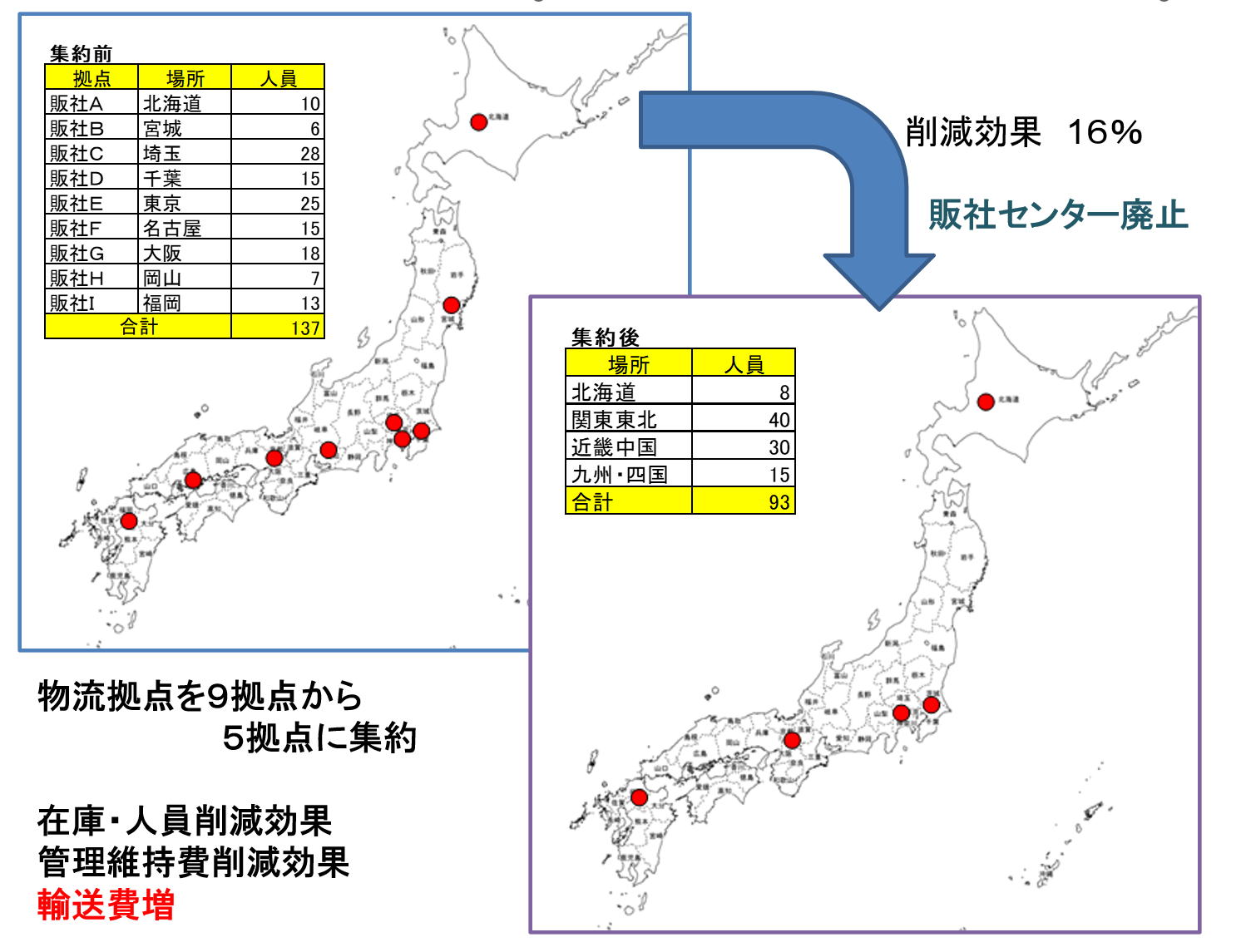
🔍 Diagram Analysis: Headcount Redistribution & Cost Reduction Mechanics
Analyzing numerical metrics and geographic shifts across the nationwide map reveals dynamic strategic benefits beyond simple node reductions:
【Pre-Consolidation: Over-Fragmented 9-Hub Network (137 Total Staff)】
Sales hubs were redundantly distributed across regional markets. In the Kanto region alone, three adjacent hubs—Saitama (28 staff), Chiba (15 staff), and Tokyo (25 staff)—employed 68 total staff, creating severe safety stock and administrative cost redundancies. Additional depots spanned Hokkaido (10), Miyagi (6), Nagoya (15), Osaka (18), Okayama (7), and Fukuoka (13).
【Post-Consolidation: Streamlined 5-Master-Hub Network (93 Total Staff)】
Redundant sales depots were closed, consolidating operations into 5 regional master blocks (Hokkaido, Tohoku, Kanto, Kansai, Kyushu).
Specifically, the Kanto/Tohoku zone consolidated 4 depots into a 40-staff master hub. Integrating Kinki/Chugoku (Nagoya, Osaka, Okayama into 30 staff) generated a 32% net headcount reduction (44 FTEs eliminated) across the network.
As illustrated in the diagram, while hub consolidation increased local outbound freight expenses, massive savings in safety stock, headcount, and facility overhead achieved a net 16% Total Logistics Cost reduction—the ultimate goal of logistics facility planning.
Drastic Hub & Headcount Reductions
- Pre-Consolidation (9 Hubs): Fragmented sales depots across 9 national sites.
➔ Total Staff: 137 FTEs - Post-Consolidation (5 Master Hubs): Redefined regional boundaries into high-capacity master hubs.
➔ Total Staff: 93 FTEs (44 FTEs / ~32% Net Reduction)
Financial Impact: Total Logistics Cost Reduction
Total Logistics Cost Reduction: 16% Net Savings
Reducing hub node counts increased last-mile delivery freight costs. However, economies of scale derived from fixed overhead, labor, and safety stock reductions far outweighed freight increases, driving a net 16% total cost reduction.
2. Structural Analysis: The "Logistics Trade-off" Concept
Formulating advanced logistics facility planning requires navigating classical logistics trade-offs—balancing conflicting cost drivers when consolidating from 9 hubs to 5 master hubs:
🔻 Cost Reduction Factors (Benefits)
- Inventory Reduction: Eliminates duplicate safety stock across regional depots, drastically lowering total supply chain working capital.
- Labor Efficiency: Eliminates redundant picking and administrative overhead across sites (137 FTEs ➔ 93 FTEs).
- Facility Overhead Reduction: Eliminates multiple warehouse leases, utilities, equipment maintenance, and WMS license fees.
🔺 Cost Increase Factors (Trade-off Penalty)
- Higher Freight Transport Costs: Consolidating logistics hub site locations increases last-mile transit distances to final retail stores or end consumers, raising trucking freight expenses and fuel surcharges.
3. Key Strategic Insights for Facility Planning
Two essential takeaways for future logistics facility planning derived from this corporate case study:
-
Mastering Trade-offs: Evaluate Total Logistics Costs, Not Freight Rates Alone
A fundamental law of logistics trade-offs states that reducing node counts increases delivery distances and freight rates. However, logistics facility planning must evaluate Total Logistics Costs (TLC). Success depends on ensuring inventory, labor, and lease savings exceed freight increases—as demonstrated by this case study's 16% net cost savings.
-
Macro Shift: From Fragmented Depots to Regional Master Hubs
Transitioning from small prefectural sales depots to regional master hubs represents a classic macro supply chain restructuring model that unlocks operational automation and standardization. Selecting new logistics hub site locations requires prime highway interchange access to support high-throughput regional distribution.