1. Background of Data Analysis
3-3. Relationship with Schedule Charts
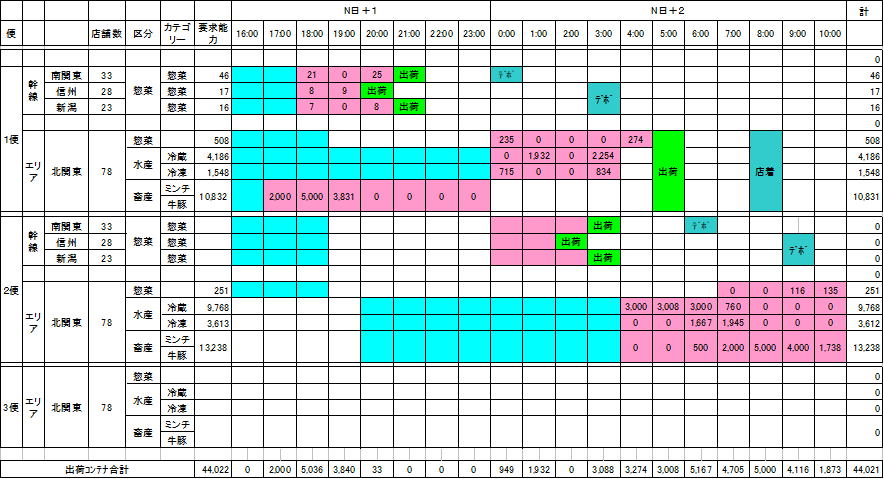
The core principle of operational time scheduling in distribution centers is "calculating backward from final truck departure deadlines to establish operational timeframes for upstream processes."
Scheduling forward from shift start or receiving times risks missing dispatch deadlines or causing extreme bottlenecks during peak hours. Because distribution centers operate under strict departure commitments, all operational steps must be calculated along a pull-based (backward-scheduled) timeline anchored at the shipping deadline.
2) Detailed Backward Calculation Logic for Process Times and Throughput
The following procedures outline how to work backward from shipping deadlines to determine hourly volume capacities for each process:
[Process 1] Loading & Truck Departure Process (Anchor Point)
- Time Determination: Set loading completion deadlines based on scheduled truck departures (e.g., 17:00 departure) and loading times (e.g., 30 minutes, starting at 16:30).
- Volume Calculation: Identify total cases and pallets to be loaded onto the vehicle, determining required loading berths, forklift capacity, and crew speed.
[Process 2] Packing, Outbound Inspection & Staging
- Time Determination (Backward): All outbound goods must be packed, inspected, and staged at dispatch bays before loading begins (16:30). Work backward to set packing deadlines (e.g., 15:30 - 16:30).
- Volume Calculation: Calculate hourly packing boxes and inspection scan lines. Determine required carton sealers, packing stations, and staging floor area.
[Process 3] Order Picking & Sorting
- Time Determination (Backward): Work backward further to set completion times for picking and sorting to feed the packing process (e.g., 14:00 - 15:30).
- Volume Calculation: Calculate hourly full-case picks and loose-piece pick lines/units. Determine peak hourly demand to size DPS (Digital Picking System) locations and automated sorter throughputs (units/hour).
[Process 4] Storage Retrieval & Pick-Face Replenishment
- Time Determination (Backward): Replenishment must be completed prior to or parallel with picking to prevent stockouts at pick faces (e.g., 13:00 - 14:00, or early morning shifts).
- Volume Calculation: Calculate case and pallet retrieval quantities required to replenish pick faces. Determine AS/RS retrieval cycles and forklift fleet sizes.
[Process 5] Inbound Dock Receiving, Inspection & Putaway (Most Upstream)
- Time Determination (Backward): Schedule receiving, inspection, and bulk putaway timeframes (e.g., 08:30 - 12:00) so inbound stock is available before replenishment starts.
- Volume Calculation: Calculate hourly inbound trucks, cases, and pallets. Size receiving berths, inbound staging areas, and putaway forklifts.
3) Workload Leveling (Pre-Picking) & Peak Staffing Strategies
To absorb peak volume spikes without over-investing in physical footprint or conveyor capacities, distribution centers employ operational workload leveling and flexible staffing models.
[1] Workload Leveling via Pre-Picking (Advance Batching)
Pre-picking shifts workload forward in the timeline to prevent severe bottlenecks during peak order cutoff windows.
- Advance Picking for Fast-Movers (Tiers A1 / A2): High-velocity SKUs with predictable demand are picked in advance during morning or off-peak hours prior to final order cutoff.
- Pre-Assembly of Value-Added Processing (VAS): Kitting, promotional inserts, and bundled sets are prepared during off-peak hours and buffered near packing stations.
- Wave & Batch Processing: Orders are aggregated into picking waves 1 to 2 hours ahead of departure deadlines, optimizing picking density and smoothing conveyor loads.
- Prerequisites & Buffering: Requires temporary buffer staging floor space near packing areas and strict cutoff agreements with sales teams regarding order cancellations.
[2] Peak Staffing Strategies & Dynamic Cross-Training
Flexible workforce allocation ensures operational capacity adapts dynamically to time-slot volume surges.
- Cross-Process Staff Reallocation: Because operational peaks shift sequentially downstream through the day, workers move from receiving/putaway in the morning (08:30 - 11:00) to picking/sorting in early afternoon (13:00 - 15:00), and finally to packing/loading in late afternoon (15:00 - 17:00).
- Core vs. Short-Shift Staffing: Full-time core staff manage baseline operations, supplemented by targeted short-shift part-time or agency staff deployed specifically during peak hours (e.g., 13:00 - 17:00).
- Labor Calculation Formula (UPH Basis):
Required Staff Count = Peak Hourly Demand ÷ Standard Productivity (UPH: Units Per Hour per Worker)