1. Background of Data Analysis
1-4. Information Required for Data Analysis
1) File Types and Items
A. Product Master
Product Code (including branch numbers) Product Name
Case Quantity (Piece Count) Case Dimensions W L H Weight
Inner Box Quantity Configured Inventory Period Designated Pallet Stacking Quantity
Product Characteristics (Storage Temperature, Shape, Material, Handling Method, Value-Added Logistics Processing)
B. Destination Master
Destination Code Destination Classification (Delivery Route, Operating Conditions, etc.)
Destination Name Presence of Labels/Tags Presence of Designated Invoices
C. Inbound Data
Date (Time) Product Code (including branch numbers) Supplier Code
Quantity (Please unify units into pieces or cases)
Inbound Characteristics & Conditions
D. Shipping Data
Date (Time) Shipping Classification Carrier Code
Ordering Customer Code Destination Code
Product Code (including branch numbers) Quantity (Pieces/Cases, Unit Information)
Shipping Characteristics & Conditions
F. Inventory Data
Product Code (including branch numbers) Quantity (Pieces/Cases, Unit Information)
Latest Receipt Date (Time) Location Number (Storage Location) Storage Conditions
G. Return Data
Date (Time) Product Code (including branch numbers)
Return Customer Code Quantity (Pieces/Cases, Unit Information)
Return Conditions
2) Specifications of Recording Media
A. Format of Recording Media
MO, CD, DVD in Standard PC Format
IBM Format (Used in N5200, AS400; rare cases)
Please specify Kanji character code format.
B. Recording Format (File Format)
Text (Delimited or Fixed-Length), CSV, SYLK
MS Excel, Database (Access or Oracle)
Excel has record limits (capacity limits)
【Explanation】From General Data Requirements to Practical Data Processing in Tera Calculation
To succeed in logistics data analysis, master data such as the "Product Master" shown above and various actual operational datasets are essential.
Furthermore, to proceed to specific "Shipping Data Analysis (EIQ Analysis)" and "Simulation Model Construction" using this system (Tera Calculation), specialized shipping data items and advanced data processing steps within the system become required.
The "Shipping Data" requested during import into Tera Calculation goes beyond simple EIQ and consists of the following 13 items.
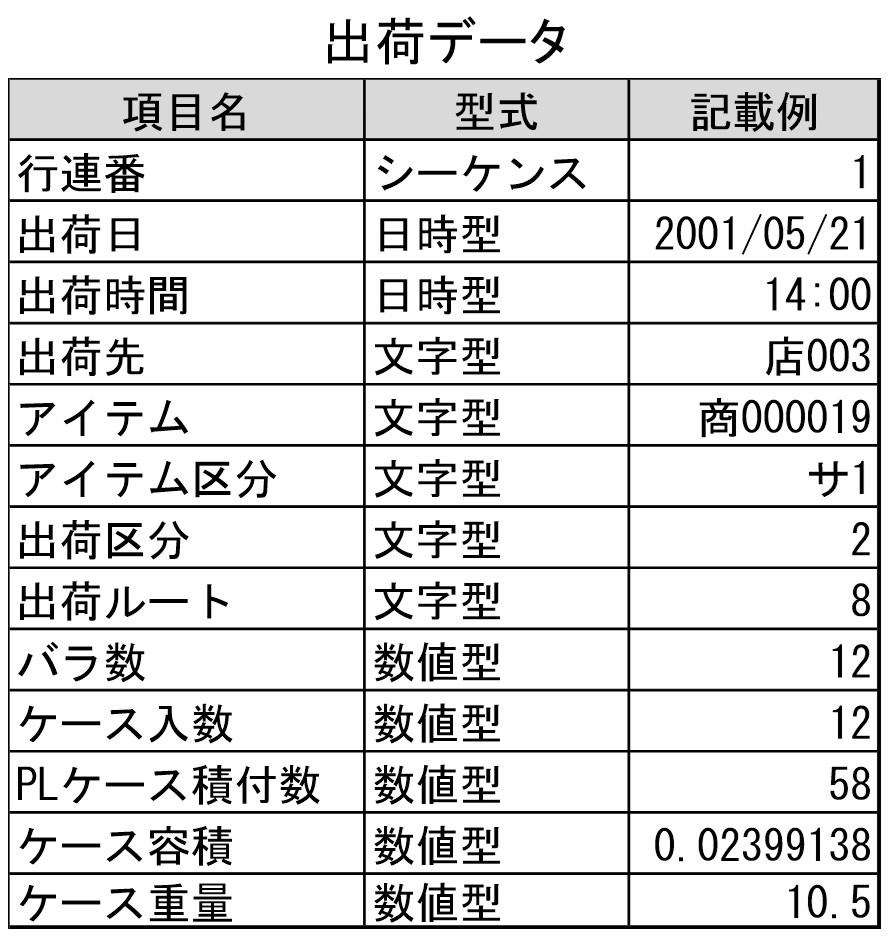
- Basic Information & Timestamp: Row Sequence Number, Shipping Date (Date Type), Shipping Time (Date Type)
- Core EIQ Elements: Destination (String), Item (String), Piece Quantity (Numeric)
- Classification & Grouping Items: Item Category, Shipping Classification, Shipping Route (All String)
- Conversion Master Information: Case Quantity, Pallet Case Stacking Quantity, Case Volume, Case Weight (All Numeric)
* Using these data points builds the foundation for subsequent unit conversions and simulations.
After importing raw shipping data, conversions and rankings are performed inside the system, generating a dataset for analysis. Below are the data items after shipping data processing in "T200."
Enables separate aggregation for case shipping and loose piece shipping.
Pre-calculates converted values into cases, pallets, volume, and weight per record in addition to piece counts.
Records unique ranking classifications (E Rank & I Rank) per record for case shipping and loose piece shipping separately.
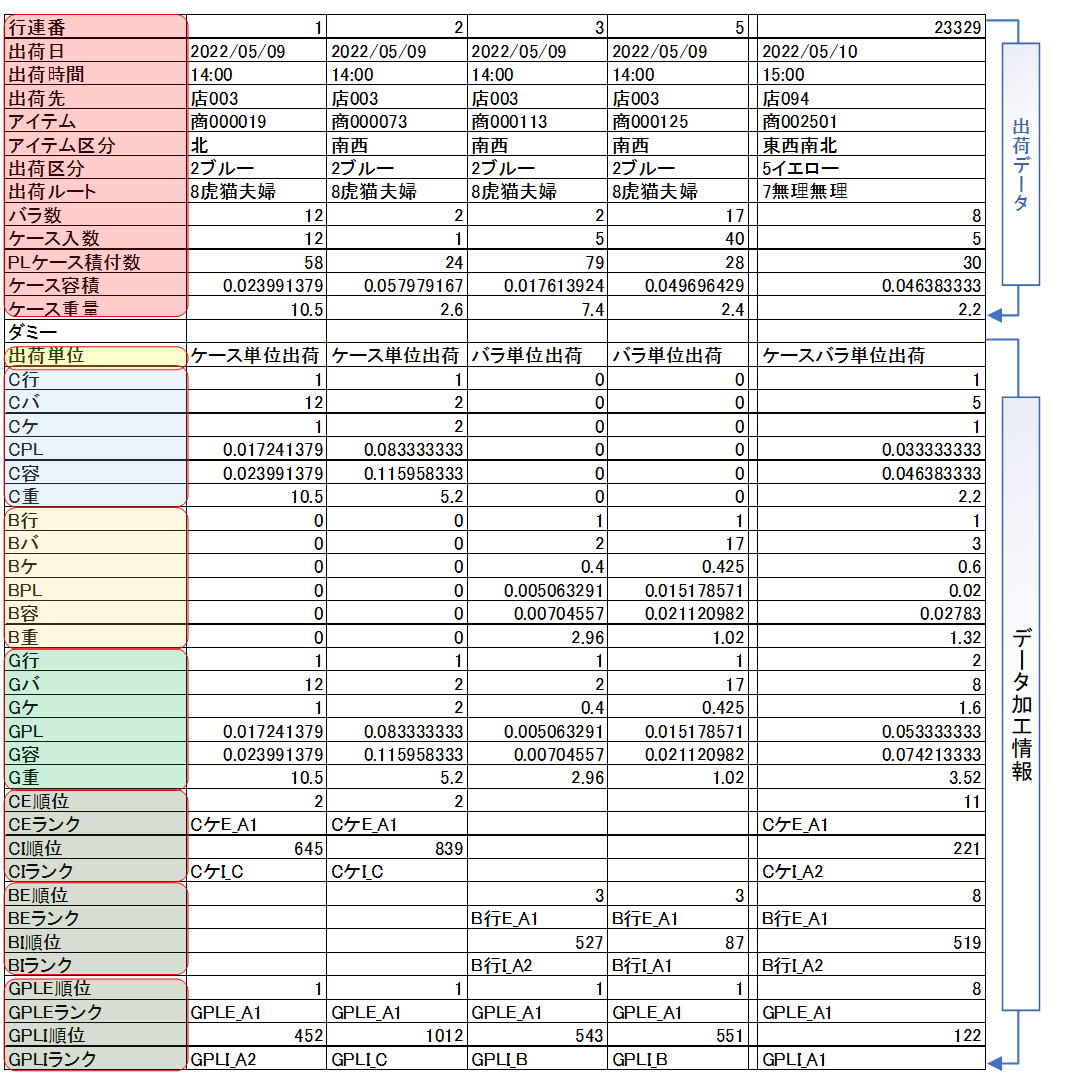
Tera Calculation performs analytical aggregations using this "T200" table.