1. Background of Data Analysis
1-3. When to Perform Data Analysis
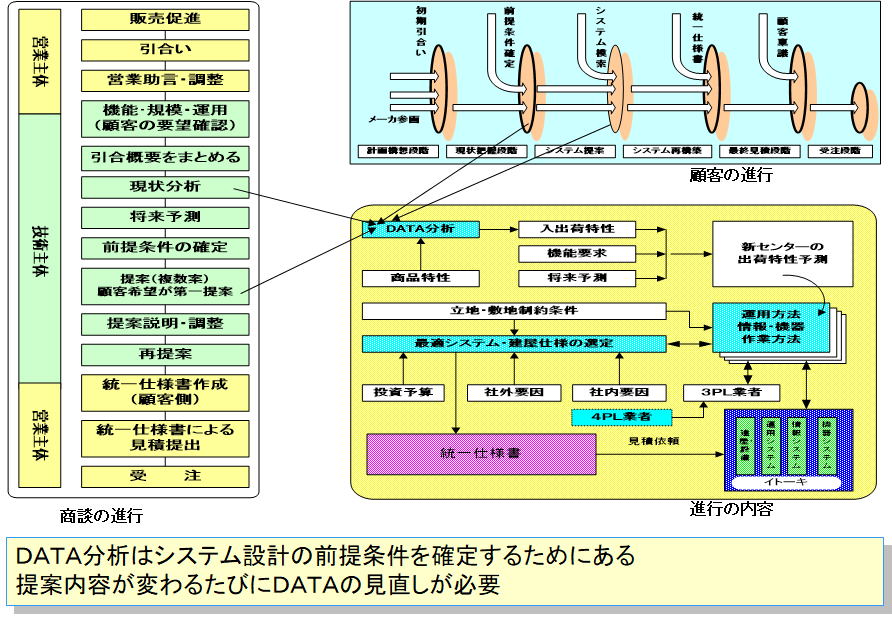
Difference Between "Negotiation" and "Client" Progress Processes
A logistics center construction project progresses along two distinct, parallel timelines: the contractor side (Negotiations) and the client side (Client).
- Negotiation Progress (Left Axis):
The internal process of the contractor (manufacturers or system integrators). It progresses via a relay between "Sales" and "Engineering." Sales organizes inquiries and requests, while Engineering performs data analysis (current state analysis & future forecast) to establish prerequisites and present multiple proposals. After adjustments, Sales compiles the final quote and secures the contract. - Client Progress (Top Axis):
The decision-making process of the client. Starting from "Initial Inquiry," it moves through "Current State Analysis," "System Proposal," "System Re-engineering," "Final Quotation," and "Contract Award." Crucially, key gateways exist between phases—such as "Establish Prerequisites," "System Exploration," "Unified Specifications," and "Internal Approval"—which must be cleared to proceed to the next stage.
How Project Operations (Progress Content) Interlock
Connecting the above two axes (Negotiations and Client) at an operational level is the "Progress Content (Project Operations)" shown in the bottom right of the diagram. The core of this interlock is Data Analysis.
- Centering on data analysis performed by Engineering (inbound/outbound traits & future projections), combined with product characteristics, the "shipping trait forecast for the new center" is derived.
- The derived characteristics are aligned with realistic constraints—such as "location/site constraints," "investment budget," and "internal/external factors (utilization of 3PL/4PL)"—to fine-tune optimal system and building specifications.
[Supplementary Explanation] Operational Process Based on Reiteration (Loops)At the bottom of the diagram, it states: "Data review is required whenever proposal contents change."
In actual project operations, initial proposals rarely pass without changes. Projects inevitably face hurdles such as "system re-engineering" due to client budget overruns or pushback during internal approval. When this occurs, instead of simply reducing equipment to cut prices, it is essential to return to "Data Analysis (Prerequisites)."
By re-evaluating questions like "If we alter this condition, can we still meet future peak shipping demand?", teams iteratively redefine requirements based on data and readjust IT systems and workflows. Through this iterative alignment across negotiations, client approval, and real data, a solid "Unified Specification Document" is ultimately achieved.