1. Background of Data Analysis
1-2. Who Performs Data Analysis
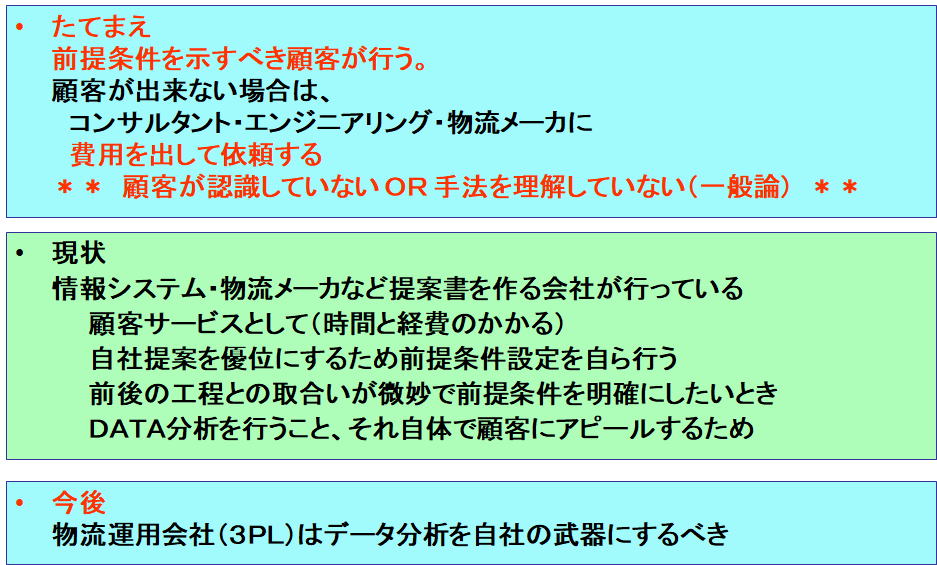
Diagram Content: Executing Entity of Data Analysis
Regarding who should lead data analysis and bear the cost, the gap between principle (ideal) and reality, as well as the future direction, is organized from three perspectives:
- Principle (Ideal):
Ideally, the "Client" who needs to define the prerequisites should perform it themselves. If the client cannot perform it, they should pay consultants, engineering firms, or equipment manufacturers to handle it. However, in reality, clients often lack awareness or understanding of data analysis techniques. - Current Reality:
In reality, "proposal-making companies" such as IT system integrators or logistics equipment manufacturers perform the analysis instead. This occurs for the following reasons:- They absorb time-consuming and costly tasks as a "customer service."
- They set prerequisites themselves to gain a competitive advantage in proposals.
- They need to clarify prerequisites for systems with delicate interfaces between processes.
- They perform analysis to demonstrate value and appeal to the client.
- Future Direction:
Logistics operations providers (3PLs) are advised to turn this data analysis capability into "their own competitive weapon."
[Explanation]While data analysis—the foundation of system design—is inherently the client's responsibility, system integrators and manufacturers often perform it free of charge as part of customer service due to a lack of client expertise. However, proposal makers also do this to establish prerequisites advantageous to themselves. Moving forward, if 3PL operators managing actual operations develop advanced analytical capabilities, it will serve as a powerful competitive advantage.
Another Perspective: Role Division Among Three Parties in Real Projects
Apart from the perspective of "who holds responsibility/cost," at the operational level of actual projects, a collaborative process driven by three parties—"Client (User)," "Sales (Proposer)," and "Design (Engineers)"—is essential.
- Client-Driven:
Understanding the business environment and future outlook best, the client provides historical operational data (raw data) and identifies site-specific irregular operations or constraints. They evaluate whether the final analysis meets business requirements. - Sales-Driven:
Sales hears client concerns and requests, defining analysis objectives and policies. Acting as a bridge, sales translates client business needs into engineering requirements and aligns overall project direction. - Design-Driven:
Design processes and cleans provided data to execute technical analysis, such as EIQ analysis and capacity calculations (simulations). Based on objective numerical data, they logically derive required equipment capacity and system specifications.
[Explanation] Why Three-Party Collaboration is EssentialIf data analysis is handed over entirely to designers or data scientists, it risks becoming an "academic exercise" detached from operational reality. Conversely, relying solely on client intuition or experience risks over-investment or capacity shortfalls lacking objective evidence.
Only when all three parties evaluate numbers from their respective domains (field insight, project coordination, and data analysis capability) can reliable prerequisites for high-precision system design be established.