1-1. Logistics history and basic knowledge
History of logisticsIf you unravel this, you will find that from ancient times to modern times, humans have continued to take on the big challenge of how to transport things efficiently.Logistics in ancient times involved hand delivery, livestock (horses, camels, etc.), or small boats, and the amount of transportation was extremely limited.It takes an enormous amount of time, often several months, to reach a destination, and they are constantly exposed to climate and security risks. However, in modern times, due to the dramatic evolution of transportation equipment such as large trucks, giant container ships, and aircraft, the amount of cargo being transported has increased dramatically, and transportation time has also been dramatically shortened.
Furthermore, the decisive difference between ancient and modern logistics lies in the evolution of containers and the capture and control of the amount transported.In ancient times, containers were mostly irregularly shaped and unsuitable for stacking, such as jute bags, pots, and irregularly shaped wooden boxes.In contrast, in modern times, ``containers that maintain a cubic shape and can be stacked in an orderly manner,'' such as cardboard boxes and plastic containers that are intended to be palletized, have become standard. The appearance of this "standardized cube" makes it possible to maintain a constant packaging shape, and as a result, automatic transportation by conveyor and automatic storage system (AS/RS) are possible.Labor saving-This is the biggest factor that strongly drove the development of mechanization.
Furthermore, modern logistics networks are not just about transporting things ``faster and more.''System for large quantity of materials (WMSetc.) to accurately grasp (capture) products and protect products from vibration and temperature changes during transportation, andwork operation``Strictly ensuring safety'' is considered as the most important issue, ensuring the peace of mind of the personnel involved and society as a whole.points (highly automatedLogistics facility) and lines (safe and optimized transport routes) make up today's sophisticated logistics networks.
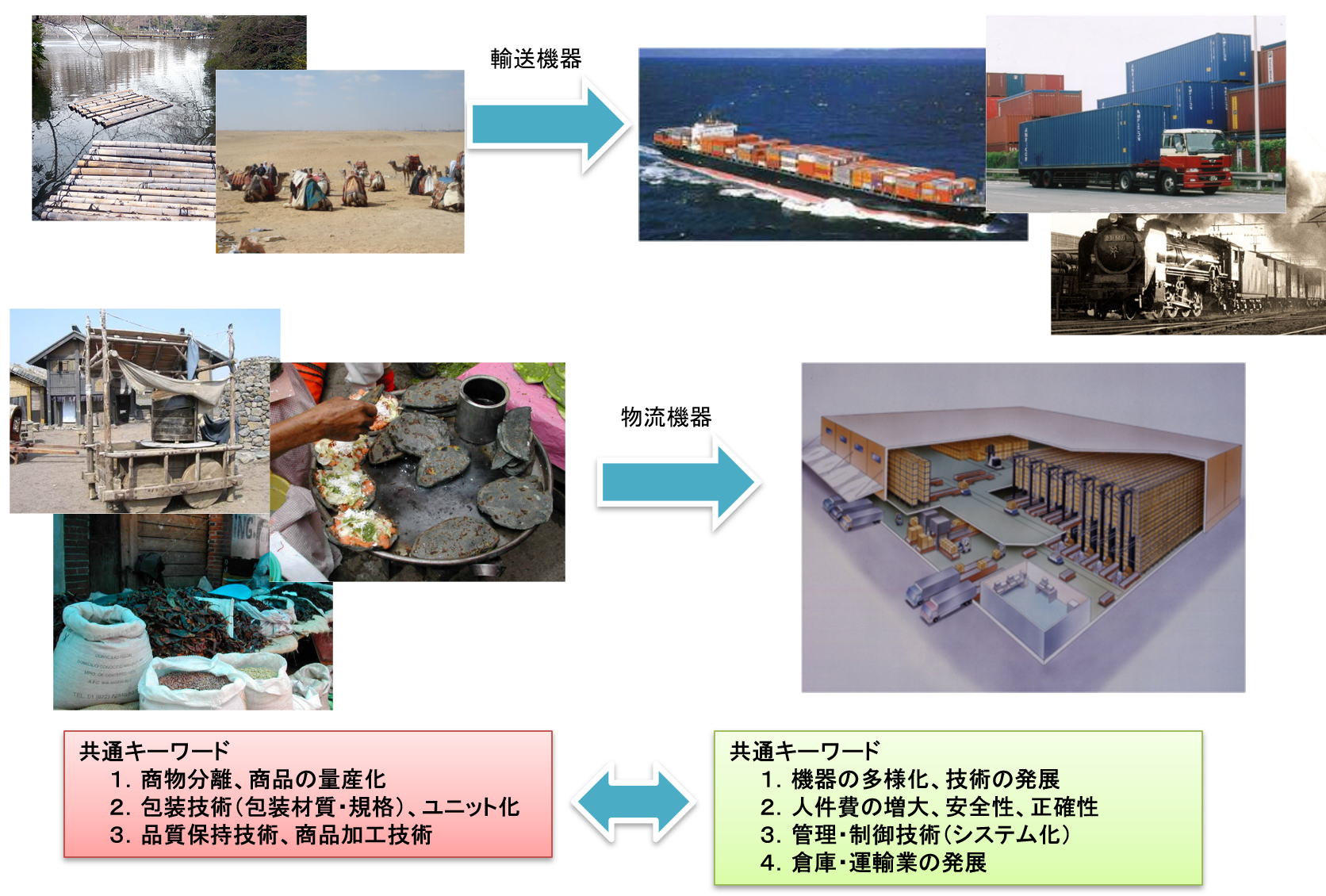
In this work, we will deal with incoming cargo packaged in standardized cardboard cases, etc., and use it as a "distribution center" that supports store deliveries and mail order shipments.Logistics facility)' physical quantity calculation and facility scale calculation (TCalc) will be explained in more practical and detailed manner.
Section 1 Role of commerce (commercial distribution) and logistics
Commercial flow (flow of commercial transactions)is the provision of goods from supply (producers and manufacturers) to demand (consumers and end users), transfer of ownership, and collection of payment.commerceRefers to all activities.This includes "transfer of information and rights" such as contracts, orders, payments, etc.on the other hand,Logistics (physical flow)teethcommerceIt is an indispensable working force for completing the process, and refers to "general work that actually physically handles products" such as transportation, storage, sorting, distribution processing, packaging, and delivery of products.
When consumers choose a company from among products of the same value and price, the deciding factor in their final purchase is ``how quickly, accurately, and without damage can the product arrive in good condition (logistics advantage)'' after placing the order. Therefore, in modern business, logistics is not just a cost center, but is positioned as an important corporate strategy (profit center) that drives sales.Furthermore, in modern times, from responding to environmental issues (ESG responses) such as serious labor shortages, correcting long working hours, and reducing CO2 emissions,Labor saving・Automation (introduction of robots, route optimization using AI, use of AGV automated guided vehicles, etc.) is progressing at an unprecedented speed.
Section 2 Types of logistics and functions of logistics facilities
Logistics can be broadly subdivided into the following categories, depending on the direction in which goods flow and the phase of the industry involved.in each areaLogistics facilityThe lead times and quality standards required vary greatly.
Arterial logistics (classification centered on secondary industries)
It is a "progressive" logistics process from raw materials to final products to the end of delivery to consumers.
- Procurement logistics:The movement of transporting raw materials and materials from primary industries (agriculture, etc.) and parts suppliers to factories in secondary industries (manufacturing, etc.).Strict delivery management that does not stop the production line, such as just-in-time (JIT)work operationis required.
- Production logistics:Movement of semi-finished products and work-in-process goods within the secondary industry (within own factories and between processing processes).Also called on-site logistics, it is directly linked to production efficiency.
- Sales logistics:Movement of products from secondary industries (manufacturers) to tertiary industries (wholesale, retail, etc.) to consumers.Responding to frequent small-lot deliveries,Logistics facilityOptimal inventory placement is the key.
Venous logistics (movement of cargo in the opposite direction)
This is a type of logistics in which products that have been consumed or have not yet been sold flow backwards, and is extremely important in a circular economy.
- Return logistics:Defective and unsold products are sent to manufacturers and wholesalers by delivery destinations (retail stores) and consumers.Logistics facilityMovement back to.Inspection and recycling are time consuming.
- Collection logistics:A movement to systematically collect used containers and products (recycled home appliances, empty bottles, etc.) for recycling and resource recovery.
- Waste logistics:A movement to safely and legally collect and transport items that cannot be reused to treatment facilities as completely waste or garbage.
New distribution format (EC logistics/consumer logistics)
Electronics due to the spread of the Internet and smartphonescommerceDue to the explosive expansion ofBtoB(intercompany),BtoC(companies vs. individuals), and even flea market apps, etc.C2CE-commerce logistics (between individuals) is rapidly growing.The biggest challenge is optimizing "last mile delivery" to private residences.WMSAdvanced information systems such as these are essential.In addition, with the enhancement of logistics agency (3PL: third-party logistics) services,Logistics facilityEven start-up businesses without functional capabilities can now easily develop large-scale businesses.
Section 3 Development of Packaging/Packaging and Logistics
History of logisticsThe development of larger and faster transport equipment (trucks and ships) is inextricably interdependent with the progress of the transport containers that support them (evolved from jute bags, barrels, and wooden boxes to modern pallets, cardboard, resin containers, etc.).
- Paletteization and modularization:
The establishment of the "unit load system" can be called a revolution in the logistics industry.By optimizing (module calculation) the length, width, and height dimensions of the cardboard to fit the size of a standard pallet (such as 11-inch in Japan) and truck bed dimensions without waste, dead space is eliminated, loading efficiency and cargo handling efficiency are dramatically improved.Labor savingWe realized this.This makes it possible to transport them in bulk using a forklift.
- Complementary functions of resin container (Oricon):
Cardboard is cheap and lightweight, but it has the disadvantage that when the contents are reduced due to bulk picking, etc., the box becomes easily crushed and its shape becomes unstable.To compensate for this, we use collapsible resin containers (Oricon) and plastic containers. Because it is sturdy and does not change its shape, it can be used in automatic transport machines (conveyors, etc.) using sensors, barcodes, and RFID, and extremely stable automation in automated warehouses.work operationis possible.Additionally, because it can be used repeatedly, it also contributes to reducing environmental impact.
Section 4 Logistics facility system structure (WMS/work operation)
modern advancedLogistics facility(Distribution centers) are not just storage places for things, but function as huge information processing factories.The following three systems mainly work in close cooperation.
1. Logistics information management system (WMS/equipment control)
Warehouse Management System (WMS: warehouse management system).Receives data on arrival schedules and shipping instructions from a higher-level host (corporate core system or ERP) in real time, andwork operationImmediate feedback of finalized data will be sent after completion.We perform strict unified management using SKU (Stock Keeping Unit): each expiration date, production lot, color, and size, ensuring inventory visibility and traceability.
2. Logistics equipment equipment system (hardware and WCS)
A group of hardware such as storage racks, automated warehouses (AS/RS), high-speed conveyors, directional sorters, and picking systems that use audio and lamps.In recent years, WCS (Warehouse Control System) has been introduced to control traffic so that each device can work together smoothly without congestion.Labor savingWe are promoting.
3. Work operation management system (LMS)
hardware andWMSNo matter how good a company is, the management of the people who run it is essential.The manager appropriately arranges workers (pickers and forklift operators), orders the work, and detects progress delays in real time (KPI management), eliminates bottlenecks, and makes sure things go as planned.work operationThis is a human and organizational management method to ensure (throughput).
Section 5 Labor saving/mechanization and consideration items
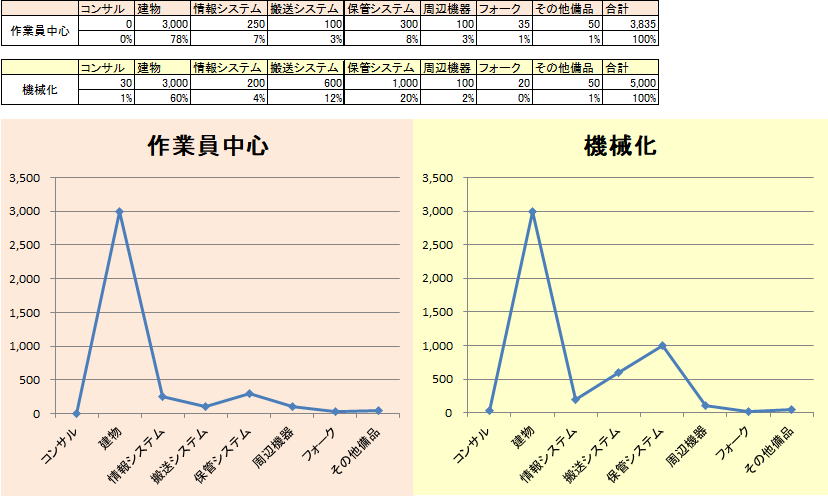
As the labor shortage worsens,Logistics facilityInvesting to reduce dependence on people has become unavoidable in operations.However, blind implementation will lead to excessive investment, so careful consideration is required in the following steps.
- 1. What is labor saving?This is the first stage of our efforts to reduce the work and physical burden (labor) on humans and increase efficiency, including reducing the weight of trolleys, reviewing flow lines, and introducing a digital assortment system.
- 2. What is mechanization (automation)?With the introduction of advanced equipment such as transport robots, automatic sorters, and automatic packing machines, the work that was previously done by humans can be replaced with machines, and fundamental improvements can be made.Labor saving- Achieving unmanned operation.
- 3. Scale/logistics volume fluctuation/operating time:Equipment capacity is not an "average value" but must be calculated and selected in such a way that it can withstand strong volume fluctuations during "peak hours" of the day or "busy seasons" throughout the year. On the other hand, buffer settings are important to avoid overspec.
- 4. Return on investment (ROI):We weigh the initial cost (CAPEX) and running cost (OPEX) of the equipment to be introduced against the resulting reduction in labor costs and lost costs due to errors, and rigorously evaluate the total balance of how many years it will take to recover the investment.
- 5. Distribution center investment breakdown:In addition to the construction cost of the building itself, material handling equipment,WMSIt is necessary to appropriately allocate investment in information systems such as the above, and warehouse infrastructure.
Section 6 How to proceed with logistics facility/distribution center design
new from scratchLogistics facilityWhen starting up or doing a large-scale renewal, a haphazard layout design will lead to a fatal failure.Completing the following 10 phases in order is a prerequisite for project success.
- Deciding on in-house equipment and outsourcing:Decide on the fundamental strategy (Make or Buy) of whether to own the assets in-house or outsource to a 3PL company.
- Planning location and scale:We select locations based on a comprehensive evaluation of the center of distribution of customers, access from expressway ICs, hazard maps for tsunamis and floods (BCP perspective), and ease of attracting part-time employees (employment environment).
- Planning concept:① Clarification of current bottlenecks and problems to be solved, ② Calculation of the upper limit of allowable investment budget, ③ Future planningcommerceWe will formulate a basic concept with an eye on expansion.
- Project management:We create an organization that cuts across each department within the company (logistics, sales, systems, finance, etc.) and clearly define decision-making roles.
- Setting basic conditions and planning conditions:We analyze required specifications such as product characteristics, future number of SKUs, and storage requirements, and formulate conditions based on quantitative data.
- Planning:We consider, compare, and evaluate multiple site layout model proposals (one-story plan, multi-story, etc.) and finalize the final master plan, which takes into account safety and truck flow lines.
- Design/construction management:We perform close collaboration and construction management to ensure that the construction schedule for the building frame does not interfere with the delivery and installation schedule for large internal logistics equipment (racks and conveyors).
- Manual creation:New equipment and equipment must be installed before the hardware is completed.WMStailored towork operationWe will create an SOP (standard operating procedure) that defines flow lines, exception handling, etc.
- Completed delivery:We conduct a comprehensive commissioning test (system coordination test, stress test assuming peak times) before operation, and strictly check whether the required capacity is met.
- Maintenance/maintenance:In order to minimize downtime after operation, we will formulate a regular preventive maintenance plan and establish a complete support system, including a remote maintenance system provided by the manufacturer.
Practical explanation: Basic flow, PCB analysis, system design method
In on-site practice,Logistics facilitySpecific analysis methods when designing internal layouts and systems,work operationI will explain the thought process of
Section 1 Basic flow of distribution center
As a general rule, it is ideal for objects within the center to move in one stroke without going backwards.
Arrival berth (truck landing and unloading) ➔ Receiving inspection (strict confirmation of quantity and exterior quality using handheld terminals, etc.) ➔ Storage area (storage in AS/RS or fixed racks, management in free locations, etc.) ➔ Stocking/replenishment (bulk allocation in units of pallets/cases, or replenishment to flow shelves for loose items in the picking area) ➔Picking/sorting (digital picking, sorter by destination, or assorting to carts) ➔ Shipping inspection (weight inspection and image inspection)/Storage by shipping destination ➔ Shipping berth (loading/unloading)
Section 2 PCB analysis and logistics equipment selection
We quantitatively analyze the form in which the cargo we handle is currently moving.It is the form of existence of luggage.P (Pallet: mass movement of pallets)、C (Case: Medium amount movement in case units)、B (Bara/Piece: small piece movement)Accurately determine the amount and ratio of each material and select the most efficient material handling equipment for each.work operation(Example: Forklifts and automatic warehouses are assigned to P, and picking carts and shutter assortments are assigned to B.)Tools like TCalc 1 aggregate and extract the quantities of C and B from the EIQ analysis data and logically link them to the selection of optimal storage equipment and area calculations.
💡 Section 3 Consideration regarding system design (trial & error and pursuit of optimal solution)
When it comes to logistics system design, there is no "one and only correct answer that is common to all companies."Therefore, it is essential to create multiple layout plans and use desktop simulations to compare them and refine them through repeated "trial and error" processes.
For example, the standard "fixed pallet shelves + manual operation using a forklift (plan 1)" which requires a low initial investment, and the introduction of "electronic pallet movable shelves/automated warehouse system" which requires a high initial investment but dramatically reduces labor costs.Labor saving(Proposal 2)", it is important to derive the layout (optimal solution for your company) that has the most advantageous return on investment (work reduction costs vs. equipment investment costs and maintenance costs) over a period of several years.
However, no matter how good it is in terms of efficiency and cost, it is important to note that"Safety is a priority (compliance with laws and regulations such as the Fire Service Act and Industrial Safety and Health Act, and clearing internal safety standards)", and“Maintaining the working environment (reducing the physical burden on workers = ergonomics, maintaining hygiene and product quality through appropriate temperature and humidity control)”should not be sacrificed.Only when these are ensured is a sustainableLogistics facilityIt can be said to be a system design.