3-6.Necessity of SCM and information coordination (Bullwhip effect)
1. What is SCM (Supply Chain Management)?
We manage everything from production to sales in an integrated manner, from raw material procurement, manufacturing (manufacturer), distribution (wholesale), and sales (retail) to the final consumer.A management method that centralizes and optimizes informationIt means.
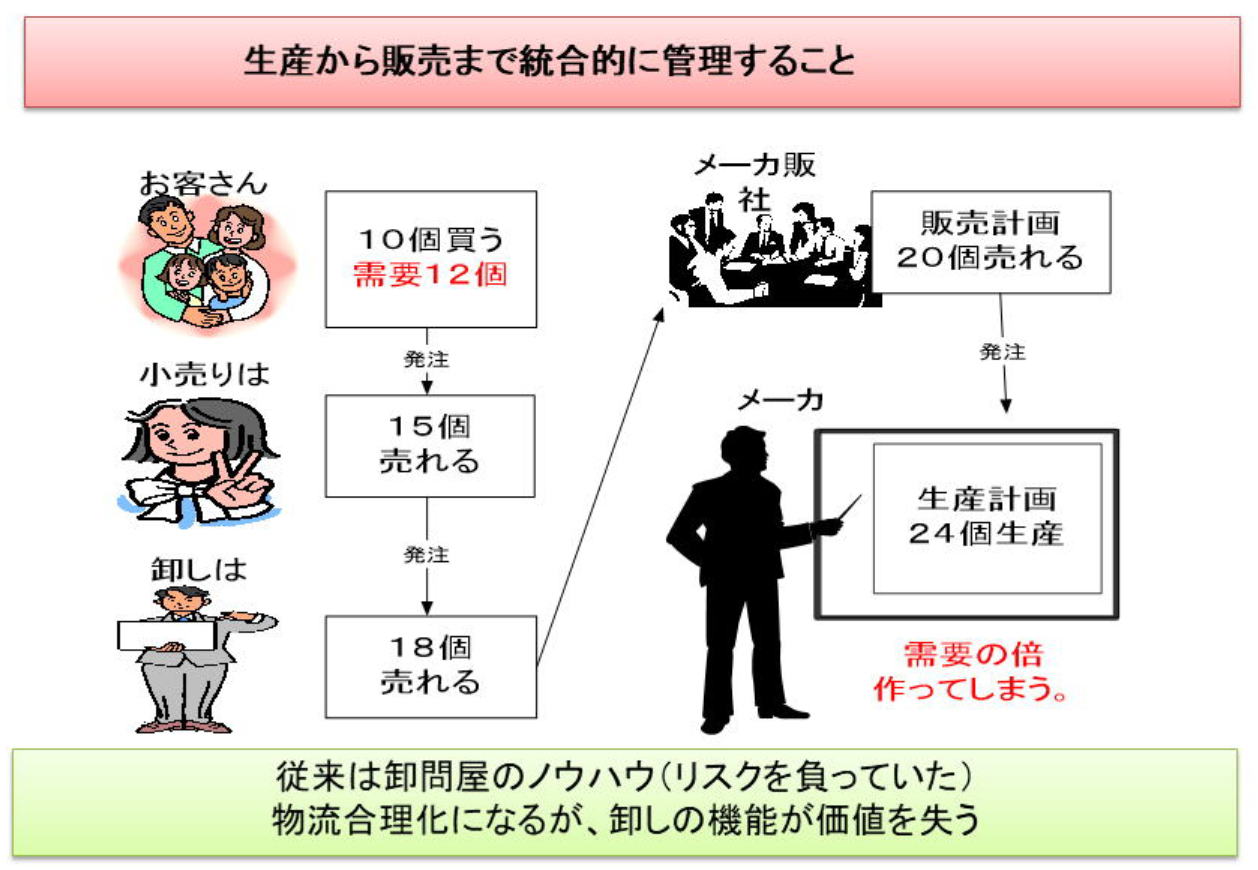
2. The problem shown in the diagram: “Demand amplification phenomenon (bullwhip effect)”
This is a typical failure that occurs when information is not shared at each stage of the supply chain.
| step | Situation/forecast | Order/production quantity |
|---|---|---|
| Customer | Purchase 10 pieces (Actual demand: 12 pieces) | ― |
| retail | We expect to sell 15 units to prevent stockouts. | Order 15 pieces from wholesaler |
| wholesale | Anticipating safety stock and expecting to sell 18 units | Ordered 18 pieces from sales company |
| Manufacturer sales company | Create a sales plan of 20 items with plenty of time to spare. | Order 20 pieces from manufacturer |
| Manufacturer | Production planning with plenty of time24 pieces produced” | 24 pieces manufactured |
📌 Results (Bullwhip effect)
In response to the actual consumer demand (12 pieces), the manufacturer ultimatelyProduced twice the amount (24 pieces)As a result, the risk of excess inventory and waste increases the further upstream (manufacturing side) you go.(Whip bending phenomenon)
3. Roles and challenges of wholesalers
Due to the advancement of SCMChanges in distribution structureThis is an explanation about.
- conventional structure
Previously, fluctuations in demand and inventory risks at each stage were absorbed by the wholesaler's know-how and risk burden, thereby maintaining a balance between supply and demand.
- Impact of SCM introduction and logistics rationalization
If sales data such as POS is shared directly with the manufacturer, overproduction will be suppressed and logistics will be optimized.On the other hand, the intermediary function (value of existence) of wholesalers, which had been absorbing risks, will weaken, and the problem will arise that their role will be omitted (disintermediation).
4. Role of wholesalers and survival strategies in the SCM era
Breaking away from the middle-margin business of simply purchasing and distributing goods,Which area should you specialize in to create added value?There are 3 strategies.
3 survival strategies
| strategy type | Content | Aim/background |
|---|---|---|
| 1. Specializing in small and medium-sized retail businesses | Offering a full line of products for small and medium-sized retailers | We will attract small and medium-sized retailers (independent stores, local supermarkets, etc.) who find it difficult to procure products on a large scale on their own by offering them the convenience of ``just relying on one company to get all kinds of products.'' |
| 2. Specializing in logistics agency | Acting as a logistics function for major retailers | As a logistics professional (3PL), we handle storage, delivery, distribution processing, etc. for major retailers.Outsourcing physical logistics infrastructure and operationsI will. |
| 3. Specializing in commercial distribution | Supporting retail industry product management, customer management, etc. | Not just transporting things,Sales data analysis, planogram proposal, inventory management, marketing supportWe provide consulting functions to increase retail store sales. |
💡 Conclusion/Message
"If you don't have one out of three, you won't survive."
Wholesalers who are merely intervening will be weeded out.It is essential to establish one or more of the following as your strengths: comprehensiveness of purchasing (specializing in small and medium-sized businesses), efficiency of logistics (logistics agency), and added value of information (specializing in commercial distribution).