3-9. About milk run transportation (traveling collection)
What is milk run transportation (traveling collection)?A logistics method in which one truck visits multiple suppliers (parts manufacturers, etc.) and picks up and collects cargo.(It originates from the fact that milk traders visited each farm to collect milk.)
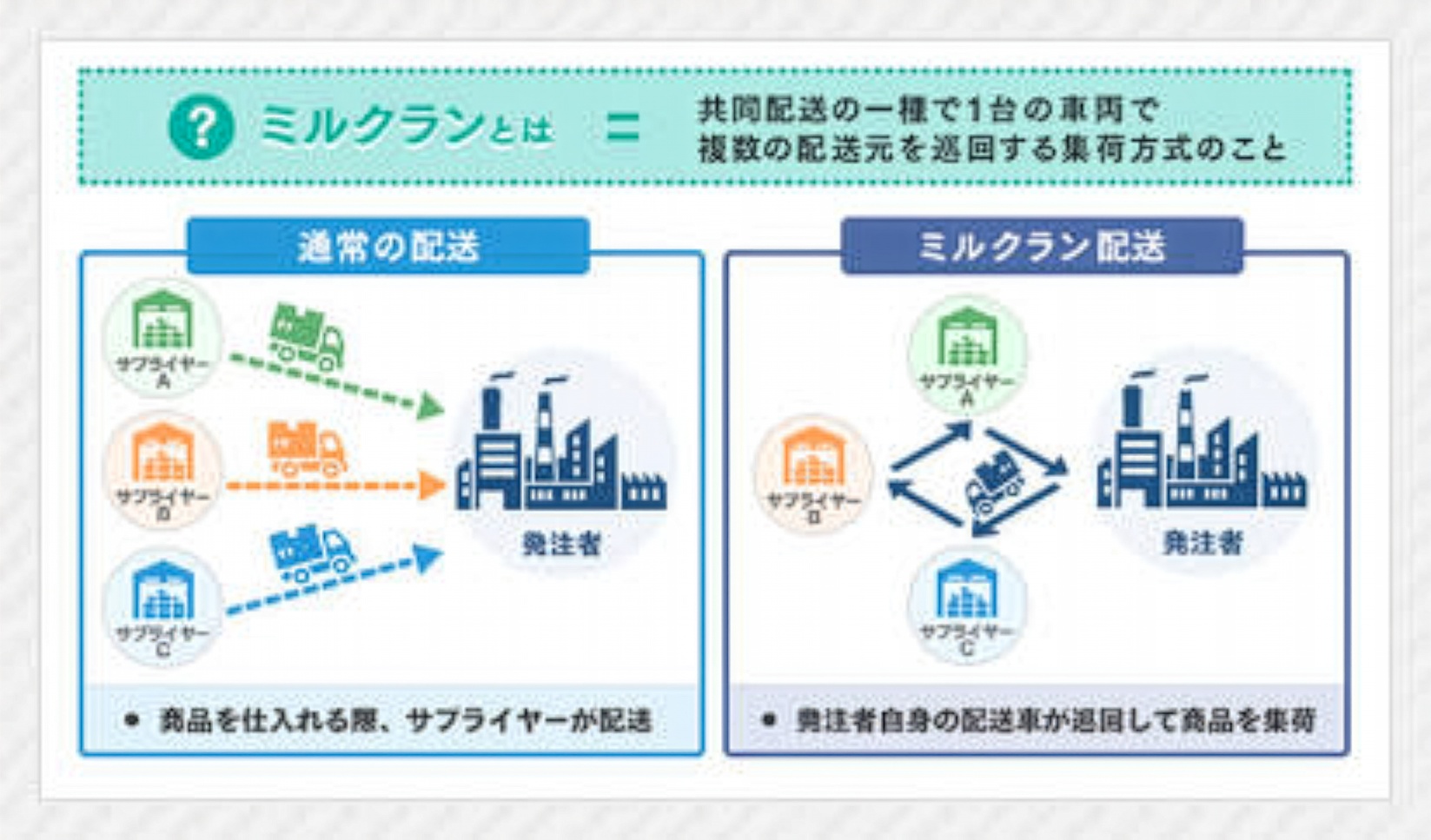
1. Basic flow of milk run transportation
In this diagram, logistics flows through the following three steps.
District A, District B, District CFor each area ofSupplier) and collect your luggage.
Packages collected in each district are once collected at the Distribution Center (DC).
Baggage collected at DC isDelivery agency transportationare transported to the factory in bulk.
2. Business flow of planning and operation (flow on the left)
In order to achieve efficient milk run transportation, this is a process in which the shipper (business partner) and the logistics company (our company) work together to optimize vehicle allocation and quantity.
| in charge | Business content |
|---|---|
| Business partners |
・ordering plan: Create a plan for when and how many parts are needed ・Delivery date adjustment: Coordination of delivery date with suppliers |
| Business partners + our company staff |
・Loading quantity adjustment: Quantity adjustment to increase truck loading efficiency ・Optimal milk run dispatch: Efficient patrol route and vehicle arrangement planning |
| Actual transportation implementation |
・Actual milk run transportation and delivery agency based on the plan |
3. Benefits and explanation of milk run transportation (collection logistics)
Compared to individual delivery (a method in which each supplier individually delivers to the factory), it has the following major advantages:
📈 Improve loading efficiency and reduce costs
Even if the shipment volume per company is small, by visiting multiple companies, you can increase the loading rate (full load rate) per truck and reduce transportation costs.
🏭 Reducing congestion and improving acceptance efficiency on the factory side
By preventing individual trucks from rushing to the factory from numerous suppliers and consolidating deliveries at a DC, we can eliminate congestion at the factory's unloading area (berth).
🌱 Reducing CO2 emissions (reducing environmental impact)
By reducing the total number of vehicles traveling and the distance traveled by empty vehicles, it is possible to achieve environmentally friendly and sustainable logistics.
📦 Realization of small-lot, high-frequency deliveries
Since you can pick up only the necessary items in the amount you need, it contributes to inventory reduction on the factory side (just-in-time).