3-2.Logistics facility planning and distribution complex selection based on analysis of cargo transportation volume
Build a supply chain that allows companies to win and eliminate waste.Logistics facility planningIn order to formulate the macrocargo transportationtrends and cargo flow by region (Regional flow・extraterritorial flow) is essential.
Simply selecting “the closest location to the area of demand” or “land with low rent” will not work after operation.cargo transportationThey will face critical challenges such as increasing costs, waiting for trucks to arrive, and difficulty securing drivers due to the 2024 problem.
In this paper, we will discuss the past 20 years of domesticcargo transportationChanges in volume, by regional blockRegional flowandextraterritorial flowbalance, and national majorDistribution complexWe analyzed the hub function played by the hub from multiple angles andLogistics facility planningWe will explain practical guidelines for implementing this.
1.Freight transport trends and background over the past 20 years
own companyLogistics facility planningThe first step to making this a success is for Japan as a whole tocargo transportationIt is important to gain accurate insight into changes in the macro environment surrounding the company.
1-1. Trends in total logistics costs (logistics cost to sales ratio/macro costs)
Downturn/stable period (2000s to mid-2010s)
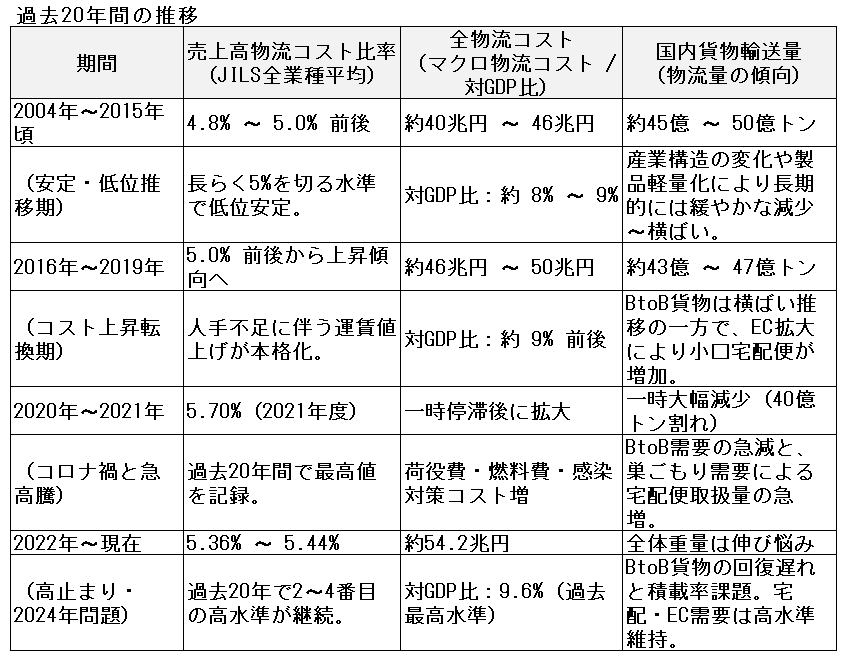
Due to price competition among transportation companies and thorough efforts to improve logistics efficiency on the company side, the ratio of logistics costs to sales has remained low for a long time.Less than 5% to around 5%It was stable at a low level.
Long-term upswing (from 2016 onwards)
Against the backdrop of rising freight rates, soaring fuel prices, and rising labor costs due to the worsening shortage of truck drivers,cargo transportationCosts have been rising in earnest.
Establishment of high standards (2021-present)
In 2021, the ratio was 5.70%, the highest ratio in the past 20 years.In recent years too5.36%~5.44%has remained at a high level, and due to the response to the ``2024 problem'' and rising prices,logistics costThe sense of burden has reached an all-time high.
1-2. Structural changes in logistics volume (domestic cargo transportation volume)
Gradual decrease in total weight (ton basis)
By relocating manufacturing industries overseas, making products lighter, and promoting joint delivery, the overall domesticcargo transportationThe weight has increased from the 5 billion ton scale in the early 2000s.Low 4 billion tonsThe trend continues to be a gradual decline or leveling off.
Dissociation between BtoB (business-to-business) and BtoC (EC/home delivery)
While BtoB mass transportation is sluggish, due to the expansion of e-commerceThe number of parcels handled by courier services has increased explosively..Even though the total weight is not increasing, the "increasing frequency of smaller shipments" is intensifying, and structural changes are progressing that are pushing up the workload at the site and the frequency of transportation.
2.Flow structure by 10 regional blocks nationwide (intra-regional flow vs. extra-regional flow)
Logistics facility planningWhen deciding the location area for a base, the most important indicator is the location of the shipping location.Regional flow(complete within block)” and “extraterritorial flow(Transportation across blocks to other blocks)” ratio.
The fact that intra-regional flows account for approximately 70-80%
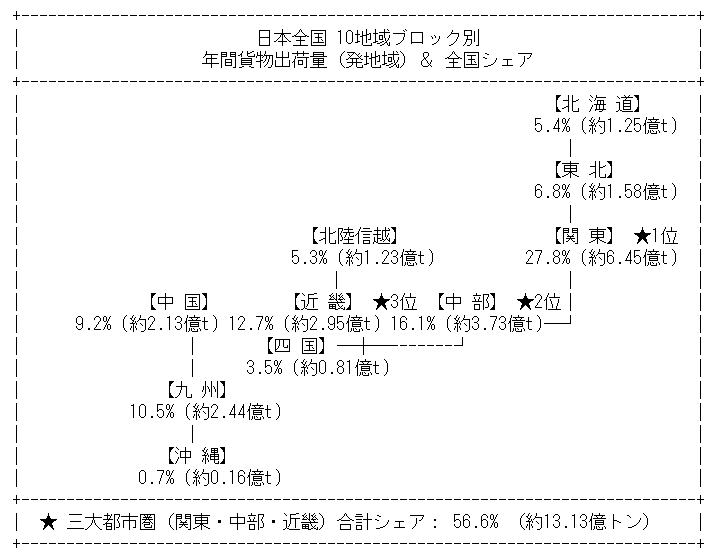
Shipped from each regional blockcargo transportationThe majority (approximately 70-80%) of the flow is completed within the same block (Regional flow)is.The basics are local production for local consumption and community-based delivery network design.
Out-of-area flows are mainly for neighboring areas and metropolitan areas.
The remaining approximately 20-30% (extraterritorial flow) is mainly occupied by "transportation to adjacent regional blocks" and "intensive transportation to metropolitan areas such as Kanto, Chubu, and Kinki."
Insights into structural characteristics and facility planning from mapping data
1. Extreme concentration in three major metropolitan areas (56.6%)
In just three blocks: Kanto (27.8%), Chubu (16.1%), and Kinki (12.7%),The majority (56.6%) of Japan's total cargo transportation volumeoccupies .When setting up a wide-area hub center, it is important toDistribution complexselection is required.2. High “local completion rate” (national average 77.1%)
National totalcargo transportationof the amountApproximately 77.1% is completed within the same block (intra-regional flow)transport across regional blocks (extraterritorial flow) accounts for only about 22.9% of the total.Especially in Kanto and KyushuRegional flowAs the ratio ofLogistics facility planningIt becomes the liver of.3. The top prefecture is “Aichi Prefecture”
In terms of regional blocks, Kanto ranks first, but if we look at individual prefectures, it is a major manufacturing hub.Aichi prefectureis ranked number 1 in the nationcargo transportationWe are proud of the quantity.This shows the importance of the Chubu region as a point of contact between production logistics and sales logistics.
3.Major distribution complexes and concentration bases nationwide
Major nationwideDistribution complex(Distribution business complex) to alleviate traffic congestion in urban areas.cargo transportationWith the aim of consolidating and increasing efficiency, the complex is located in a prime location that is directly connected to expressway interchanges (ICs), major arterial roads, ports and airports.
1. Metropolitan area (Kanto area)
In the Tokyo metropolitan area, which has huge consumption areas and international infrastructure, there areDistribution complexbutRegional flowandextraterritorial flowIt forms the core of
- Keihin/Heiwajima area (Ota Ward, Tokyo)
Various logistics warehouses are concentrated here, including the Keihin Truck Terminal, one of the largest in Japan.It is a comprehensive logistics base representing Japan, adjacent to Haneda Airport and Tokyo Port, and directly connected to the Metropolitan Expressway Bayside Line and Haneda Line.
- Itabashi Distribution Business Complex (Itabashi Ward, Tokyo)
Located along the Metropolitan Expressway No. 5 Ikebukuro Line, with easy access to the Kanetsu Expressway and Tohoku Expressway.To the northern part of the metropolitan areaRegional flowand to Kanetsu/Tohoku area.extraterritorial flowIt is a relay base.
- Kasai Distribution Business Complex (Edogawa Ward, Tokyo)
Located along the Tokyo Bay Road, this is a delivery base for central Tokyo and the Chiba/Ibaraki area.Kasai Truck Terminal and various cold food warehouses are highly concentrated here.
- Atsugi Distribution Complex / Atsugi Inland District (Atsugi City, Kanagawa Prefecture, Aikawa Town)
A junction point where the Tomei Expressway (Atsugi IC), Shin-Tomei Expressway, and Ken-O Expressway intersect.To the entire metropolitan areaRegional flowIn addition to connecting the Chukyo and Kansai areasextraterritorial flowfunctions as a wide-area hub.
2. Chubu area (Chukyo area)
Japan is home to the automobile industry and is home to the Tomei, Meishin, Chuo Expressway, and Shin-Tomei Expressways.cargo transportationIt's a junction.
- Komaki Distribution Business Complex (Komaki City, Aichi Prefecture)
"Japan's largest logistics junction" close to the Tomei/Meishin connection point (Komaki IC).Chukyo areaRegional flowNot only that, but also connects eastern and western Japan.extraterritorial flowIt is a cross-dock base.
- Meiko Tobishima Distribution Complex (Tobishima Village, Aichi Prefecture, Nagoya City)
Directly connected to the Nagoya Port International Container Terminal, with excellent access to the Ise Bayside Road.Storage, processing, and import/export cargo and partscargo transportationIt is a port-based base that is responsible for
3. Kinki region (Kansai area)
Meishin Expressway, Chugoku Expressway, Hanshin Expressway, Kinki Expressway, and Shin-Meishin Expressway run like a web, connecting all of western Japan.extraterritorial flowcovers.
- Kita-Osaka Distribution Business Complex (Ibaraki City, Minoh City, Osaka Prefecture, etc.)
The largest logistics hub in the Kansai region, where Meishin (Ibaraki IC), Chugoku Expressway, Kinki Expressway, and Shin-Meishin Expressway are located.Keihanshin metropolitan areaRegional flowand to all of western Japan.extraterritorial flowWe will take care of it all at once.
- Higashiosaka Distribution Business Complex (Higashiosaka City, Osaka Prefecture)
It is directly connected to the Kinki Expressway and the Hanshin Expressway No. 13 Higashi-Osaka Line, and collaborates with manufacturing clusters.It boasts high convenience as an urban delivery base within Osaka city.
- Kobe Distribution Business Complex (Suma Ward/Nishi Ward, Kobe City, Hyogo Prefecture)
A node connecting Kobe Port, Sanyo Expressway, Chugoku Expressway, and Kobe Awaji Naruto Expressway.To the Chugoku and Shikoku regionsextraterritorial flowand an international cargo hub.
4. Kyushu, Chugoku, Shikoku, Hokkaido, Tohoku area
In regional blocks, there are wide areas near major expressway junctions and metropolitan area interchanges.Distribution complexis being formed.
- Tosu Distribution Business Complex (Tosu City, Saga Prefecture)
"Kyushu's logistics crossroads" where Kyushu Expressway, Nagasaki Expressway, and Oita Expressway intersect.It is a major hub that takes advantage of its location, allowing delivery to all prefectures in Kyushu within a few hours.
- Fukuoka Distribution Center (Tanotsu) (Higashi Ward, Fukuoka City)
The largest distribution and wholesale complex in Kyushu, close to the Kyushu Expressway (Fukuoka IC), Hakata Port, and Fukuoka Airport.urban typeRegional flowThis is the main point.
- Sapporo Distribution Center (Oyachi District) (Sapporo City Shiroishi Ward/Atsubetsu Ward)
The largest base in Hokkaido, directly connected to the Hokkaido Expressway (Sapporo Minami IC).Wide area to various parts of Hokkaidocargo transportationand delivery to the Sapporo metropolitan area.
- Sendai Distribution Center (Miyagino Ward, Sendai City, Miyagi Prefecture)
The largest hub in Tohoku, covering 6 prefectures, close to Tohoku Expressway, Sendai Eastern Road, and Sendai PortDistribution complexis.
4.Three roles played by distribution complexes in logistics facility planning
Companies are advancedLogistics facility planningWhen promoting this, rather than acquiring land from the private sector and building bases on its own, the government, development corporations, etc.Distribution complexThere are extremely large structural and strategic advantages to expanding and locating within a distribution business complex.Distribution complexis not only a collection of warehouses, but also a regional economy and a wide area.cargo transportationAs an essential social infrastructure that smoothly connects networks, it plays the following three important roles.
- Dramatically improving the efficiency of transshipment and cargo handling operations at transportation nodes
Distribution complexis located in a prime transportation location with direct access to major freeway interchanges (ICs), highways, international ports, and freight rail stations.This allows long-distance large-capacity transport transported from rural areas and long distances (other blocks).cargo transportation(extraterritorial flow), and short-distance small-lot delivery within the city (Regional flow).It exhibits advanced "cross-dock (transshipment/sorting) function" that smoothly transfers the baton to other ships.By separating and consolidating the flow lines of long-distance large trucks and urban pickup and delivery vehicles at junctions, we can dramatically reduce empty vehicle runs (vacancy rate), reduce driver time commitments, and minimize total transportation and delivery costs.
- Preservation of the urban environment (separation of housing and engineering) and ensuring full 24-hour operation
In order to protect residential areas and urban centers from logistics pollution such as noise, vibration, and exhaust gas caused by large trucks parked on the road, idling, and cargo handling at night,Distribution complexBased on the urban planning principle of ``separation of housing and construction,'' residential buildings are concentrated along suburban roadsides and along the bay.Since it is possible to prevent environmental burdens and complaints from local residents, this gives logistics companies a huge practical advantage in that they can secure legal and environmental stability by allowing trucks to depart and arrive late at night and early in the morning, and by continuously operating 24 hours a day, 365 days a year.
- Joint delivery and aggregation effect by gathering companies from different industries and the same industry (promoting GX)
Distribution complexTruck terminals, commercial warehouses, multi-level automated warehouses, wholesale markets, distribution centers, and distribution processing facilities are concentrated within the complex.By taking advantage of this geographical agglomeration effect, companies in the same industry or in nearby areas can easily make joint arrangements for trucks and share cargo (joint delivery).Dramatically improving the loading rate per vehicle will not only solve the chronic shortage of truck drivers (2024 problem), but also serve as a strong foundation for promoting decarbonization and green logistics (GX) that will significantly reduce carbon dioxide (CO2) emissions.