3-11. Types and functional levels of distribution centers
throughout the supply chainClassification (type) of logistics and differences in characteristics by area (production logistics vs. sales logistics), in recent yearsStructural impact of BtoC (mail order) expansion on logistics costsI will explain about it.
A1 Types of logistics
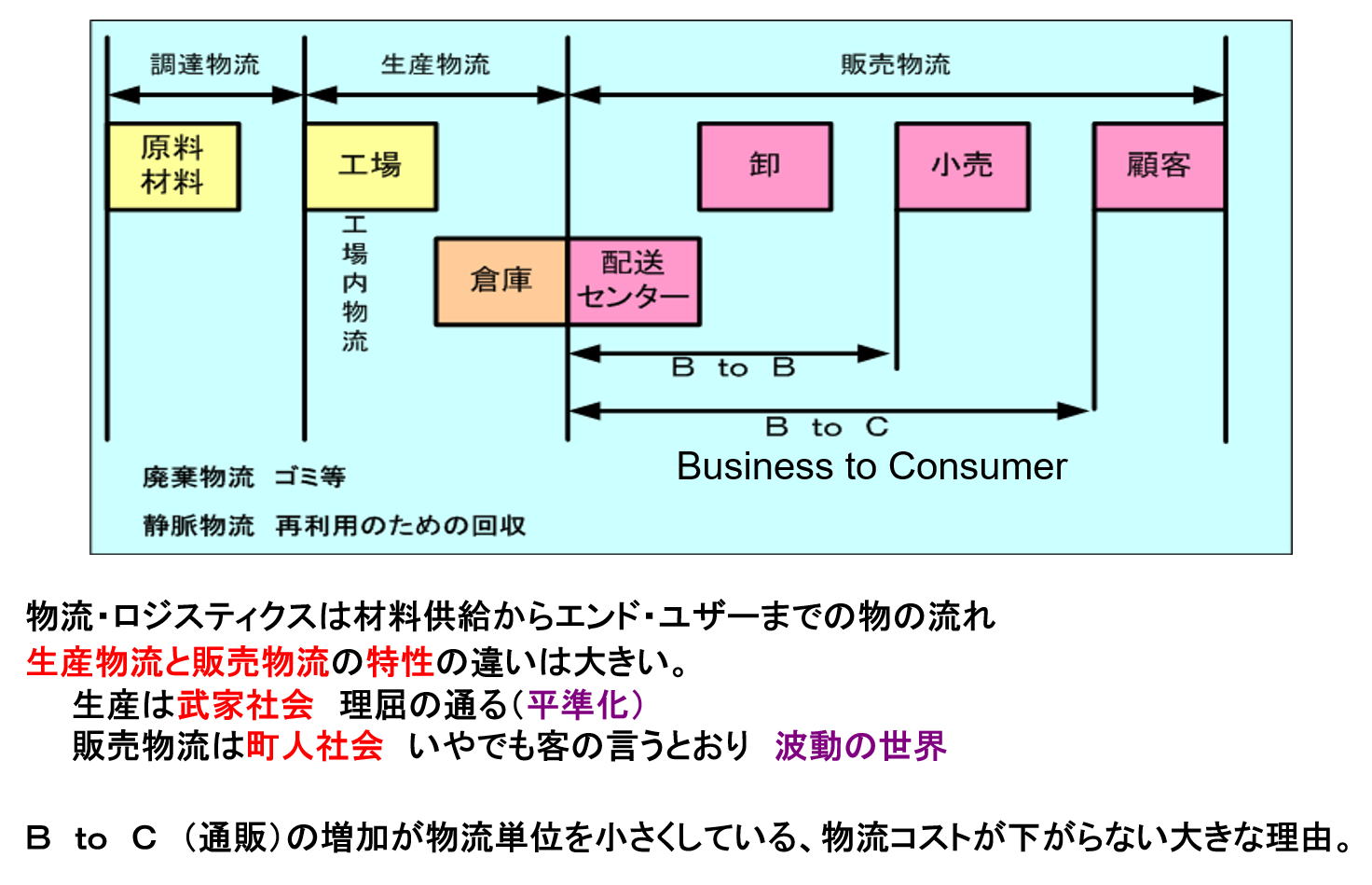
A2 explanation and points
① Five classifications of logistics (supply chain flow)
The flow of goods can be broadly classified into the following five categories.
procurement logistics
Logistics involves sending raw materials, parts, and materials from suppliers to factories.
production logistics
Logistics involves moving raw materials within factories and transporting finished products to warehouses and distribution centers.
sales logistics
Logistics involves delivering finished products from warehouses and distribution centers to wholesalers and retailers (BtoB) and final customers (BtoC).
waste logistics
Logistics for disposing of unnecessary packaging materials and garbage.
venous logistics
Logistics (compared to a vein) that collects products and materials for recycling, reuse, and return.
② Definitive difference between production logistics (samurai society) and sales logistics (chōnin society)
The metaphors ``samurai society'' and ``chōnin society'' capture the essence of logistics management.
- Production logistics = “Samurai society (reasonable/levelling)”
Since it operates based on the factory's production plan, you can systematically control (level out) when, where, what, and how much to transport.It is a world where there are few changes in plans and it is easy to operate with rules that emphasize efficiency.
- Sales logistics = “Townsman society (as the customer says, a world of waves)”
Because it moves in accordance with the orders (demand) of end users and business partners, the quantity of goods fluctuates greatly depending on the day of the week, season, sales, weather, etc.It is an uncontrollable world that responds to requests such as "I want it now" and "I want it at a specified time."
③ Increase in BtoC (mail order) and “reasons why logistics costs are not decreasing”
Traditional BtoB (intercompany logistics)
It was possible to transport large lots in cases and pallets from the distribution center to wholesalers and retailers.
Expanding BtoC (mail order/EC)
From the distribution center to a "private home", the item will be delivered in small pieces (small lots).
💡 Mechanism that prevents costs from falling
1.Rapid increase in work hours:The time and effort required to pick up each product one by one (bulk picking), individually wrap and inspect them increases dramatically.
2.Decreased delivery efficiency:In contrast to BtoB, which uses large trucks to deliver to several companies, BtoC delivers small packages to countless individual homes, which increases costs such as the number of vehicles, mileage, and redelivery.
A3 summary
``Sales logistics (especially BtoC) is susceptible to fluctuations in demand, and the trend toward smaller orders has made it extremely difficult to reduce costs.'' This indicates a structural issue.Therefore, in the field"How to create a system to absorb vibrations" "How to automate and improve the efficiency of small-lot picking and shipping work"will be an important theme.
B1 Sales logistics warehouse characteristics
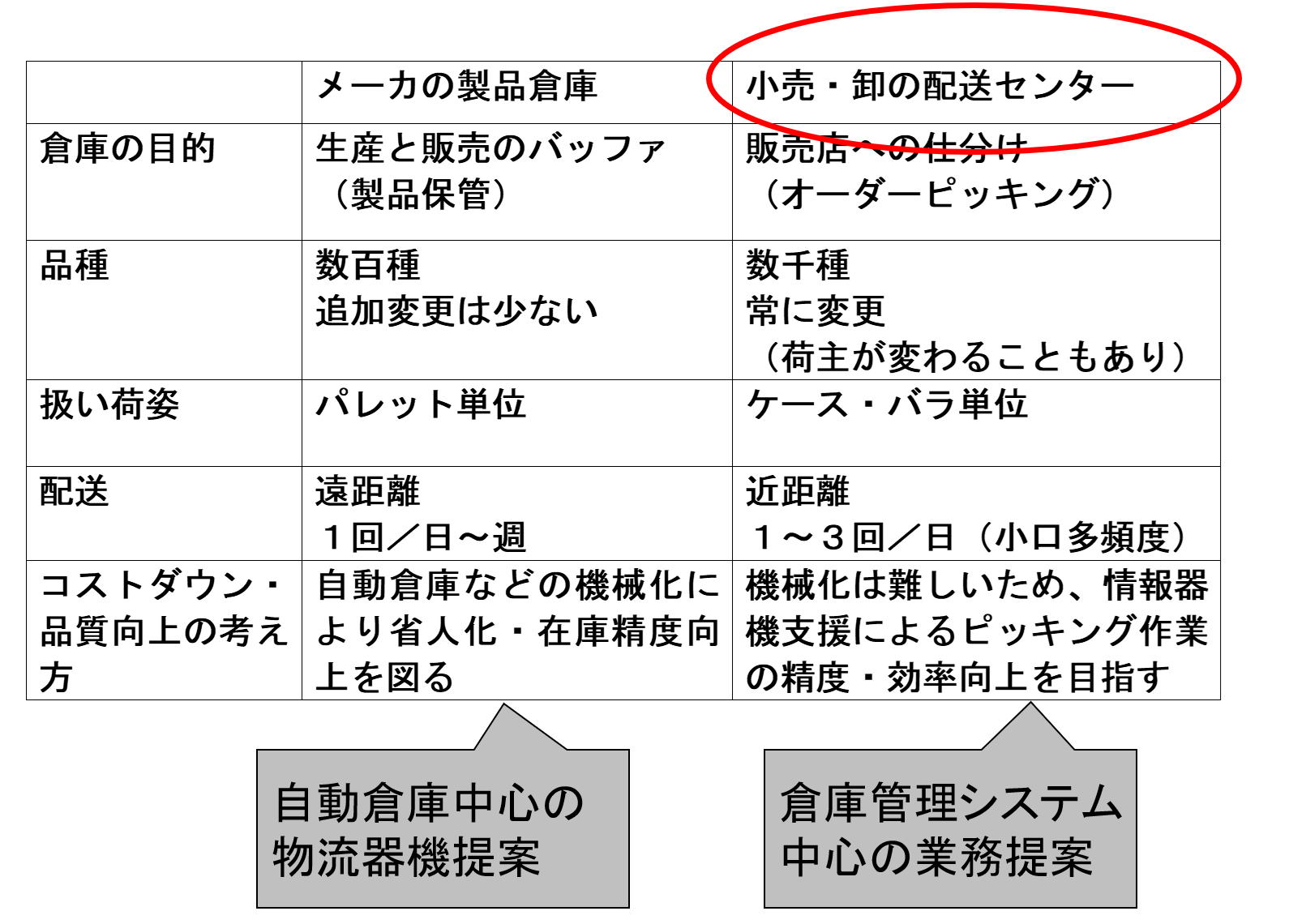
We compare the differences between two typical base types, ``manufacturer's product warehouse'' and ``retail/wholesale distribution center,'' in five categories, and organize what kind of improvement approach (system proposal) is needed.
Comparison and explanation of B2 items
| Comparison items | Manufacturer's product warehouse | Retail/Wholesale Distribution Center (Priority Area) | Explanation/Structural differences |
|---|---|---|---|
| Purpose of warehouse | Production and sales buffer (product storage) | Sorting to stores (order picking) | Manufacturers are storage type, while retailers and wholesalers are transit/picking type, which quickly sort and send out items. |
| variety | Hundreds of species (few additional changes) | Thousands of types (always subject to change and shipper changes) | Retail/wholesale is an environment where the number of items handled is orders of magnitude larger and changes frequently, making it difficult to design fixed shelves. |
| How to handle packaging | pallet unit | case/piece unit | Manufacturers work on large orders (pallets), but retailers and wholesalers mainly work on small orders (cases and pieces), which increases the proportion of manual work. |
| delivery | Long distance (once/day to week) | Short distance (1 to 3 times/day, frequent small lots) | Retailers and wholesalers have extremely strict shipping time schedules in order to handle frequent small-lot deliveries to stores. |
| Approach to cost reduction and quality improvement | Aim to save labor and improve inventory accuracy through mechanization such as automated warehouses. | Since mechanization is difficult, we aim to improve picking accuracy and efficiency with information equipment support. | Manufacturers can easily automate hardware by fixing packaging styles and types, but retailers and wholesalers need flexibility (software) to handle fluctuations and a wide variety of products. |
Insights in B3 logistics proposals and improvements
① Proposals to manufacturer product warehouses [mainly hardware (logistics equipment)]
Because packaging forms and types are standardized and fixed, this is an area where "labor saving and unmanned" efforts by introducing large logistics equipment such as automated warehouses, palletizers, and AGVs are likely to be cost-effective.
② Proposals to retail/wholesale distribution centers [mainly software (WMS/business support)]
Due to the large variety of products, small-lot shipments, and frequent changes, it is extremely effective to combine WMS with handheld terminals and digital picking to optimize work flow, make adjustments, and improve work speed.
Management level of C1 distribution center
This is a model that categorizes the stage of introduction of IT, equipment, and equipment (digitization/automation maturity) at distribution centers into four stages: "Level 1 to Level 4."
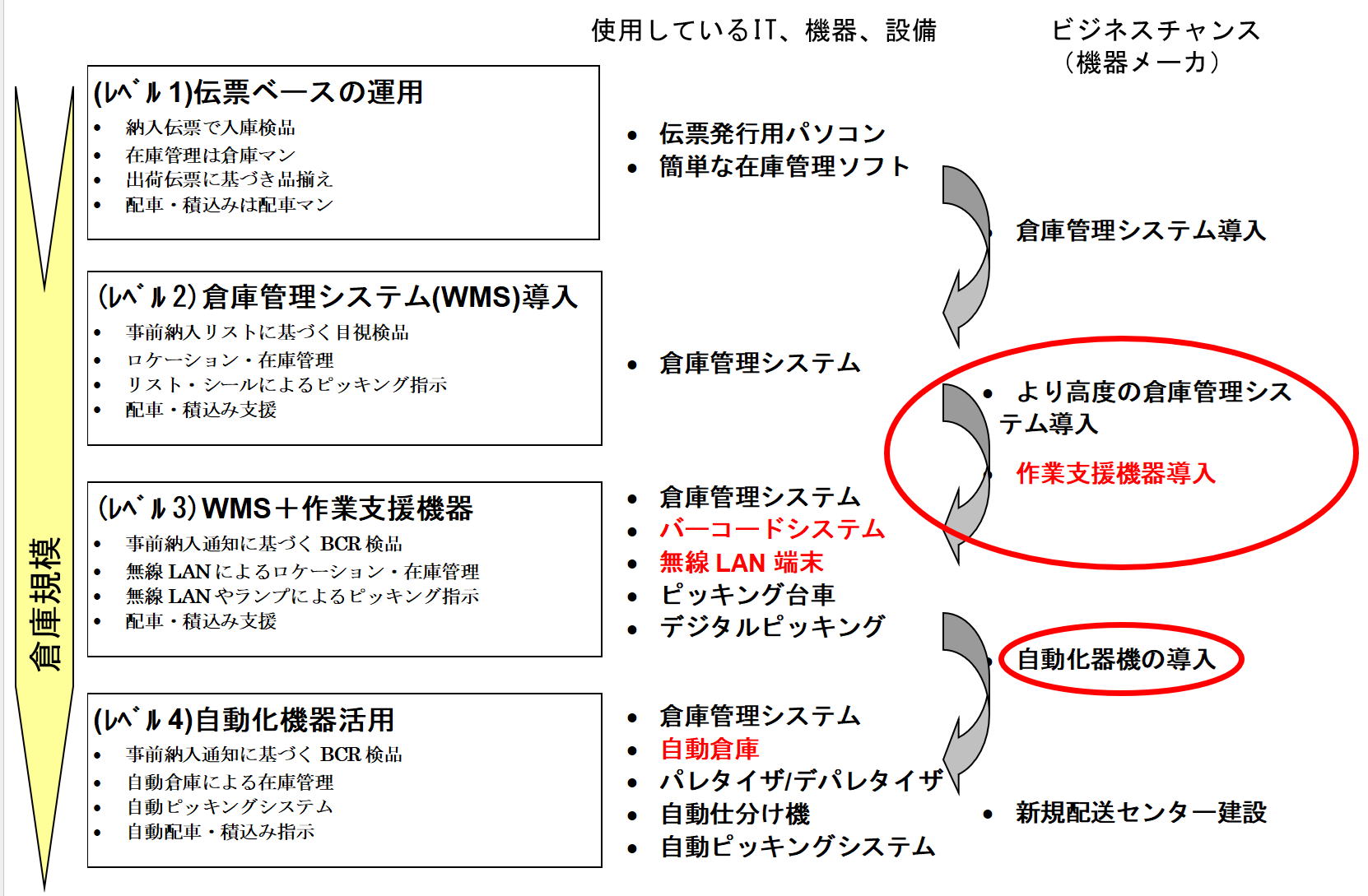
Management level of C2 distribution center (4 steps up)
| management level | Operational characteristics | IT/equipment/facilities used | Business opportunities for manufacturers |
|---|---|---|---|
| (Level 1) Slip-based operation |
“Operation that relies on people (experts)” ・Inspection using paper delivery slip ・Inventory/product assortment/vehicle allocation is managed manually or on paper |
・PC for issuing slips ・Simple inventory management software |
Proposal for introducing a warehouse management system (WMS) |
| (Level 2) WMS introduction |
"Operation based on data list" ・Visual inspection based on list ・Start of location management/dispatch support |
・Warehouse management system (WMS) | Introduction of more advanced WMS + work support equipment |
| (Level 3) WMS + work support equipment |
"Pokayoke real-time operation" ・BCR (barcode) inspection ・Go paperless with wireless LAN/lamp instructions |
・WMS/barcode system ・Wireless LAN terminal/picking cart ・Digital picking |
Introduction of automation equipment |
| (Level 4) Utilization of automated equipment |
“Labor saving/automated operation” ・Inventory management in automated warehouses ・Automatic picking, automatic sorting |
・WMS/automated warehouse ・Palletizer / Depalletizer ・Automatic sorting machine/automatic picking |
Proposal for construction of a new distribution center |
C3 detailed explanation and important business insights
- Evolution from “human dependency to automation” as warehouse scale expands
As the warehouse size increases, the level increases from level 1 to level 4.Levels 1 and 2 are determined by humans, level 3 is system instructions and work support equipment to prevent human errors, and level 4 is full automation by machines.
- Proposal areas for retail/wholesale distribution centers
It is difficult to suddenly introduce Level 4 (automated equipment) in a field where there is a lot of variety and bulk picking.Stepping up from Level 2 to Level 3 (more advanced WMS + work support equipment such as handheld terminals and digital picking) is the area with the highest return on investment.
D1 center scale and information system classification
It systematizes the correspondence between the "equipment/material handling level" and the "IT/information system classification" that supports it, depending on the scale and complexity of the distribution center (number of industries, area, number of customers).
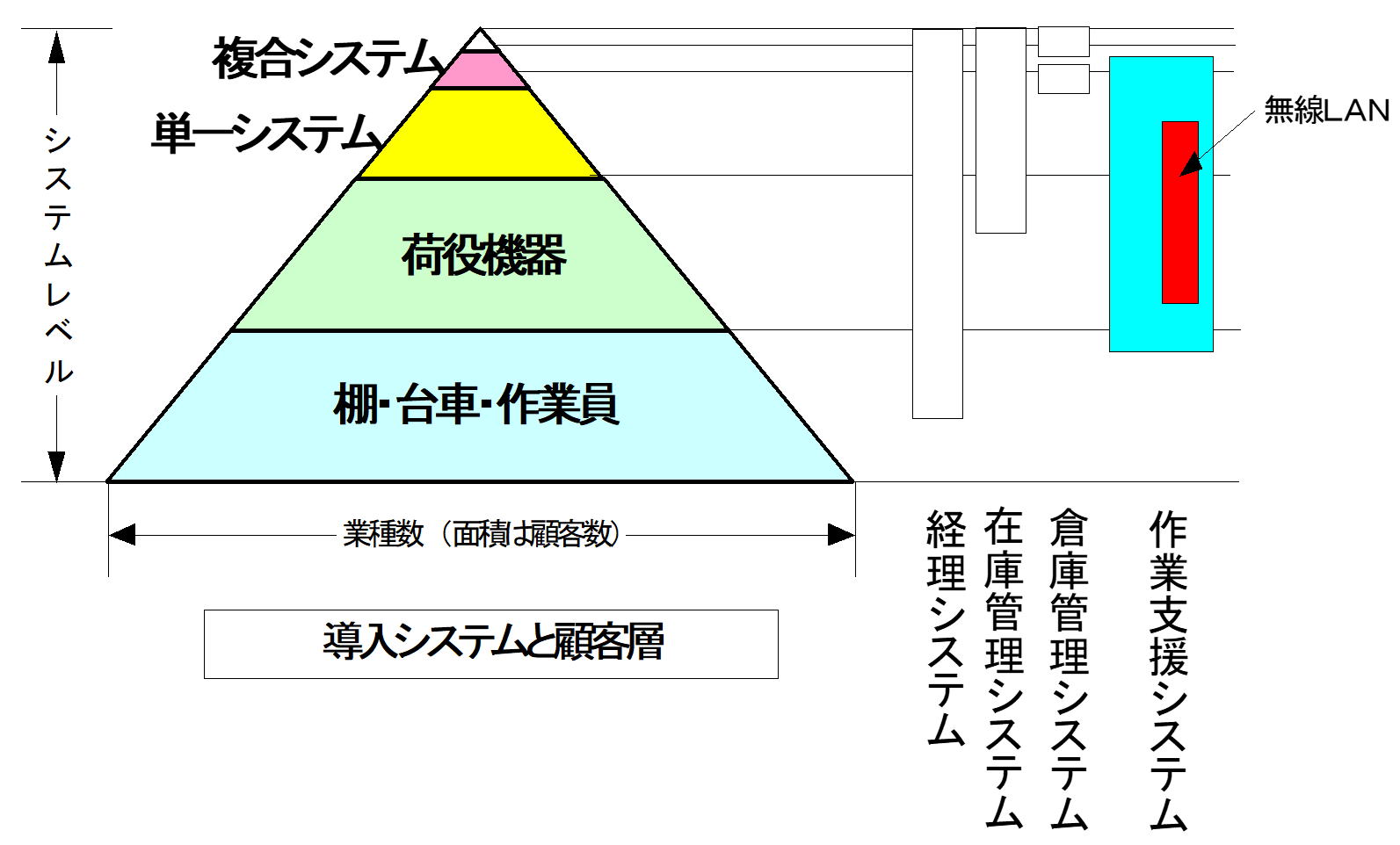
D2 detailed explanation
① Equipment/material handling level (pyramid structure)
- Bottom layer: shelves, trolleys, workers(Manpower-based operation)
- 2nd layer: Cargo handling equipment(Equipment that assists human power such as forklifts and conveyors)
- Layer 3: Single system(Single automation such as automatic warehouse only, sorter only)
- Top layer: complex system(Advanced collaboration of automated warehouse + AGV + automatic picking, etc.)
② Information system classification (4 layers)
- Accounting system:Top-level core system that serves as the base for all levels
- Inventory management system:System for managing theoretical inventory
- Warehouse management system (WMS):Manage physical items and work logic such as location and picking procedures
- Work support system (wireless LAN):Real-time instructions and performance detection on handy terminals, etc. (Pokayoke)
Important insights in D3 practices and improvement proposals
1. “Work support system (wireless LAN)” is essential for on-site improvement.
Even in sites where automated equipment has not been introduced, work precision and productivity can be dramatically improved by simply introducing a "work support system + wireless LAN".
2. Preventing mismatch between capital investment (hardware) and system investment (software)
The approach with the highest return on investment is to first introduce a set of "WMS + work support system (handy/wireless LAN)" in accordance with the physical level of the site and digitalize the site.