3-10. Logistics facility planning and base type comparison in supply chain
advancedLogistics facility planningIn order to optimizeUnderstand the differences between "production logistics" and "sales logistics" in the entire supply chain, as well as changes in commercial transactions in BtoB, BtoC, and CtoC.is essential.
The area you should invest in and the approach you take to reduce logistics costs will vary greatly depending on the type of base you are looking for (manufacturer product warehouse or retail/wholesale distribution center).
👉Towards the functional level and system construction inside the distribution center
1-1.Types and areas of logistics in the supply chain
Within the entire supply chain, logistics flows can be broadly classified according to their roles.

🔍 [Illustrated detailed explanation] Boundary structure between "production logistics" and "sales logistics" in overall logistics (image2151_2.jpg)
The diagram above shows the "logistics" that encompasses the entire supply chain (procurement, production, and sales).production logisticsandsales logisticsThis is the basic model that shows how the is divided.
- Procurement/Production Area (Production Logistics/Material Flow):This is the "flow of goods" centered around factories and raw material warehouses.This has been planned in advance"Production plan"Because cargo moves based on
- Sales area (sales logistics / Physical Distribution):It is the flow of goods from distribution centers, wholesalers, retail stores, and final customers (BtoB/BtoC/CtoC).This is from the customer side"Order information"This is an uncontrollable world where we have to absorb fluctuations in shipping due to seasonal and sales events, as well as small-scale production of a wide variety of products and limited delivery times.
Facility planning insights:As indicated by the dashed line in the center (boundary between warehouse and distribution center),production logisticsOur warehouse, which is responsible forsales logisticsThe distribution center responsible for theLogistics facility planningapproach is required.
1-2.Five major classifications of logistics and characteristics by area
① Five logistics classifications that make up the supply chain
1. Procurement logistics
This is a logistics area that procures raw materials, parts, and auxiliary materials necessary for manufacturing products from domestic and overseas suppliers and supplies them to factories.
2. Production logistics
This is a logistics area that involves moving raw materials between processes within a factory, storing semi-finished products, and transporting finished products to the company's own warehouse or distribution center (DC).
3. Sales logistics
This is the most important and complex logistics area that delivers products from distribution centers to end users such as wholesalers/retail stores (BtoB) and private homes (BtoC).
4. Waste logistics
This is a logistics area that collects and transports unnecessary packaging materials, cardboard boxes, waste products, etc. generated during production and logistics processes to disposal sites.
5. Reverse logistics
In response to environmental protection and a recycling-oriented society, this field of logistics is responsible for the "return collection" of initially defective products and misdelivered products, as well as the "recovery and redistribution" of recycled materials (pallets, etc.).
② Structural differences between production logistics (plan-driven) and sales logistics (demand-driven)
- Production logistics = “Controllable world (planning and leveling)”
Since cargo is moved based on the factory's "production plan" and "shipping schedule," it is possible to accurately predict and level out "when, where, what, and how much to transport" in advance.Because demand fluctuations are small, it is an area where it is easy to achieve an extremely high return on investment through unit loading (integrated pallet transportation) and hardware/mechanization (labor saving investment) such as automated warehouses.
- Sales logistics = “A world at the mercy of demand fluctuations (customer-first, uncontrollable)”
Since orders from stores and end consumers act as triggers, the amount of goods delivered can fluctuate dramatically depending on the day of the week, season, weather, special sales, TV exposure, etc.Because it is necessary to meet strict customer demands such as "I want it now," "same-day delivery," and "specified time slot," accurate data analysis in advance and a flexible work system (software management using WMS) are required.
③ Transition to BtoB, BtoC, and CtoC logistics and changes in cost structure
BtoB (Business-to-Business Logistics)
Features:The delivery destination is a store or business office.Shipping lots per delivery destination are large, and "large-lot deliveries" in pallets or cases are the norm.Work efficiency is high, and logistics costs per piece are kept low.
BtoC (Business-to-consumer logistics/EC mail order)
Features:Deliveries are made to countless private homes.Shipping lots are "small lots" of one to several items.Piece picking, individual inspection, and individual packaging are required, which dramatically increases the number of work hours in the warehouse.
CtoC (person-to-person logistics/flea market/auction)
Features:Logistics sent by individuals to individuals.Rapid expansion due to the rapid penetration of flea market apps (Mercari, etc.) and online auctions.The packaging style, size, and packaging style of products are not standardized, creating a new logistics flow in which pickup and sorting operations take place via convenience stores and PUDOs (delivery lockers).
④ Impact on logistics sites brought about by CtoC (personal EC) logistics
- Non-standardized packaging and the difficulty of automatic sorting
In BtoB and BtoC, the size of cardboard boxes for products is relatively standardized, but in CtoC, items are sold and packed by individuals, so the packaging may be irregular (non-standard), such as paper bags, reusing existing boxes, or envelopes.As a result, there are cases where conventional high-speed sorters (automatic sorting machines) cannot read or transport the items, and special image sensors and manual sorting processes are required.
- Dispersion of “first mile” (pickup/delivery) and coordination of PUDO/convenience store logistics
In CtoC logistics, shipping sources are distributed at multiple locations such as private homes, nearby convenience stores, and delivery lockers (PUDOs) installed at stations.Delivery companies need to collect small parcels scattered across the country, consolidate them at regional hubs, and then transport them on main routes, which is a factor in the rise in first-mile collection logistics costs.
- Close collaboration between anonymous delivery and information systems
In order to achieve "anonymous delivery" that protects the personal information of both sellers and buyers, data linkage using QR codes and barcodes is essential.Logistics facility planningIn addition to physical cargo, it is important to introduce advanced information APIs and WCS (warehouse control systems) that connect personal information and cargo without contact.
💡 Why it becomes difficult to reduce logistics costs due to small-lot distribution (BtoC/CtoC)
1.Explosive increase in work hours:Labor costs increase as each item is picked one by one from a large inventory (bulk picking), individually packed, inspected, and labeled.
2.Decrease in delivery density and redelivery costs:Unlike BtoB, where thousands of items can be unloaded in a single delivery, BtoC/CtoC involves frequent deliveries of small quantities to individual homes, resulting in an increase in the number of vehicles required, a shortage of drivers, and re-deliveries due to absenteeism, which increases the cost of last-mile transportation and delivery.
2.Base characteristics in sales logistics (manufacturer product warehouse vs. retail/wholesale distribution center)
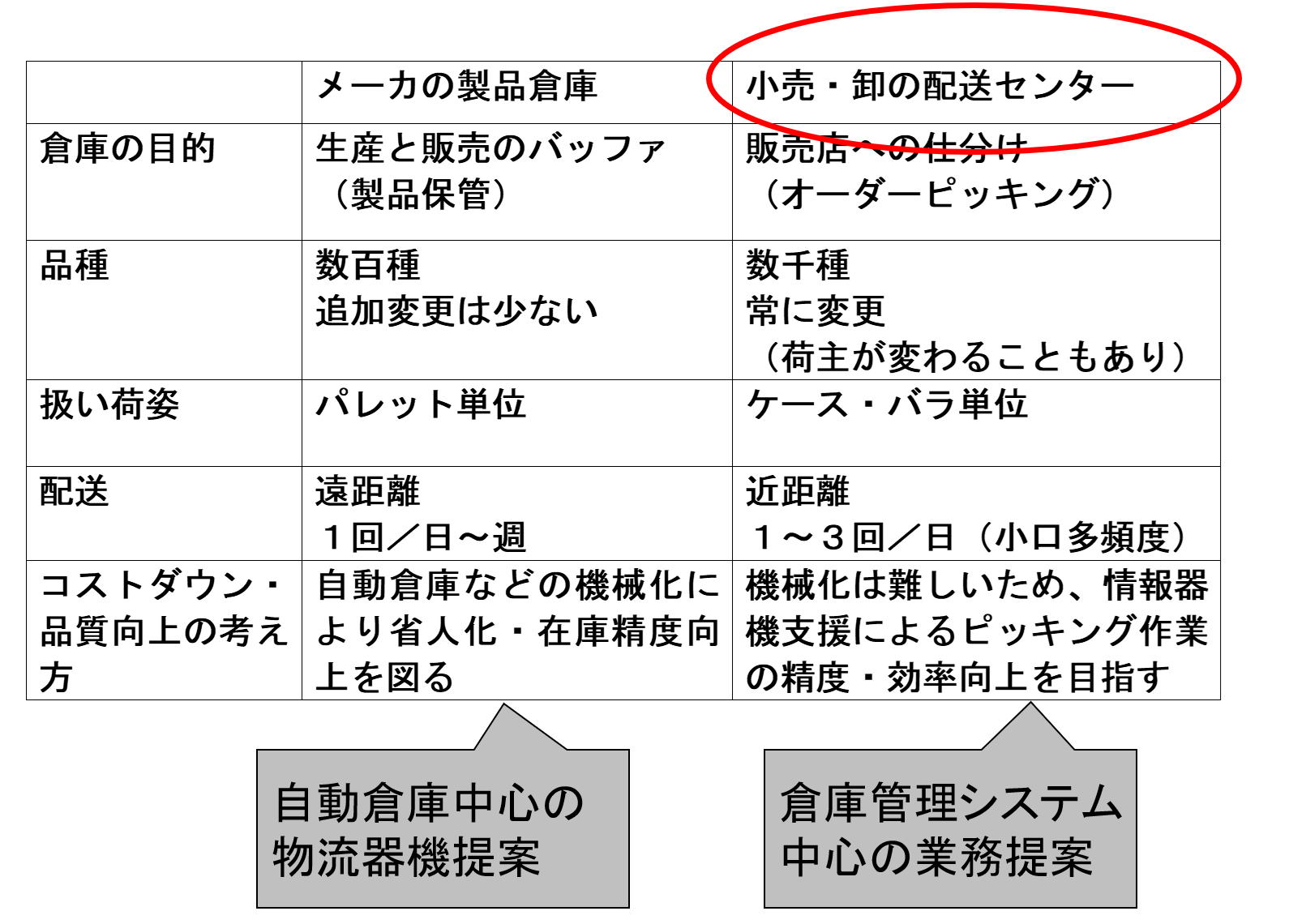
🔍 [Illustrated detailed explanation] Comparison and proposal axis between manufacturer product warehouse and retail/wholesale distribution center (image151.jpg)
The above diagram is a comparison table showing the operational characteristics of "manufacturer's product shipping warehouse" and "retail/wholesale distribution center (TC/DC)" and the differences in effective proposal approaches for each.
- Manufacturer product warehouse (left column):The purpose is to buffer production and sales (product storage).There are only a few hundred varieties, and the packaging is mostly on pallets (P), and long-distance deliveries are made.Since the packaging style and type are fixed,“Proposal of logistics equipment centered on automated warehouses (hardware-driven mechanization and labor saving)”provides the highest return on investment.
- Retail/Wholesale distribution center (right column/red frame area):The purpose is sorting (order picking) to retailers and individuals.There are a huge number of products, ranging from thousands to hundreds of thousands of varieties, and the packaging is mainly case-based (C/B), with frequent short-distance small-lot deliveries (1-3 times a day).Because there is a lot of manual work and variety changes, it is difficult to automate with hardware.“Warehouse management system (WMS)-centered business proposal (software-driven picking accuracy and efficiency improvement)”is required.
Comparison and contrast of base types
| Comparison items | Manufacturer product warehouse | Retail/Wholesale Distribution Center (TC/DC) | Structural differences in facility planning |
|---|---|---|---|
| Main purpose of warehouse | Buffer between production and sales (inventory storage/adjustment) | Sorting to stores/individuals (order picking) | Manufacturers use long-term storage, while retailers and wholesalers use pass-through and high-speed sorting methods, which determine how to quickly disseminate products without stagnation. |
| Handling SKU (number of products) | Hundreds to thousands of types (limited to in-house products) | Tens of thousands to hundreds of thousands of species (frequent replacement) | In the retail/wholesale field, the number of items is extremely large, and new products are frequently added and discontinued, so variable location (free location) management is essential instead of fixed shelves. |
| Handling packaging (PCB) | Mainly pallet units (P) | Mainly case (C) and individual units (B) | Manufacturers focus on large-lot pallet handling, but retailers and wholesalers require a high proportion of manual work such as piece picking and small-lot work. |
| Delivery frequency/form | Medium/long distance transportation between bases (once/day to week) | Short-distance route delivery/individual delivery (multiple times a day) | Retailers and wholesalers have to deal with store delivery time restrictions (time service), which requires strict management of shipping berth turnover and truck access. |
| Improvement/Investment Approach | Mechanization and labor savings through automated warehouses and automated transportation (AGV) | Optimize work accuracy and flow lines using WMS/work support (handy/DPS) | Manufacturers can easily automate hardware because they use standard packaging, but retailers and wholesalers need flexibility in software (systems and on-site operations) that can withstand changes in packaging. |