4-4. Importance of current situation survey and on-site survey in logistics facility planning
advancedLogistics facility planningIn order to plan and build a lean distribution center, we need not only digital data analysis but also detailedCurrent status surveylived withOn-site investigationis essential.
Before starting data analysisOn-site investigationorInterview surveyBy understanding the actual status of current operations through this method, it becomes possible to clarify specific customer operational requests and irregularities (specificities) unique to the site that cannot be seen by numbers alone.This prevents misinterpretation of quantitative data and enables highly accurate analysis aggregation and optimization simulation.
In this article, we will not fail.system designis as important as data analysis in order to realizeInterview surveyrole and specificCurrent status surveyWe will thoroughly explain the know-how for using sheets.
1. The absolute value of “on-site investigation/hearing investigation” in system design
Why is "on-site investigation" as necessary as data analysis?
Logistics facility planningor warehousesystem designIt is extremely dangerous to rely solely on the analysis (quantitative analysis) of WMS transaction data extracted from WMS (warehouse management systems) and core systems.This is because data is only a record of the results of ``what moved and how many items moved in the past'' and does not tell us the background such as ``why the work procedure was done that way'' or ``what kind of constraints there were on-site.''
For example, even if the data records simply "case shipment of 100 boxes," the actualOn-site investigationWhen this is done, issues and idiosyncrasies unique to the site will be highlighted, such as ``special tags are required for specific customers'', ``boxes are often crushed upon arrival and repacking is required'', and ``berths are punctured due to a high concentration of trucks coming in at certain times of the day.''
“Before” data analysisOn-site investigationand key personnelInterview surveyBy doing so, you will get the following major benefits:
- 1. Identifying the “true needs” of customers and sites:The specific operational requirements for ``shortening delivery lead times'' and ``zero incorrect shipments'' sought by management and customers will be clarified.
- 2. See through data noise and outliers:Data cleaning accuracy is dramatically improved because numerical spikes (noise) due to seasonal fluctuations or sudden promotions can be grasped in advance.
- 3. Enables highly effective system design:We provide site-based solutions that take into account work flow lines, worker proficiency, and physical constraints (ceiling height, beam, column pitch, etc.) and are not just theoretical theories.System constructionis completed.
💡 [Conclusion] “Quantitative data analysis” x “Qualitative on-site investigation” = The most powerful logistics facility planning
Objective numbers (data analysis) and the real situation on the ground (on-site investigation/hearing investigation)system designThese are the two wheels of a car.If either one is missing, there is a high risk of a defective system that will cause confusion on-site after operation.
2. Current status survey form (8 sheets in total) that can be used directly in practice and explanations
This is the standard format for the "Current Status Survey Sheet" that our research institute has been using in our consulting field for many years.As a preliminary preparation before data analysis, please thoroughly check and fill in the following interview items.
📂 Obtain the current status survey sheet: Download the current status survey form template (.7z)
Survey sheet structure and hearing points for each sheet
Cover: Current status survey materials
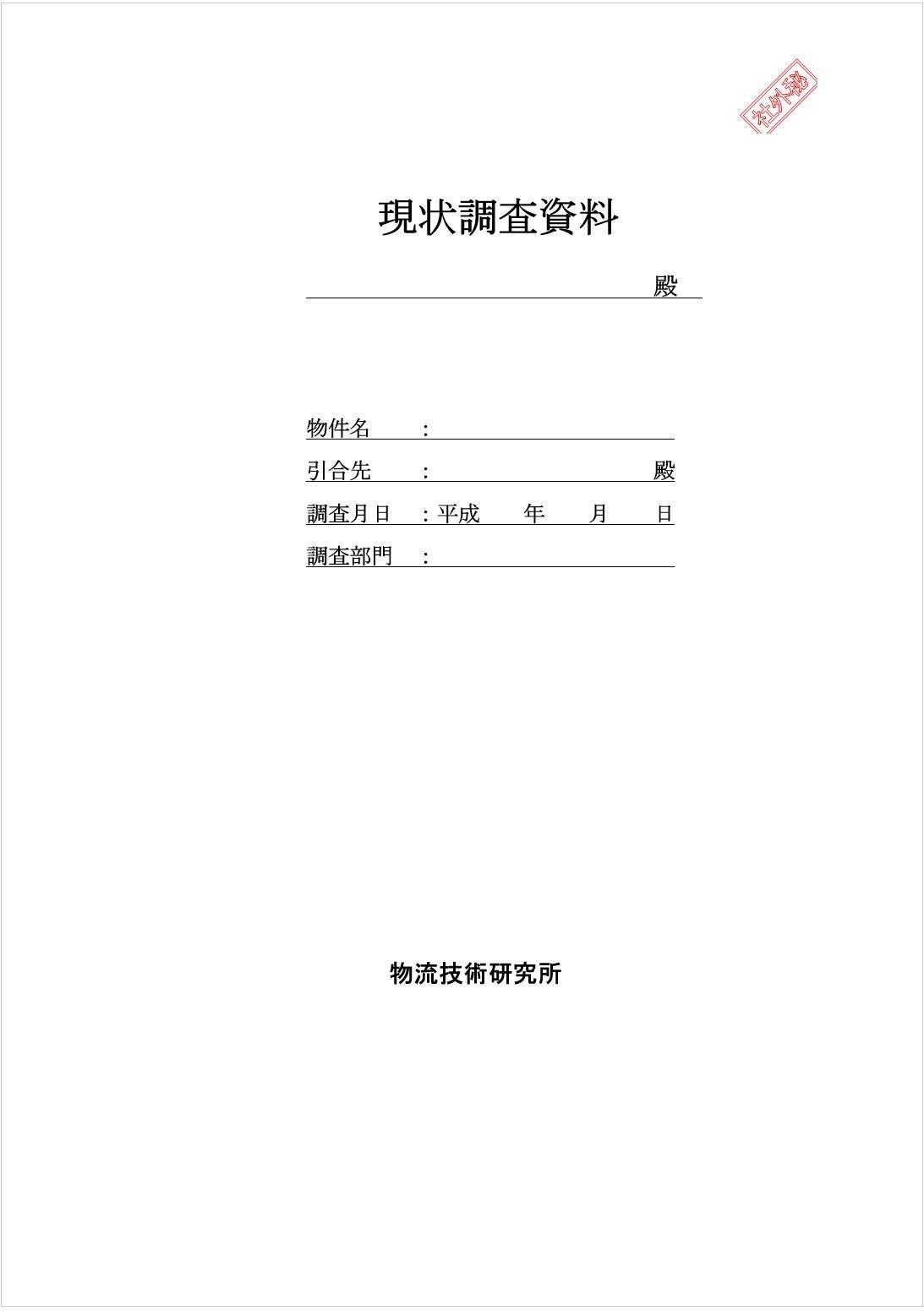
🔍 [Sheet 1 Description] Project management and security (confidentiality)
This sheet is the cover of initial hearing materials for the distribution center construction/renewal project.
- Strict confidentiality:Base reorganization plans, physical data, and investment budgets are the company's top secrets and are therefore strictly managed as "confidential".
- Identifying basic information:Clarify the property name, customer name (inquiry), survey date, and department in charge of the survey, and record the preconditions for the project.
1.Plan overview
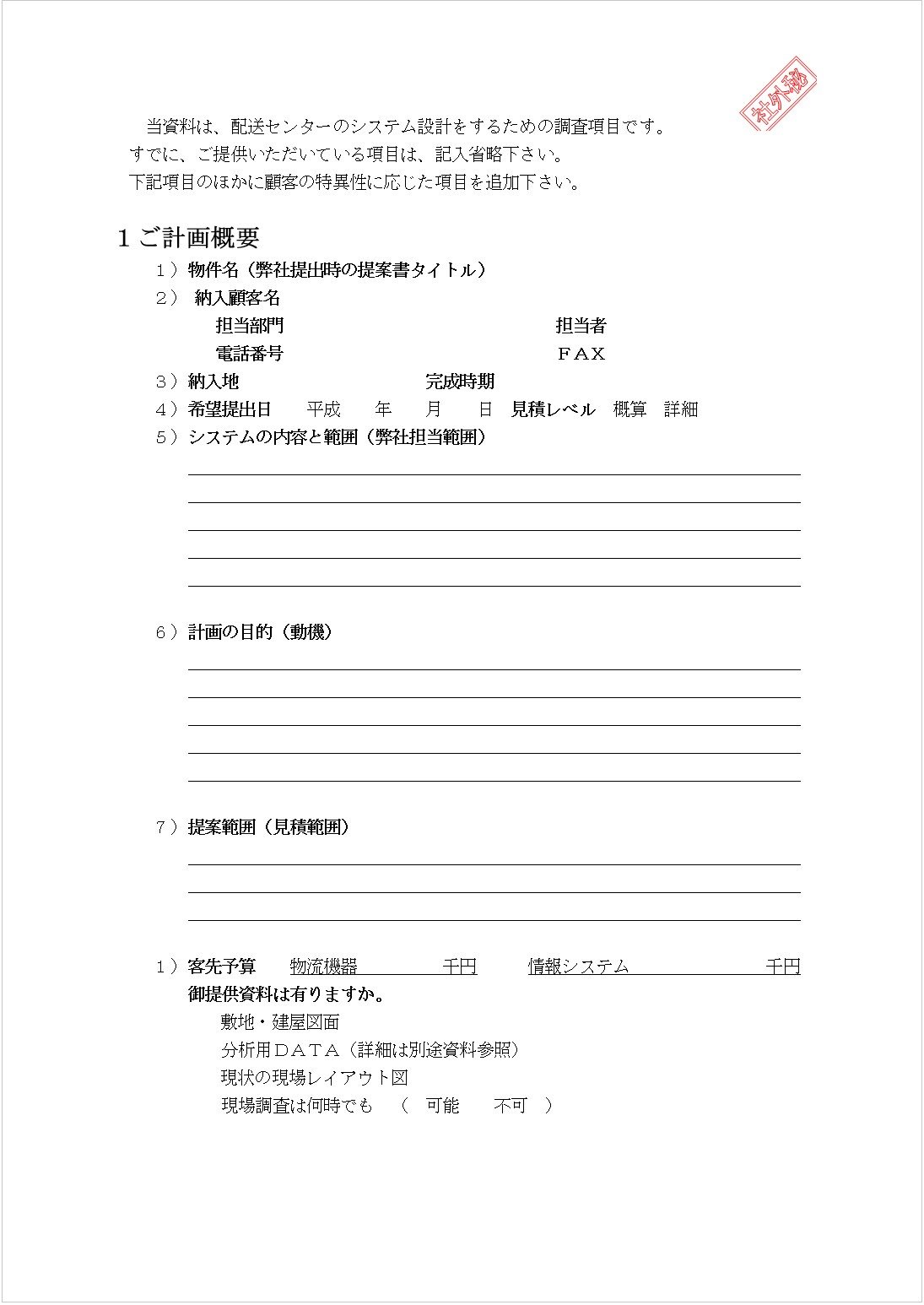
🔍 [Sheet 2 explanation] Determination of project purpose, investment budget, and hearing scope
This is a sheet for hearing the motivation for promoting the project, schedule target (completion time), and investment budget.
- Planning purpose (motivation):``Expansion of shipping processing capacity'' ``Response to labor-saving measures due to labor shortage'' ``By consolidating baseslogistics costClarify the goal that will be the axis of decision-making, such as "reduction".
- Confirm investment budget:Understand the framework of logistics equipment budget (material handling) and information system budget (WMS/IT infrastructure) at an early stage, and create a realistic plan that suits your needs.system designI will devise a.
- Preparation for Inside Out:We check the presence of site/building drawings and data for analysis, and move on to the design step where we decide on the box (building) from the contents (operation/flow line).
2.Building overview (hardware specs)
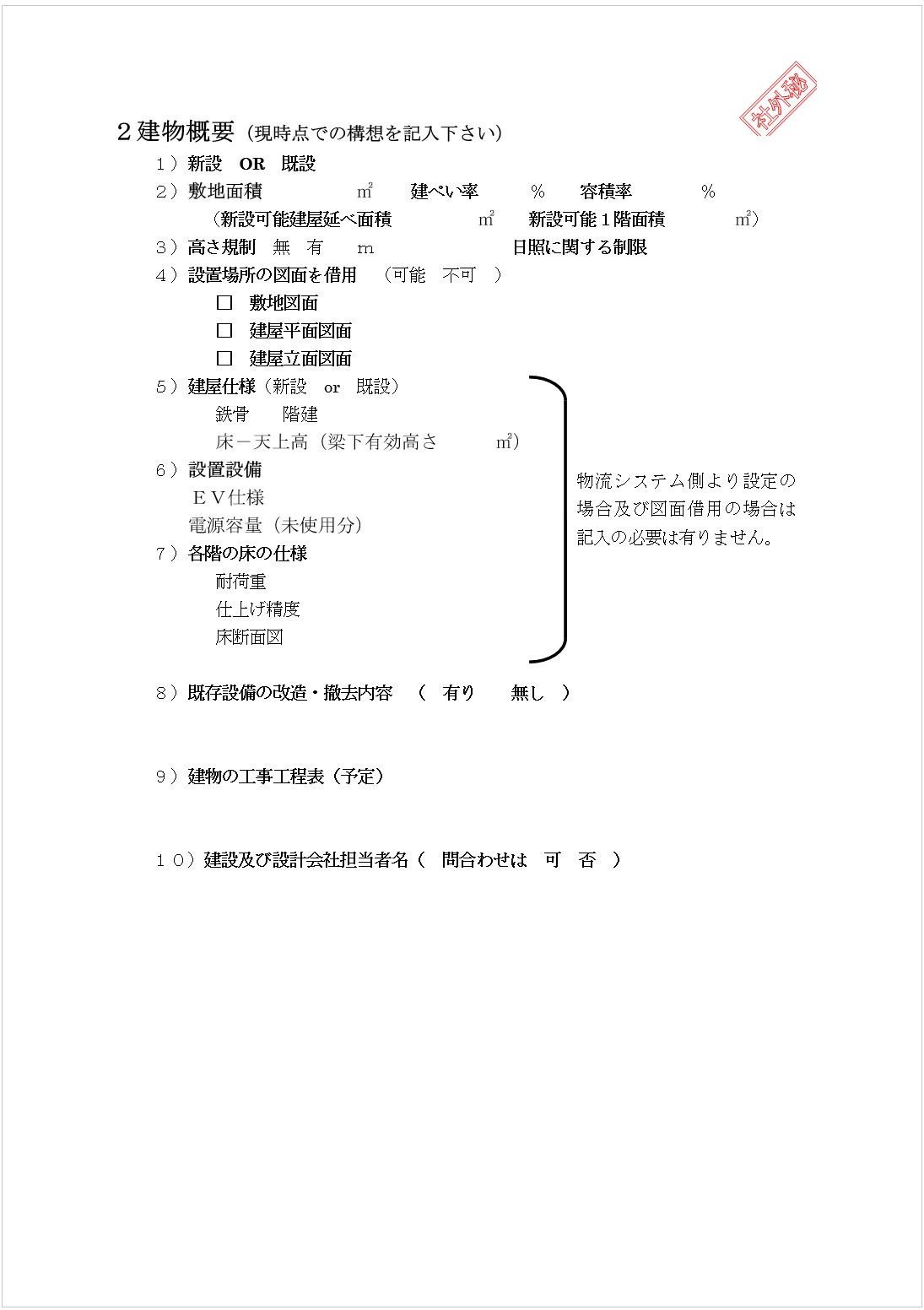
🔍 [Sheet 3 explanation] Investigation of constraints on building regulations and physical structure (hard specifications)
This sheet investigates the physical specifications of new or existing buildings and restrictions under the Building Standards Act.
- Legal limits and permissible area:We calculate the allowable total floor area that can be constructed based on the site area, building coverage ratio, floor area ratio, and height regulations (31m walls, etc.).
- Space/equipment infrastructure:We will investigate the effective height under the beam (securing 5.5m or more), floor load capacity (1.5t/m² to 2t/m², etc.), and power receiving equipment capacity (automated warehouse, freezing and refrigeration equipment, high-voltage power for EV charging).
- Thorough inside-out:As noted,logistics systemThe golden rule is to adapt the building specifications to the side design results (required height, floor load).
2-1.Functions for each area (floor)
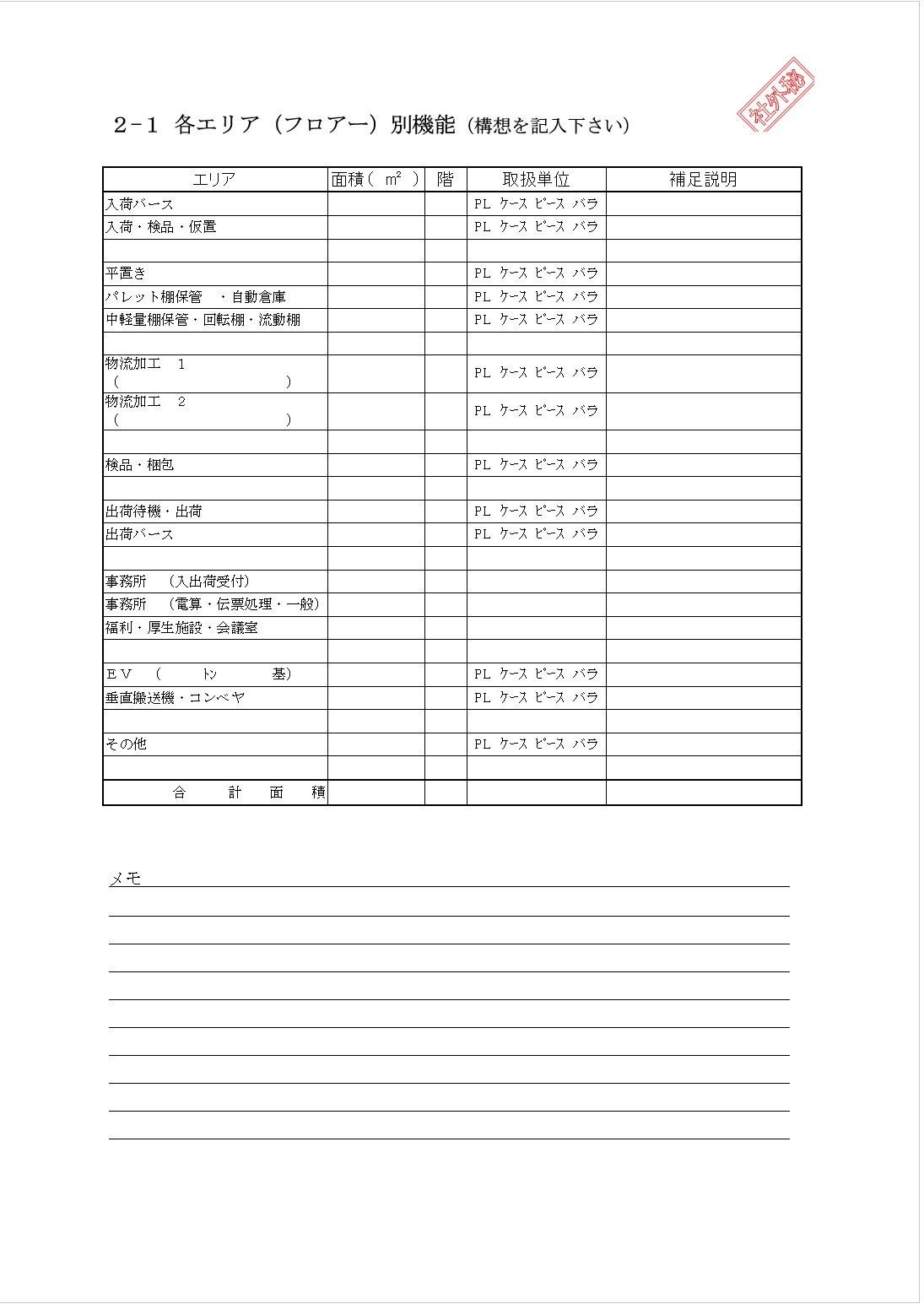
🔍 [Sheet 4 explanation] Hearing on allocation by functional area and handling unit by PCB (packaging style)
This is a basic layout sheet that organizes the required area and handling units for each functional zone (receiving, storage, processing, inspection, shipping) in the warehouse.
- Interaction with PCB analysis:Check the packaging unit that moves in each area (P = pallet, case, piece, B = bulk).We clarify how the packaging will transform from the time of arrival to the time of shipment.
- Functional zoning:Calculate the layout area (m²) of receiving berths, pallet shelves/automated warehouses, medium and light shelves, distribution processing areas, inspection and packaging, shipping waiting spaces, EVs/vertical conveyors, and offices.
3.Survey on logistics volume (3-1 Product characteristics / 3-2 Arrival characteristics)
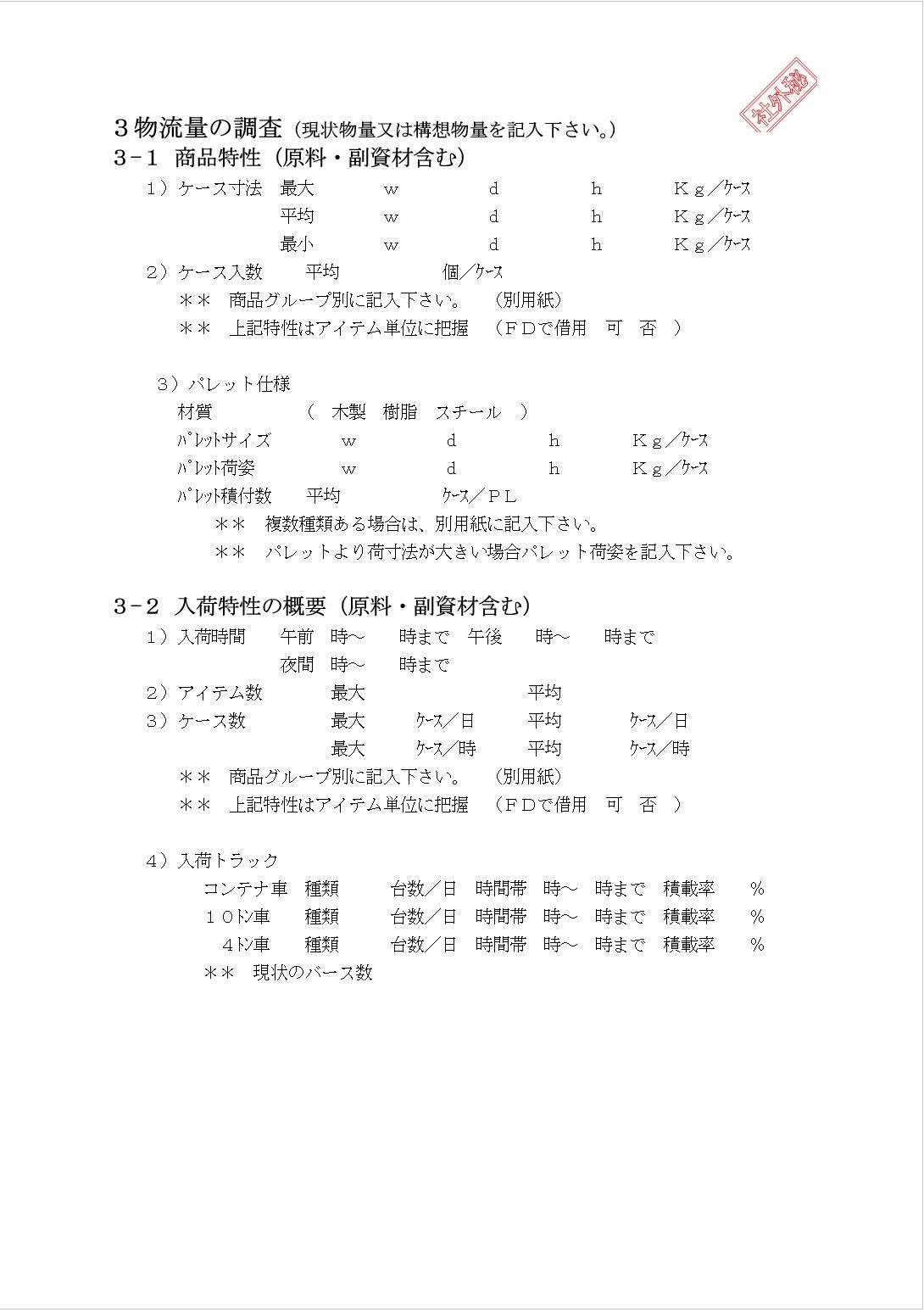
🔍 [Sheet 5 explanation] Investigation of product physical attributes (packing dimensions) and incoming truck receiving capacity
This is a product/arrival attribute sheet for calculating the shelf pitch, load capacity, and number of arrival berths for material handling equipment.
- Product characteristics:We will inquire about the external dimensions of the case (maximum/average/minimum W×D×H/Weight), number of cases, and pallet specifications (wooden/resin, number of loading stages).
- Arrival characteristics:We quantify the arrival time (morning/afternoon/night), the number of arriving cases per day/hour, the number of incoming truck types (10t/4t/container), and the loading rate.
3-3.Inventory characteristics (including raw materials and auxiliary materials)
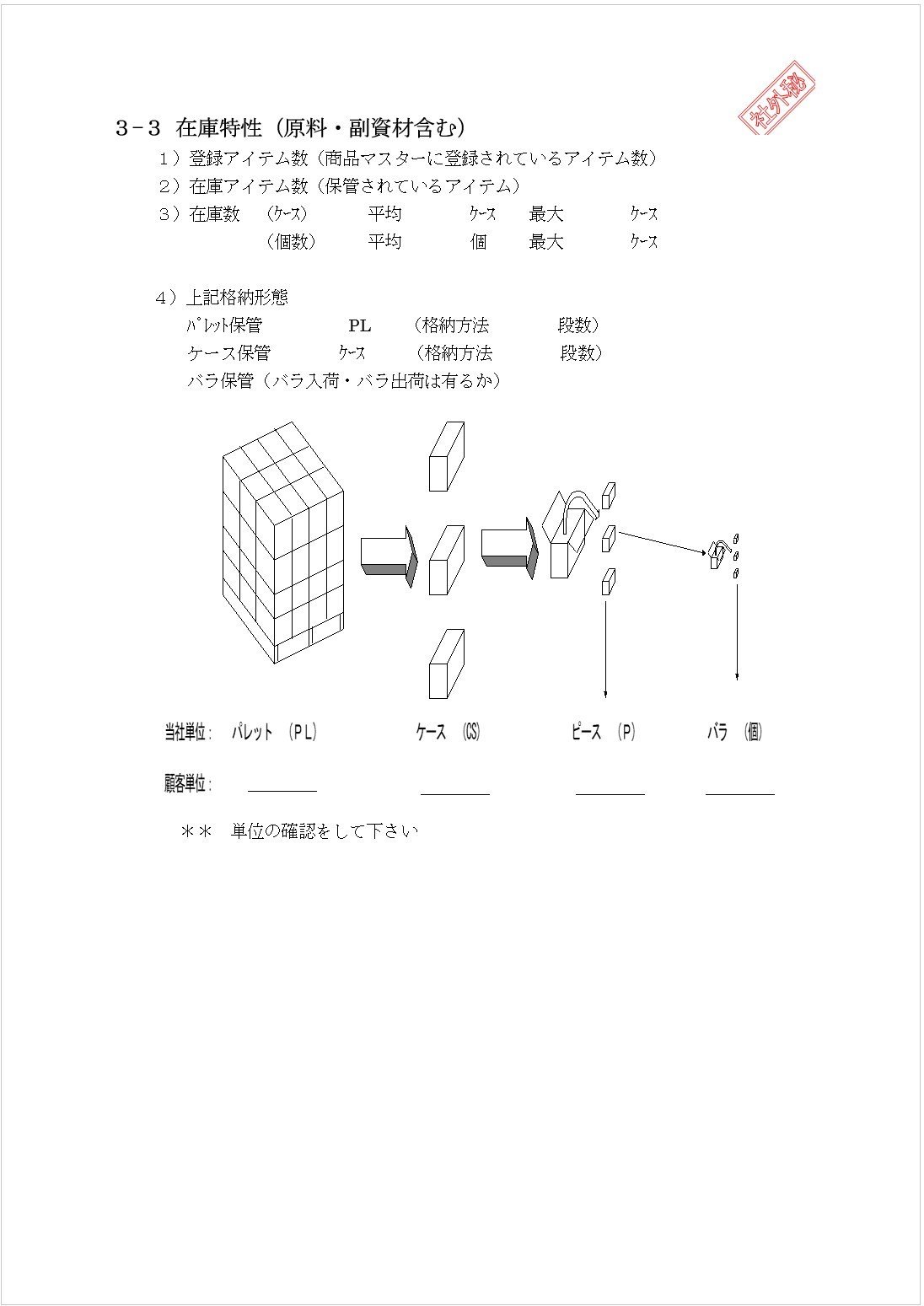
🔍 [Sheet 6 explanation] Checking the consistency of the number of SKUs, storage capacity, and data units
This is an inventory structure survey sheet for designing the required storage capacity (number of pallet racks and shelves).
- Analysis of SKU structure:Check the discrepancy between the number of registered items (master number) and the actual number of items in stock (SKUs actually stored at all times).
- Selection of storage format:Based on the average/maximum inventory (case/number), we will calculate the optimal storage method and number of stages for pallet storage, case storage, and bulk storage.
- [Most important] Consistency of data units:We reconcile the differences (PL/CS/PCS) between "company management unit" and "customer management unit" in advance to prevent calculation errors during data analysis.
3-4 Shipping characteristics / 3-5 Documents / 3-6 Working hours
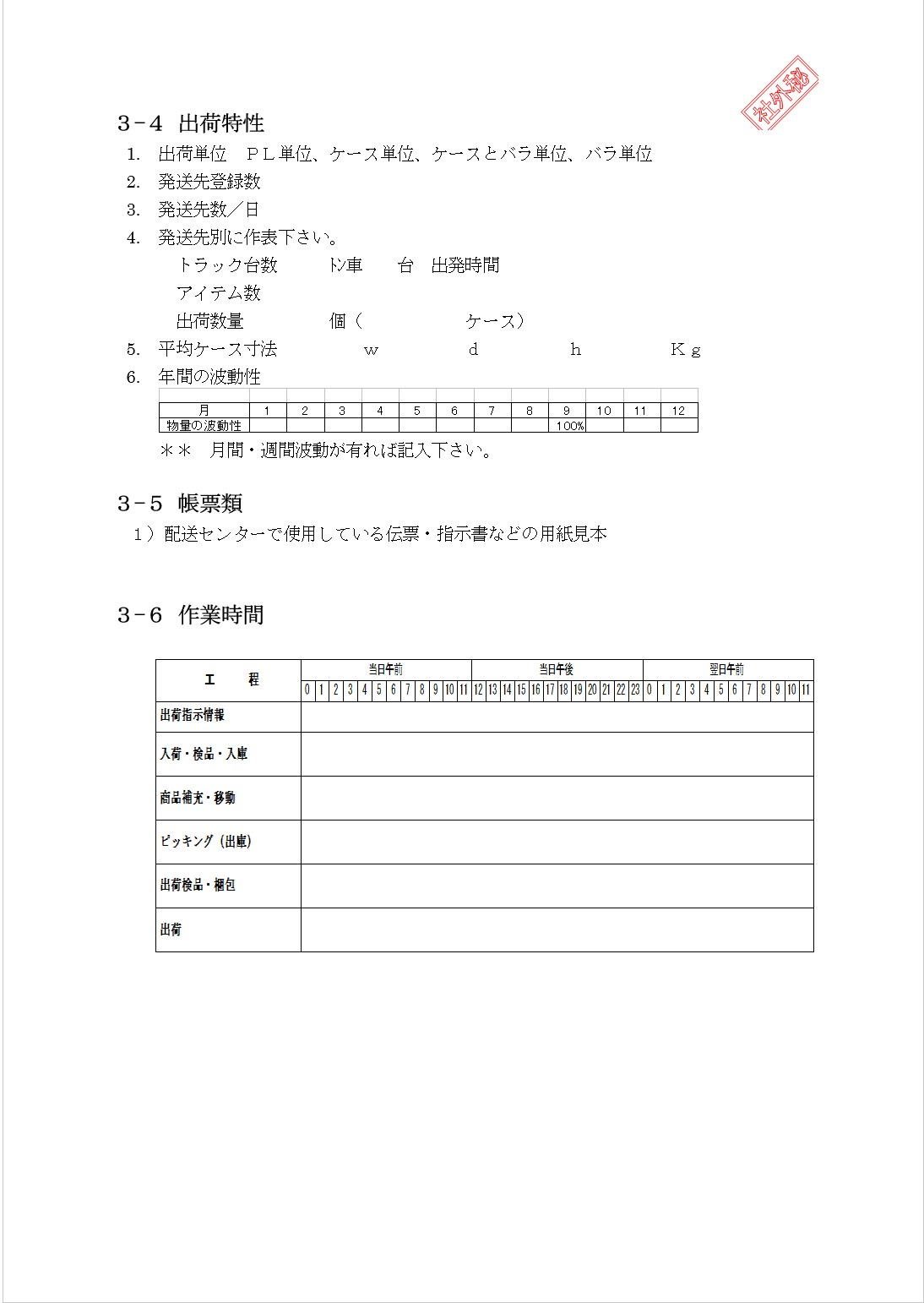
🔍 [Sheet 7 explanation] Shipping wave, 24-hour time schedule, lead time survey
This is a sheet that elucidates the time axis (work time schedule) from order closing to shipping completion and wave characteristics.
- Shipping characteristics:Understand the shipping unit (PL/case/bulk), number of registered delivery destinations, number of delivery destinations per day, number of trucks, and departure time.Plots the monthly quantity wave (annual 100% standard).
- Work time axis (24 hour schedule):On the time axis from the morning of the same day to the morning of the next day, it is possible to visualize when each process of receiving shipping instruction data, receiving/inspecting/warehousing, replenishing products, picking, packing, and shipping by truck concentrates (spikes).
3-7.Personnel composition / 4.information system
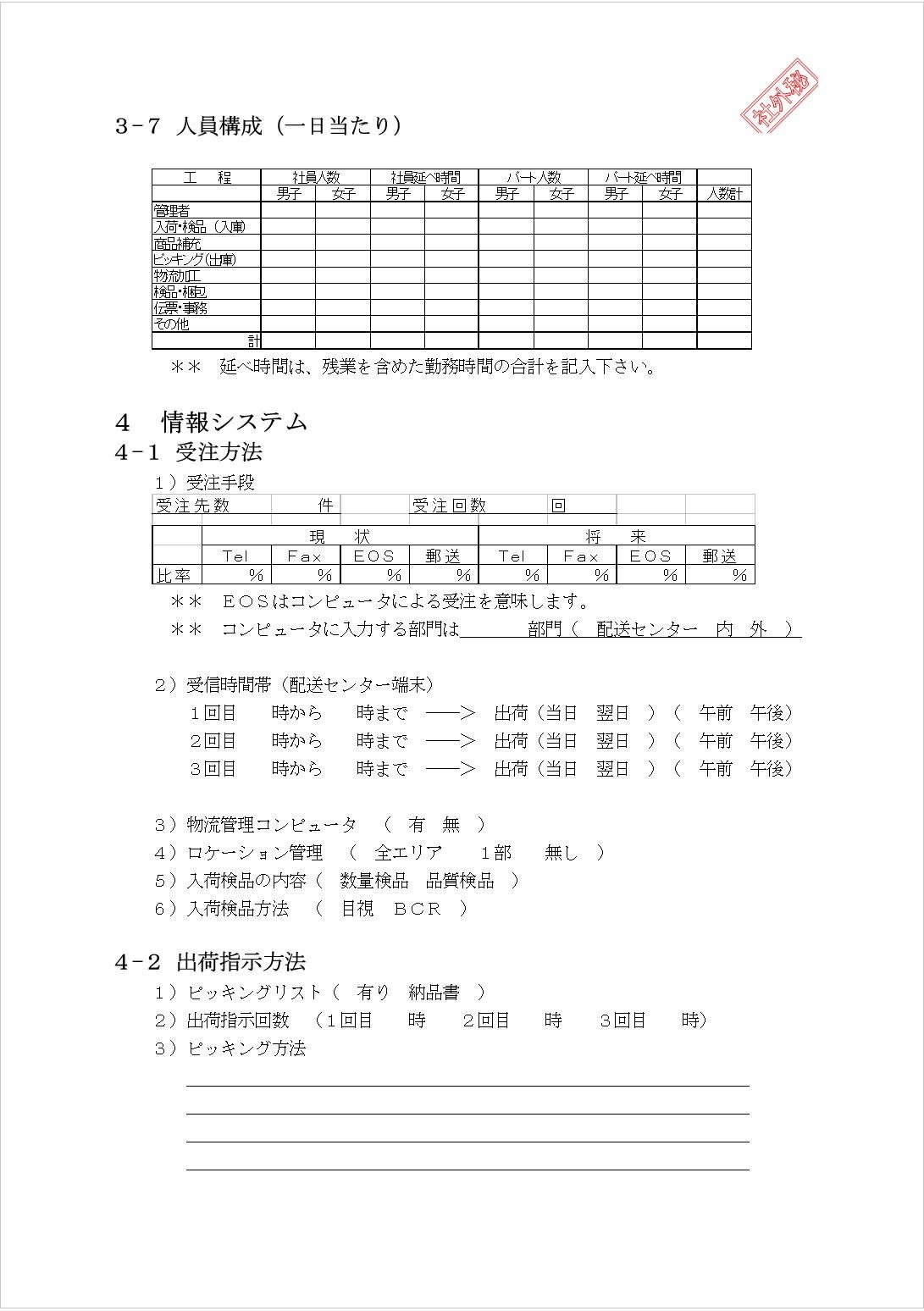
🔍 [Sheet 8 explanation] Labor cost by process and IT/WMS infrastructure requirements survey
This is a requirements investigation sheet for the current on-site personnel (labor costs) and the information system (WMS) that controls material handling and operations.
- Personnel composition by process:Calculate the number of employees and part-time employees and total working hours (including overtime) for each administrator, arrival, replenishment, picking, processing, packaging, and document issuance.This is the basis for evaluating the labor cost reduction effect (ROI) due to the introduction of automated equipment.
- Information system requirements:We comprehensively identify the method of receiving orders (EOS/Tel/Fax/Web), number of receptions (closing time and shipping timing), presence or absence of WMS (warehouse management system), location management level (all areas/parts), receiving inspection method (visual/BCR), and picking instruction method.