3-14. Logistics system construction period and project team formation method
1.Consideration period (example of 3PL food distribution center)
This is a practical document that organizes the review process of the "New Center" opening project and the corresponding hierarchical structure of data and folders on the PC. The entire story from concept to suspension, restart, and production is visualized.
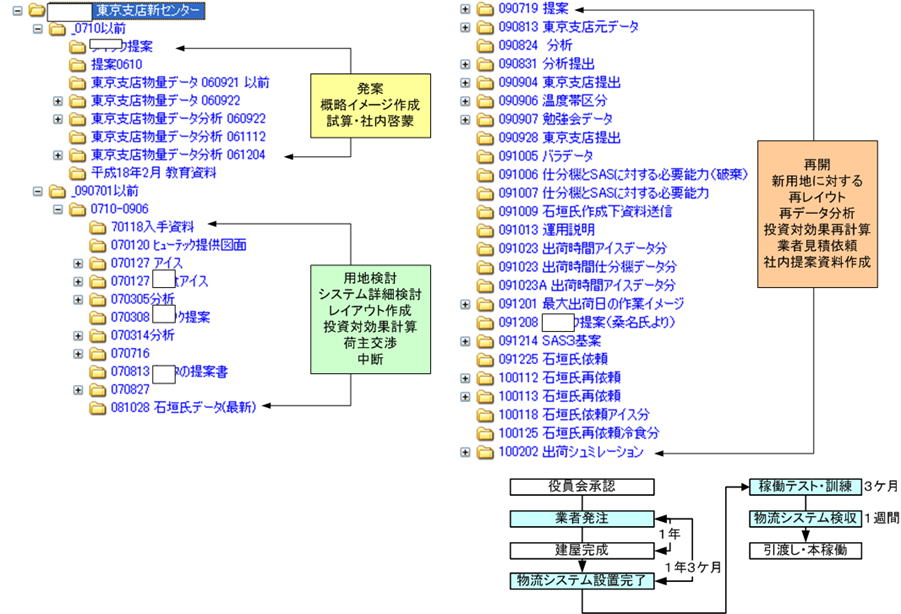
🔍 [Detailed explanation of illustrations] Realistic changes in the project as understood from the folder hierarchy
This is a project transition diagram using the actual folder hierarchy of "Tokyo Branch New Center".This diagram clearly documents how building a large-scale distribution center is a long and complex process.
- Records of ideas and initial consideration (before 0710):The project began with an idea, and as can be seen in the folder "Before 0710", initial proposals and quantitative data analysis had been steadily being carried out since 2006 (before 060921).
- The reality of temporary suspension (0710-0906):Although site considerations, return-on-investment calculations, and negotiations with the shipper were repeated, the project was once ``suspended'' due to inconsistencies in the terms and conditions, which is vividly recorded.
- Reopening at new site (after 090719):When the project was “restarted” on a new site in July 2009 (090719), actions such as re-layout, re-data analysis and re-calculation of return on investment proceeded at a rapid pace. Detailed verification is carried out including shipping simulation (100202).
- Lead time until production:From approval by the board of directors to ordering from a contractor, it will take one year to complete the building, and a further three months to complete the installation of the logistics system (1 year and 3 months in total). The actual construction lead time is shown, starting from operational testing and training (3 months), logistics system acceptance inspection (1 week), and delivery and full operation.
1-1. Process transition and folder structure (4 phases)
① Ideation/initial concept phase
season: _Before 0710(Around 2006-2007)
Implementation details:Proposal, creation of overall outline image, rough estimate, internal consensus building.
data:Analysis of past physical data, educational materials, and initial proposals.
② Detailed consideration and temporary suspension phase
season: 0710-0906(October 2007 - June 2009)
Implementation details:Site study, detailed system study, ROI calculation, shipper negotiations.
result:Temporarily suspended due to inconsistent conditions.
③ Re-examination phase for reopening/new site
season: 090719-100202(July 2009 - February 2010)
Implementation details:Resumption at new site, layout re-creation, SAS/temperature zone verification, shipping simulation.
④ Approval/construction/actual operation phase
Standard construction lead time is approximately 1 year and 6 months to 1 year and 7 months from board approval (approval ➔ order ➔ 1 year construction ➔ system implementation ➔ testing ➔ actual operation).
1-2. Practical points shown in this document
- Information and process traceability:The data (versions) at which discussions were conducted are centrally managed in dated folders.
- “Suspension and restart” risk management:Even if there is a temporary suspension due to non-conformity with the conditions, past evaluation assets can be retained and reexamination can be quickly shifted when a new site is decided.
- Specific verification of material handling system:Quantitative studies are being conducted to build a high-performance center, including SAS (automated sorting system), temperature zone classification, and shipping simulation.
2.Project team organization
This is a "promotion system diagram (project system diagram)" for opening and renewing a distribution center.
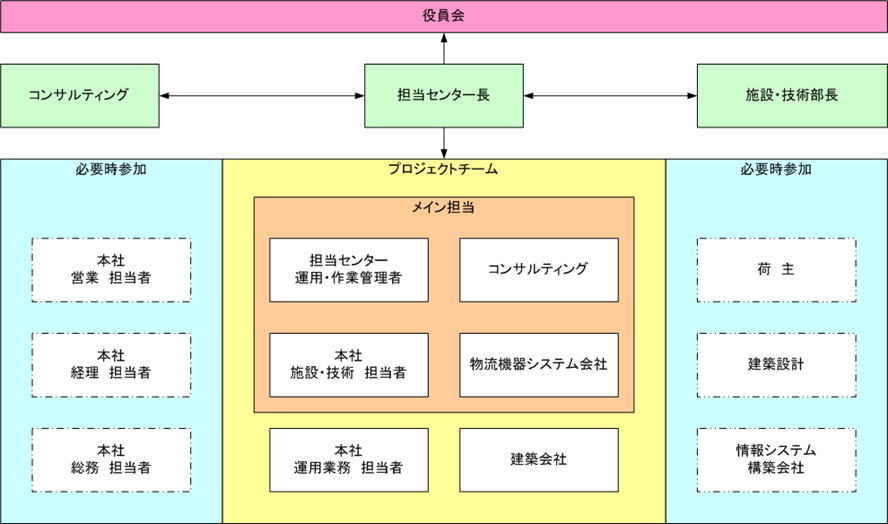
🔍 [Detailed explanation of diagram] Strong propulsion system that separates core and spot
This diagram represents an ideal "promotion system diagram" for a logistics center opening project.You can see the structure that allows for both speed of decision-making and ensuring expertise.
- Decision making line (upper row):It depicts the intersection of top-down and bottom-up relationships, with the board of directors at the top as the apex, and the center director in charge, who is in charge of the project. On either side are the "Consulting" and "Facilities/Technology Managers" who provide advice based on their specialized knowledge.
- Project team main person in charge (center):These are core members who play a central role in actual work.In addition to internal staff such as ``operations and work managers'' on-site, ``facilities and technology personnel'' and ``operations personnel'' at the head office, external ``logistics equipment system companies,'' ``construction companies,'' and ``consulting'' work closely together to create a system in which hardware and software design is carried out simultaneously.
- Participating members when necessary (left and right):These are spot members who are not permanently stationed in the project and join only during necessary phases.On the left are the head office's sales staff, accounting staff, and general affairs staff, and on the right are the shippers, architectural designers, and information system construction companies, creating a streamlined and streamlined formation that joins only when specialized knowledge is required.
2-1. Overall structure and division of roles
① Management/supervision layer (decision-making line)
- Board of Directors:Approval of final business plan, investment decision (determining budget frame)
- Center director in charge:Overall control and reporting to the board of directors as chief executive officer (PM)
- Facilities/Technology Manager/Consultant:Supervision and advice from a technical and professional perspective
② Project team (execution team)
- Main person in charge:Operations manager, consultant, head office technology, material handling equipment company
- support:Head office operations staff, construction company
2-2. Members who participate when necessary (spot participation)
| classification | Constituent members | Role/participation timing |
|---|---|---|
| Internal support (left side) | ・Head office sales person ・Head office accounting person ・Head Office General Affairs Person |
・sales:Contract conditions and revenue adjustment with shippers ・accounting:Budget management, asset recording, and depreciation support ・general affairs:Land contract, legal procedures, labor environment improvement |
| External partner (right side) | ・Shipper ・Architectural design ・Information system construction company |
・Shipper:Coordination of delivery conditions, packaging, and shipping requirements ・Architectural design:Creation of basic design/detailed design ・System company:WMS collaboration/IT infrastructure development |
2-3. Practical points of organizational chart
- Clear separation of "core" and "spot":Prevent the involvement of related departments while increasing the speed of decision-making.
- Fusion of field (operations) and head office (technology/standards):A layout that matches on-site usability and company-wide technical standards.
- Balance between hard and soft:In addition to building construction, we also simultaneously design shipper requirements and systems such as WMS.
3.Steps of planning progress
This is a phase-by-phase promotion process (stage gate) and practical rules for building a logistics center and introducing a system.
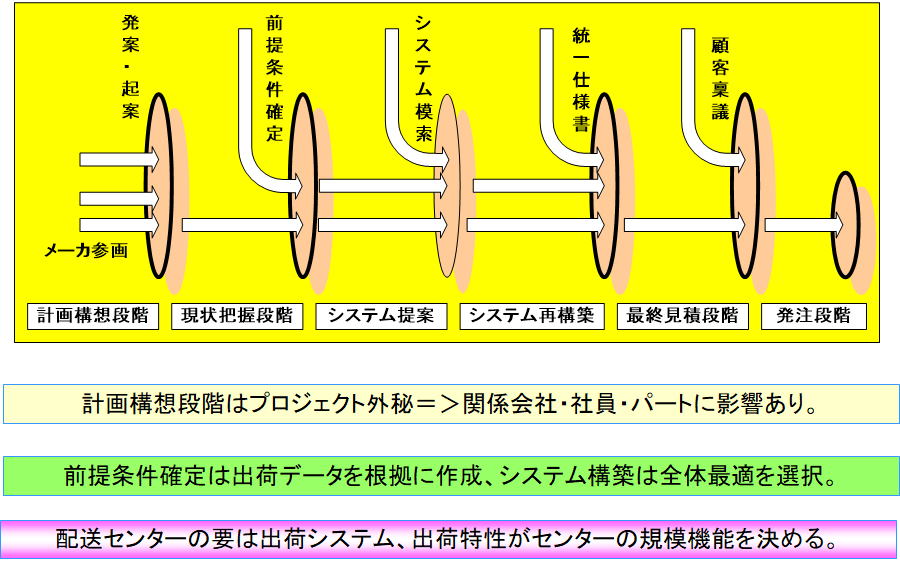
🔍 [Detailed explanation with illustrations] How the “stage gate” works to narrow down the options
This is a conceptual diagram that expresses the steps of planning progress using six phases and "stage gates".A filtering mechanism is demonstrated to ensure that complex projects move forward.
- 6 progression stages:From left to right, the irreversible processes are defined as ``planning concept stage,'' ``current situation understanding stage,'' ``system proposal,'' ``system reconstruction,'' ``final estimate stage,'' and ``ordering stage.''
- Convergence by gate:Between each phase there is a "gate" indicated by an orange oval.In the initial stage of ``proposal/proposal (manufacturer participation)'', there are multiple system proposals and vendor options (multiple arrows), but the options are narrowed down more and more as the process passes through the gates of ``determination of prerequisites,'' ``exploration of the system,'' and ``creation of unified specifications.'' By the time we move from the final "customer approval" to "order placement," the process of converging into a single, solid vector is visually expressed.
- Three golden rules listed at the bottom:At the bottom of the diagram, the golden rules of management to lead the project to success are clearly stated.It emphasizes the importance of information management and data-driven design, such as ``the planning stage is confidential to the project,'' ``prerequisites are determined based on shipping data,'' and ``shipping characteristics determine the size and function of the center.''
3-1. Promotion process by phase
| stage (phase) | Main action points at the gate |
|---|---|
| 1. Planning stage | Idea/draft/manufacturer participation:This is the stage where we develop an initial concept and begin to involve major equipment manufacturers. |
| 2. Stage of understanding the current situation | Prerequisites confirmed:This is the stage of identifying the current quantity and operation and solidifying the prerequisites for the plan. |
| 3. System proposal | System exploration:The stage of exploring and selecting options such as necessary functions and material handling (automated equipment). |
| 4. System reconstruction | Uniform specifications:This is the stage where proposals from each company are compared and integrated and incorporated into a unified specification (RFP). |
| 5. Final estimate stage | Customer approval:The final amount and conditions are finalized, and the final settlement and approval process is completed by the shipper and within the company. |
| 6. Ordering stage | Final order:The stage of signing a contract and moving on to actual manufacturing and construction. |
3-2. Important messages for project promotion
① Information management and risk care
"The project is confidential at the planning stage => Affects affiliated companies, employees, and part-timers."
*Since base integration and reorganization have an impact on the field, information management is essential at an uncertain early stage.
② Data-driven and overall optimization
``Prerequisites were determined based on shipping data, and overall optimization was selected for system construction.''
*We eliminate emotion and optimize the entire supply chain based on quantitative shipping data.
③ Essence of building a logistics center
"The core of a distribution center is the shipping system, and the shipping characteristics determine the size and function of the center."
*The key to success is to design (reverse design) based on shipping characteristics (number of delivery destinations, shipping volume, waves, etc.).
4.Scope of consideration for logistics system construction
The process from requirements definition to system selection to vendor request for quotation (RFP) and the most important principles for site development.
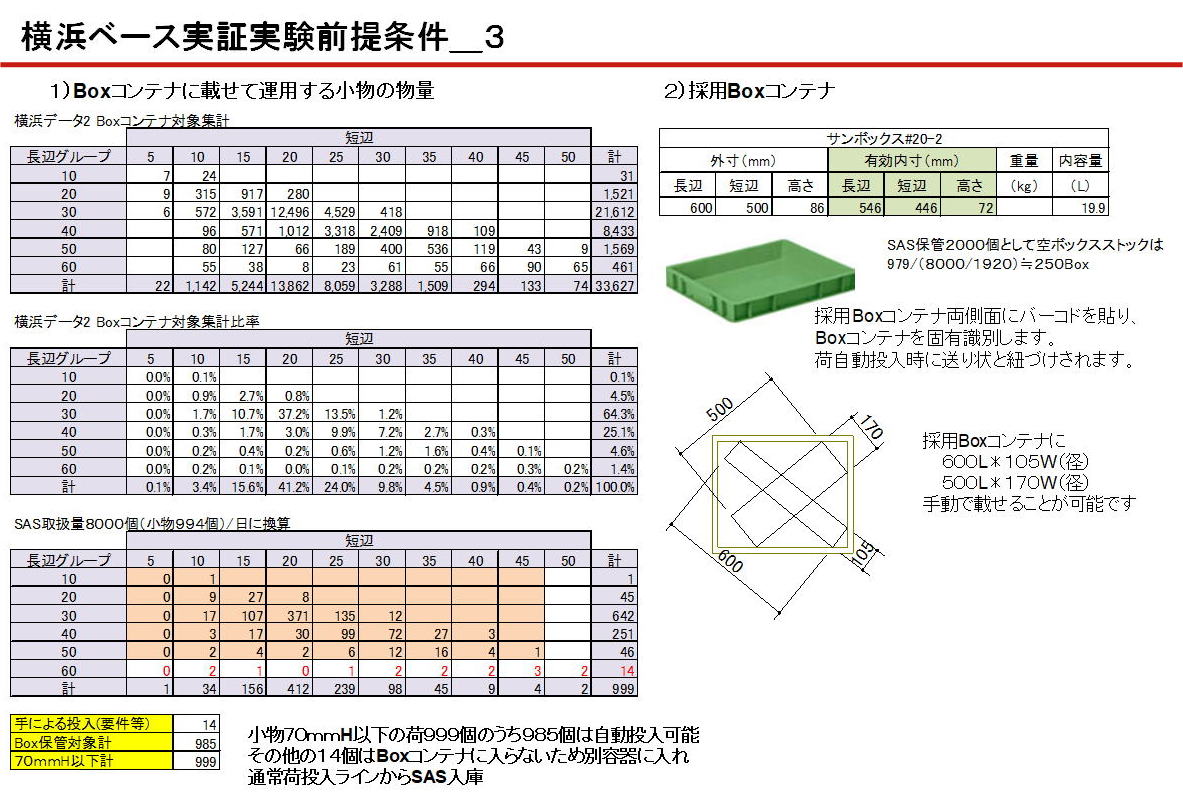
🔍 [Detailed explanation of illustration] Example of detailed data analysis in Box container selection
The figure shows detailed data analysis (quantification of STEP 1 in the scope of study) for actually operating small items in a Box container as a prerequisite for the Yokohama-based demonstration experiment.
- Matrix summary of physical quantities (left side):The "Yokohama Data 2 Box Container Target Tabulation" table cross-tabulates the quantity of small items by long side and short side size (groups of 5 mm to 50 mm or more), and visualizes the size distribution of a total of 33,627 items, including percentages.
- Selection of optimal container and barcode operation (right side):Based on the analysis data, we have selected "Sunbox #20-2 (external dimensions: long side 600 x short side 500 x height 86 mm, capacity 19.9 L)" as the optimal "adopted Box container". It also describes the system requirements for attaching barcodes to both sides of the adopted Box container and linking it to the invoice when loading automatically.
- Quantitative requirements definition for exception handling (bottom left):Based on the table of ``SAS handling amount of 8,000 items (999 small items)/day'', it has been determined that 985 of the 999 items with a height of 70 mm or less can be loaded automatically. On the other hand, it can be seen that the remaining 14 items cannot fit into the Box container, so they are placed in a separate container and entered into SAS from the normal loading line, which is a very specific operational requirement definition for exception handling.
4-1. 3 steps of construction process
Based on product characteristics and DATA analysis, we quantitatively predict the shipping characteristics of the new center from the shipping characteristics, functional requirements, and future forecasts.
We formulate multiple concrete plans and compare them with site constraints, investment budget, internal and external factors, and the knowledge of our 3PL/4PL partners.
We create a "Uniform Specification Form (RFP)" and request quotations from each manufacturer (buildings, equipment, operations, information systems) so that we can compare them under the same conditions.
💡 The most important principle in base development (inside-out)
"For the distribution center, decide on the logistics system first and then adjust it to the building specifications."
If the box (building) is built first, efficient material handling will be difficult due to column pitch and ceiling height.The golden rule is to design the contents (system/flow line) in advance and then create a box that encloses it.
5.Progress details and planning steps
This is a comprehensive roadmap that integrates the negotiation progress process (sales/technical role shift) and planned progress.
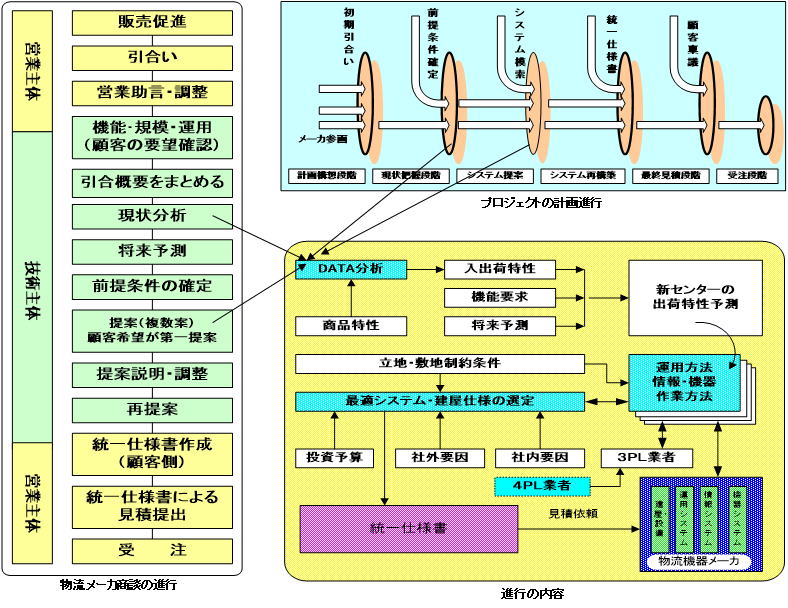
🔍 [Detailed explanation of illustrations] Comprehensive roadmap showing the link between sales and technology
This comprehensive roadmap is drawn by completely linking three axes: ``progress of logistics manufacturer business negotiations (on the left),'' ``project planning progress (top right),'' and ``content of progress (bottom right).'' This is a master plan that provides an overview of the entire project.
- Role shift by phase (left side):It shows a structure in which the steps in the negotiation process shift from ``sales-centered'' (inquiries and sales advice) in the early stage to ``technical-centered'' (current analysis, future forecasts, determination of prerequisites, and proposals) in the middle stage, and then once the final specifications are finalized, the initiative shifts to ``sales-centered (creation of unified specifications, submission of estimates, and order acceptance)'' again.
- Progress content and overall optimization puzzle (bottom right):This is the core of the project.First, we determine ``incoming and shipping characteristics,'' ``functional requirements,'' and ``future predictions'' from product characteristics and DATA analysis, and then integrate them to derive ``forecast shipping characteristics for the new center.'' Based on these predictions, we formulate "operation methods, information, equipment, and work methods."Furthermore, we comprehensively review location/site constraints, investment budget, internal and external factors, and requests for estimates from 3PL and 4PL companies (building equipment, operation systems, information systems, logistics equipment systems), and arrive at the "selection of the optimal system and building specifications." It covers the process of unraveling the complex puzzle for overall optimization, in which a "unified specification" that includes all of these is finally created.
5-1. Role shift in each phase
1. Early stage: Sales-based
Sales promotion ➔ Inquiry ➔ Sales advice/coordination.
Sales will act as a point of contact and identify issues and initial needs.
2. Middle stage: Technology-based
Analysis of current situation ➔ Future forecast ➔ Determination of prerequisites ➔ Proposal.
Engineers analyze the data and create a concrete system plan.
3. Late stage: Sales-based
Creation of unified specifications ➔ Submission of quotation ➔ Acceptance of orders.
After finalizing the specifications, we will make final adjustments and sign a contract.
6.Internal situation of the project team
This is an approach that changes the mindset from "conflict of opinions and confusion (scalar)" in the early stages of a project to "overall optimization (vector)" where everyone is heading in the same direction.
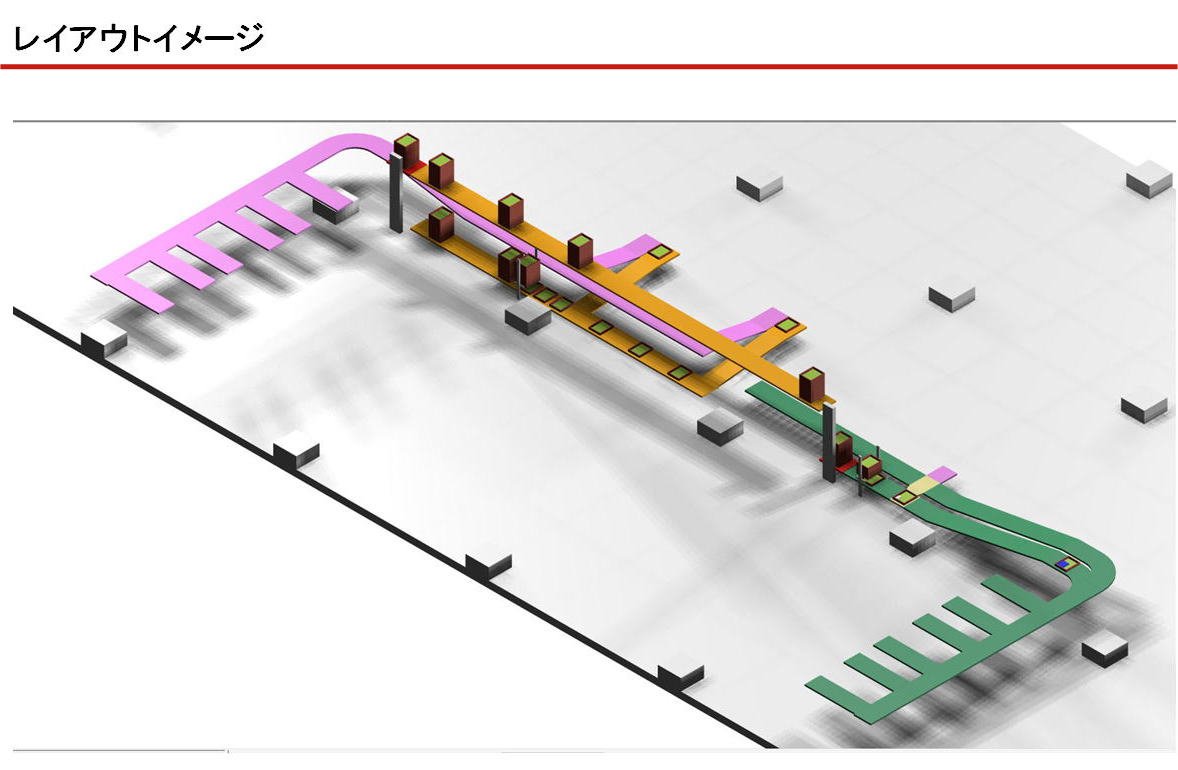
6-1. Transition from “scalar” to “vector”
| step | state (concept) | Features/Internal situation |
|---|---|---|
| early stage | scalar (Size only, orientation varies) |
-Each person makes different claims and is fixated on departmental profits (local optimization). |
| Promotion/unification | Organize, adjust, visualize | Organize and visualize information and make adjustments based on objective grounds. |
| Attainment stage | vector (There is a size and a clear direction) |
・Unification of purpose and means has been completed, and a shift has been made to "overall optimization." |
🔑 Requirements for vectorizing teams
“Objectivity that allows a third party to evaluate and the ability to express images is required.”
Quantitative logistics data (objectivity) and illustrations and 3D visualization (expressiveness) that allow everyone to share the mental image are the keys to consciousness integration.
7.Project creation materials (13 items of basic plan)
These are the 13 structural requirements of the "basic plan" that should be approved by management (approval) and included in the RFP for vendors.
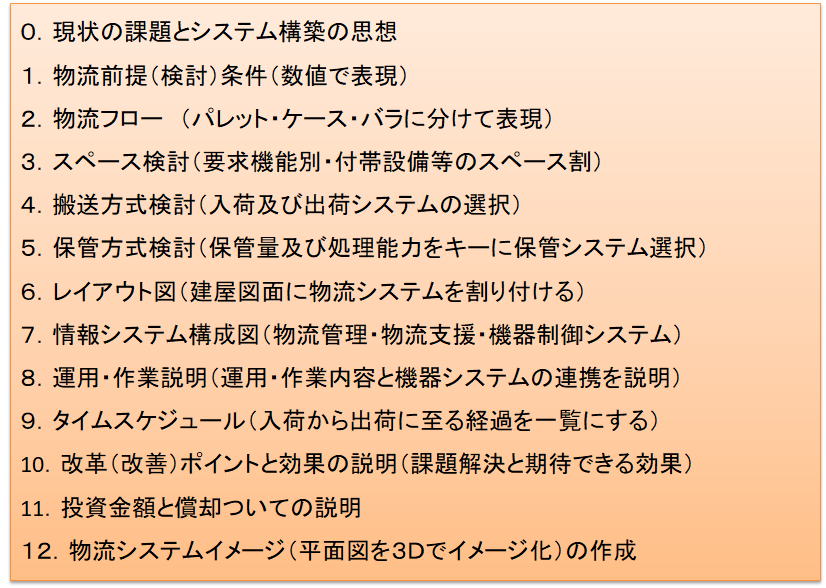
1. Philosophy and data basis
- 0. Current issues and system construction philosophy
- 1. Logistics assumptions (examination) conditions (numerical expression)
2. Physical design (hardware/space)
- 2. Logistics flow (pallet/case/bulk)
- 3. Space consideration (estimate of area by function)
- 4. Consideration of transportation method
- 5. Consideration of storage method
- 6. Layout diagram assignment
3. Operational design (system/site)
- 7. Information system configuration diagram (WMS/WCS, etc.)
- 8. Operation/work explanation
- 9. Time schedule
4. Decision making/effectiveness measurement
- 10. Reform (improvement) points and effect explanation
- 11. Investment amount and amortization (ROI)
- 12. 3D system image creation
📌 Practical summary
By having these 13 items in place, it will be possible to create a situation in which ``management can make investment decisions,'' ``the field can visualize the operation,'' and ``vendors can create accurate estimates.''