3-8. Key points of logistics facility planning: Consolidation of logistics bases (locations) and logistics trade-offs
In modern supply chains, optimalLogistics facility planningPlanning is one of the most important management tasks that affects a company's profit margin and competitiveness.In particular, we are focusing on how to reorganize distribution centers scattered across the country.Logistics base (location)” has the impact of fundamentally overturning the balance between a company's fixed costs and variable costs.
This chapter provides an example of a dynamic reorganization of a household goods company.Through this case study, we will discuss the effects of significant cost and personnel reductions that occur when consolidating bases (changing locations), and thelogistics tradeoffsWe will provide a deep explanation of the structure of ``(Antinomies)'' from a practical perspective.
1.Example of change in logistics base (location) at a daily goods company (macro perspective)
In the past, during the period of high economic growth, the correct answer was to ``locate detailed bases in locations closer to consumers.''However, one household goods company took a bold approach.Logistics facility planningBy reviewing theLogistics base (location)The decision was made to integrate.
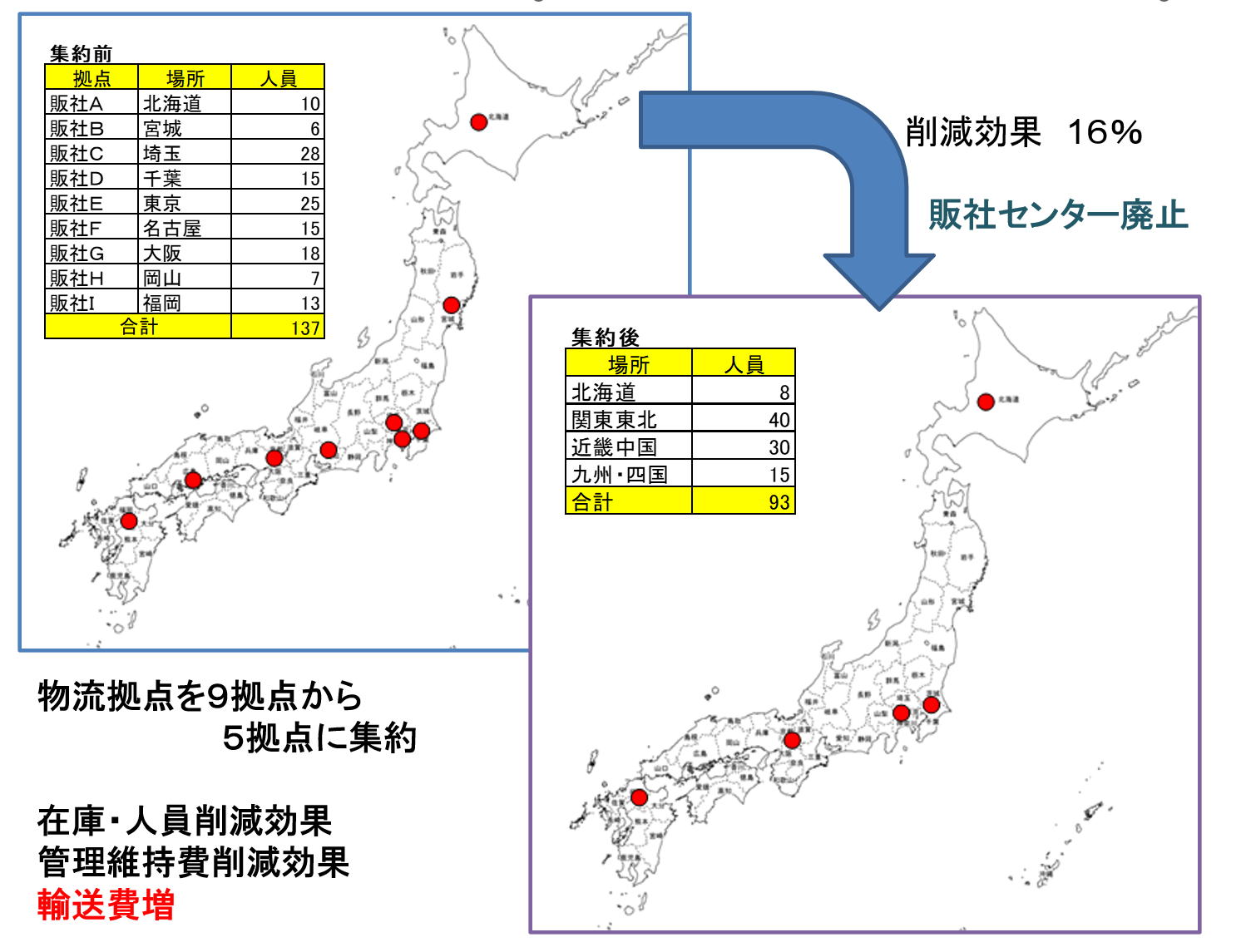
🔍 [Interpreting the diagram] Specific personnel allocation and reduction mechanisms before and after consolidation
A detailed analysis of the figures shown in the figure above and the changes on the map of Japan reveals that there is more than just a decline in numbers, there is a strategicLogistics base (location)The dynamism of reorganization is emerging.
[Excessive dispersion before consolidation (9 bases, 137 people in total)]
In the past, sales company centers were located in detail according to consumption areas throughout Japan.The Kanto area is particularly noteworthy.Saitama (28 people), Chiba (15 people), Tokyo (25 people)There are three bases in close proximity, and the Kanto region alone has an extremely large number of bases.Total 68 peopleThe company was in an inefficient situation, with a large number of staff and safety inventory and management and maintenance costs significantly duplicating.In addition, nine red dots were scattered across the country: Hokkaido (10 people), Miyagi (6 people), Nagoya (15 people), Osaka (18 people), Okayama (7 people), and Fukuoka (13 people).
[Create a wide-area hub after consolidation (5 bases, 93 people in total)]
We have taken the plunge and abolished unnecessary sales company centers and largely integrated our logistics network into five wide-area blocks.The red dots on the map are organized into five locations: Hokkaido, Tohoku, Kanto, Kansai, and Kyushu.
In the Kanto-Tohoku area, which was particularly overcrowded, the four bases of Miyagi, Saitama, Chiba, and Tokyo were integrated.40 peoplehas been significantly slimmed down.In addition, by establishing a base in the center of each block, such as the "Kinki Chugoku Area (Nagoya, Osaka, Okayama combined, 30 people)",44 staff reductions (approximately 32%) across the companyIt creates a strong impact.
As shown in the lower left of the diagram, this consolidation had the side effect of ``increased transportation costs (deficit)'', but it far outweighed this by ``reducing inventory and personnel'' and ``reducing management and maintenance costs,'' ultimately resulting in a ``16% total cost reduction effect.'' This isLogistics facility planningIt is the essence of
Dramatic changes in number of locations and personnel
- Before consolidation (9 bases):We have a detailed network of sales company centers in nine locations nationwide.Logistics base (location)were distributed in a distributed manner.
➔Total personnel: 137 people - After consolidation (5 bases):We have redefined area boundaries and consolidated into large hub locations that cover a wide area.
➔Total personnel: 93 people(44 people / approximately 32% reduction in personnel)
Total cost reduction effect on management
Total logistics cost reduction effect: 16% reduction
Reducing the number of locations resulted in the disadvantage of increased delivery costs (freight), which will be discussed later.However, due to economies of scale that far exceeded this, we were able to reduce fixed costs, personnel, and safety stock, and achieved a significant reduction (16% reduction) in logistics costs for the entire company.
2.Explanation of structure (“logistics trade-off” in logistics)
advancedLogistics facility planningWhen planning a project, one thing you are always faced with is, ``If I stand up, I won't stand.''logistics tradeoffsThis is the dilemma.Let's break down the contradictory structure of ``cost reductions'' and ``increased costs'' that occur when consolidating bases (9 bases ➔ 5 bases).
🔻 Factors that reduce costs (benefits)
- Inventory reduction:The unnecessary duplication of safety stock held at each location will be completely eliminated, and the total inventory amount for the entire company will be dramatically reduced.
- Headcount reduction:This eliminates the duplication of workers who pick on-site and managers who coordinate each location, improving productivity (reduced from 137 people to 93 in the case study).
- Reduced management and maintenance costs:Multiple warehouse rents (ground rent), utility costs, material handling equipment costs, and system maintenance costs such as WMS are significantly reduced.
🔺 Factors that increase costs (disadvantages)
- Increase in transportation costs: Logistics base (location)Reducing the number of products means that the "physical last mile distance" from each location to the final delivery destination (store or private home) will increase.As a result, truck delivery fees (transportation costs, gasoline costs, and driver labor costs) will definitely increase.
3.Insights from this case study (Summary of key points in logistics facility planning)
From this example of a household goods company, we canLogistics facility planningThe key insights to learn can be summarized in two points:
- A strategy to control “logistics trade-offs” and win in “total cost” even if transportation costs increase
Reducing the number of bases increases the delivery distance, so transportation costs will inevitably increase.logistics tradeoffsis an absolute law.However, modernLogistics facility planningTherefore, transportation costs alone should not be evaluated.The key to success is whether or not you can reduce inventory, personnel, and management and maintenance costs on a scale that outweighs the increasing transportation costs, and in this case we were able to successfully reduce costs by 16% overall (win in total costs).
- Macro shift from “small decentralized bases” to “wide area hub bases”
By abolishing the sales company centers that were previously located in each prefecture and consolidating them into wide-area hubs for each area, we are aiming to improve the efficiency of base operations and achieve a high level of standardization (introducing automated equipment, etc.).Macro logistics reorganization modelis.newLogistics base (location)requires a prime location that can withstand wide-area delivery, such as being close to an expressway interchange.