3-5. B2B, B2C, and C2C Differences in Logistics Facility Planning
In modern commerce, B2B (Business to Business), B2C (Business to Consumer), and C2C (Consumer to Consumer) represent fundamental operational differences that extend far beyond whether end buyers are corporate entities or individuals.
These three transaction models differ fundamentally in handled lot sizes, delivery velocity, packaging quality standards, and underlying warehouse fulfillment architectures. Consequently, executing sound logistics facility planning requires completely distinct approaches to equipment selection and footprint calculation depending on the targeted business model.
Driven by higher profit margins, many manufacturers and wholesalers are rapidly transitioning from traditional B2B wholesale to B2C (specifically D2C: Direct to Consumer), making structural warehouse transformations an urgent priority.
1. Structural Operational Differences Across Business Models
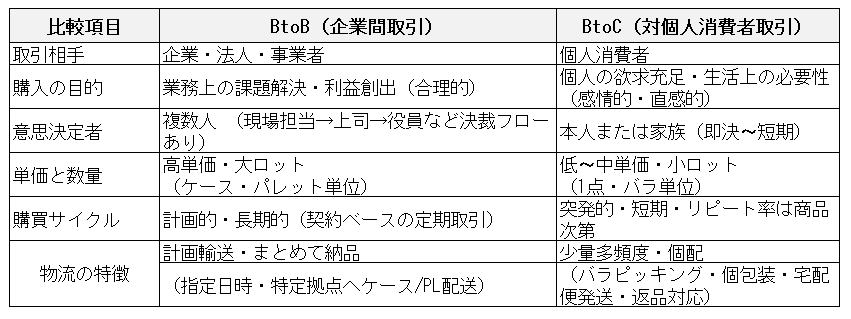
① B2B (Business-to-Business) Logistics Characteristics
B2B logistics focuses on bulk shipments moving from factories to wholesaler depots or retailer backrooms. Transactions involve large financial values and bulk unit loads (full pallet or master case quantities).
In logistics facility planning, heavy truck traffic demands wide dock berths and wide forklift traffic aisles. Because order fulfillment centers on full-case or pallet picking, large automated systems like Pallet AS/RS and high-speed sorters deliver exceptional return on investment.
② B2C (Business-to-Consumer) Logistics Characteristics
B2C fulfillment (e-commerce) centres on last-mile parcel delivery directly to individual households. Orders consist of extremely small piece quantities (1–2 items per order) spread across massive order volumes.
In logistics facility planning, operations require extensive piece-picking zones (pick-to-light, optimal walking paths) and spacious packing/inspection stations for gift wrapping or promotional inserts. Merging small-piece B2C workflows into a bulk-handling B2B facility creates severe aisle congestion and collapses operational throughput.
③ C2C (Consumer-to-Consumer) Logistics Characteristics
C2C models represent consumer platform exchanges (C2C marketplaces, online auctions). Platform providers do not hold physical inventory; logistics relies on parcel carriers executing highly dispersed pickup and delivery across residential networks.
2. Key Manufacturing Industries Transitioning from B2B to B2C (D2C)
Manufacturers traditionally selling full cases through B2B wholesale channels are increasingly launching direct 1-piece B2C / D2C sales via branded e-commerce sites or online marketplaces:
-
Apparel, Textile & Garment Manufacturers
Shift & Challenge: Transitioning from OEM manufacturing and bulk brand wholesale to direct-to-consumer online sales. Warehouse facilities must adapt from store-bound bulk carton shipping to item-level piece picking, re-folding, and returns processing.
-
Food, Beverage & Agricultural Producers
Shift & Challenge: Expanding from bulk supermarket supply to direct online subscriptions, farm-direct sales, and premium bundles. Requires multi-temperature (ambient, chilled, frozen) piece packaging and strict FIFO expiration date management for parcel delivery.
-
Consumer Goods & Household Product Brands
Shift & Challenge: Supplementing big-box retail distribution with direct online sales. Requires scalable fulfillment architectures built to absorb massive promotional order spikes (e.g., Cyber Monday sales events).
-
Precision Appliances, Cookware & Furniture Manufacturers
Shift & Challenge: Adapting commercial-grade equipment designs into premium consumer products sold directly online (often seeded via crowdfunding). Demands protective individual parcel packaging and rapid spare parts fulfillment.
-
Printing, Novelty & Specialty Packaging Industries
Shift & Challenge: Shifting from bulk corporate print runs to web-to-print on-demand custom goods and single-unit novelties. Demands precise digital tracking systems to ensure error-free individual parcel delivery.
3. Core Drivers Behind the Manufacturer D2C Shift
① Higher Gross Margins & Pricing Control
Eliminating wholesale and retail intermediary markups allows brands to capture full retail margins while retaining complete control over promotional pricing.
② Explosion of Turnkey E-Commerce Platforms
SaaS platforms (Shopify, BASE) allow brands to launch global e-commerce storefronts within days without massive custom software investments.
③ Direct First-Party Customer Data Capture
Capturing buyer demographics, geographic data, and feedback directly enables rapid, agile product iteration and targeted lifecycle marketing.
④ Growth of Direct Social & Digital Marketing
Social media channels (Instagram, X, TikTok) allow brands to communicate brand origin stories directly, building loyal brand communities at low customer acquisition costs.
⑤ Maturity of E-Commerce 3PL Fulfillment Services
Turnkey e-commerce 3PL providers handle piece-picking, gift packaging, and end-to-end parcel fulfillment, allowing manufacturers to focus on product creation and brand marketing.
When traditional B2B manufacturers enter B2C (D2C) markets, the primary operational points of failure are "building 1-piece picking and packing fulfillment workflows" and "managing individual consumer customer service (returns, order edits)."
Attempting piece-picking in the corner of a bulk pallet warehouse using manual labor rapidly collapses operational throughput and causes mis-shipments that damage brand reputation. B2B and B2C fulfillment architectures are fundamentally incompatible. Sound logistics facility planning requires establishing dedicated B2C operational zones or outsourcing e-commerce fulfillment to specialized 3PL partners.
💡 Special Feature: Fundamental Operational Differences in B2B, B2C, and C2C Fulfillment
Different commercial flows dictate completely distinct material handling strategies within distribution centers. Successful logistics facility planning requires tailored operational workflows designed specifically for the target business model:
🏢 B2B (Business to Business)
■ Order Profile & Load Units:
Bulk unit movements (full pallets, master cartons). Large order volumes with scheduled delivery dates.
■ Primary Equipment Focus:
Forklifts, Pallet AS/RS, palletizers, and heavy-duty material handling machinery for bulk movement.
■ Facility Planning Priority:
Expansive truck docks and wide forklift travel aisles engineered for heavy vehicle turning radiuses.
🛍️ B2C (Business to Consumer)
■ Order Profile & Load Units:
Micro-lot piece picking (1–2 items per order) across high order volumes with severe promotional order spikes.
■ Primary Equipment Focus:
Picking carts, Digital Assort Systems (DAS), automated carton sealers, and piece-picking robotics.
■ Facility Planning Priority:
Spacious packing, inspection, gift-wrapping, and value-added processing stations supported by flexible labor areas.
📦 C2C (Consumer to Consumer)
■ Order Profile & Load Units:
Non-standard individual packages moving through consumer platforms. Highly unpredictable pickup locations and timing.
■ Primary Equipment Focus:
Cross-dock parcel sorting terminals operated by courier networks (Yamato, Japan Post); platforms hold zero inventory.
■ Facility Planning Priority:
Zero long-term storage required. Designed exclusively for ultra-high-speed barcode/vision scanning and automated parcel sorting.