3-4. Evolution from 1PL/2PL to 3PL & Next-Gen "Collaborative Logistics"
In modern corporate management, maintaining increasingly complex supply chains using purely internal corporate resources has become extremely difficult. Therefore, formulating state-of-the-art logistics facility planning begins by establishing an outsourcing strategy—deciding which assets to own internally vs. delegate to specialized external partners.
This chapter traces the evolutionary history of logistics outsourcing from internal 1PL/2PL models to 3PL, examining the emerging industry imperative of "Collaborative Logistics" and its transformative impact on logistics facility planning.
1. Understanding 1PL, 2PL, 3PL, and 4PL Outsourcing Models
Logistics operational models have evolved progressively from 1PL to 3PL and 4PL, differing in system ownership, technology integration, and scope of operational responsibility.
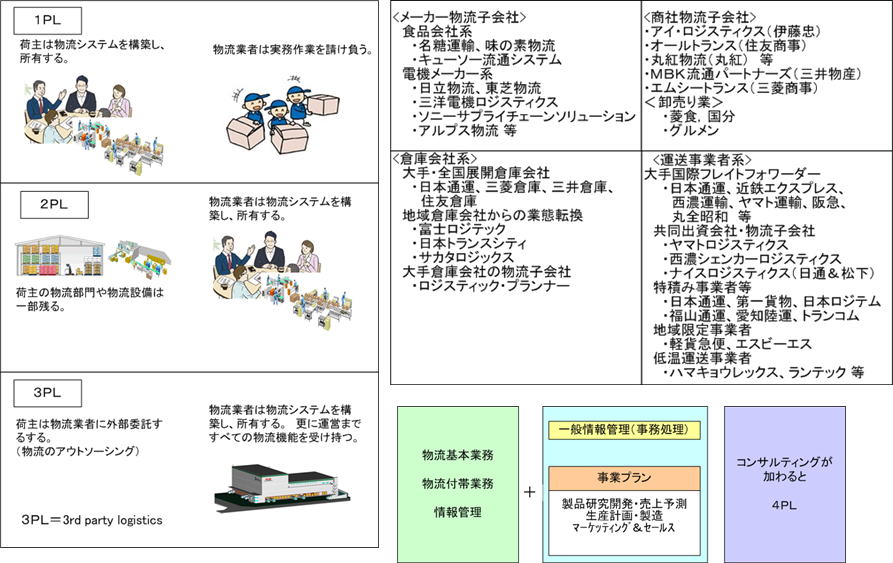
■ 1PL (First-Party Logistics / In-House Logistics)
Structure: The shipper (manufacturer, wholesaler, or retailer) finances, constructs, and owns its entire internal logistics infrastructure and warehousing systems. External carriers are contracted purely for basic physical transport execution (truck hauling).
Challenges: While accumulating proprietary operational know-how, owning large-scale distribution centers creates heavy fixed depreciation burdens. In-house fleets struggle to flex during volume spikes and seasonal demand swings, creating operational rigidity.
■ 2PL (Second-Party Logistics)
Structure: Logistics service providers (warehouse operators, carriers) invest in and own core transport assets and physical warehousing. However, overall supply chain planning remains within the shipper's internal logistics department.
Challenges: Operational boundaries between shipper and provider overlap, creating fragmented system integration and blurred operational accountability.
■ 3PL (Third-Party Logistics / Full Logistics Outsourcing)
Structure: The prevailing modern supply chain model. Shippers downsize or eliminate internal logistics departments, fully outsourcing end-to-end logistics operations to a 3PL provider. The 3PL provider designs, manages, and operates customized logistics networks, handling daily warehouse management and transport dispatch.
Benefits: Removes massive warehouse fixed assets from balance sheets (off-balance-sheet management), allowing corporations to refocus capital on core product development and sales. In new logistics facility planning, leveraging a 3PL provider's expertise enables rapid deployment of automated, high-throughput distribution centers.
💡 Next-Gen "4PL" Model
4PL expands beyond traditional 3PL execution (warehousing, fulfillment, transport IT) to integrate strategic supply chain consulting—overseeing upstream product R&D forecasting, manufacturing scheduling, sales/marketing alignment, and global IT integration as a lead strategic partner.
2. Diverse Industry Origins of 3PL Providers
3PL providers possess distinct core strengths depending on their parent industry origins:
- Manufacturer Logistics Subsidiaries: Specialized in parent-company product characteristics. Includes food/beverage-centric subsidiaries (Meito Transportation, Ajinomoto Logistics, Kewpie/QSO) and electronics/machinery subsidiaries (Hitachi Transport System/LOGISTEED, Toshiba Logistics, Alps Logistics).
- Trading Company & Wholesaler Subsidiaries: Possess extensive global supply chain trade networks. Includes trading house logistics arms (I-Logistics/Itochu, Sumitomo Global Logistics, Marubeni Logistics, Mitsui & Co. Logistics) and wholesale distribution networks.
- Warehouse Operator Origins: Leverages heavy physical asset foundations (racks, multi-tenant hubs). Includes major warehouse groups (Nippon Express, Mitsubishi Logistics, Mitsui-Soko, Sumitomo Warehouse) and regional asset operators.
- Carrying & Express Freight Lineage: Built upon nationwide surface transport fleets. Includes international freight forwarders and linehaul carriers (Nippon Express, Kintetsu World Express, Seino Transportation, Yamato Transport, Fukuyama Transporting).
3. Maximizing Efficiency via "Collaborative Logistics"
While 3PL adoption improved individual firm efficiency, industry-wide driver shortages and net-zero carbon mandates cannot be solved by single companies alone. This has driven the industry-wide adoption of "Collaborative Logistics (Joint Delivery Systems)".
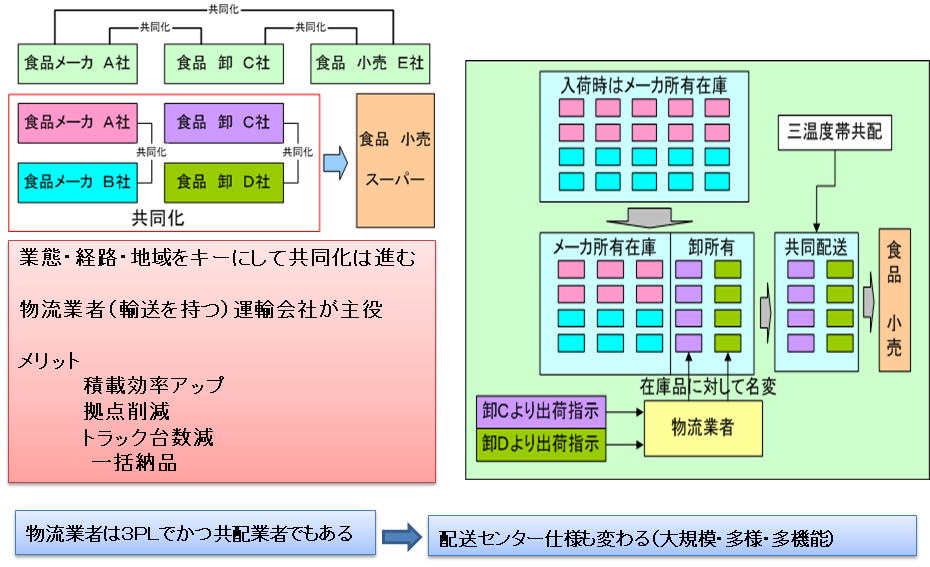
■ Breaking Industry Silos via Shared Logistics Systems
In traditional logistics, individual manufacturers and wholesalers dispatch partially loaded trucks directly to retail stores, creating severe dock congestion, long driver waiting times, and low fill rates.
Collaborative Logistics consolidates cargo from multiple competing manufacturers and wholesalers into a single shared distribution hub based on geography, route, and product category. Combined shipments are delivered to retail stores on shared consolidated trucks.
■ Asset-Based Logistics Providers as Collaborative Anchor Operators
Orchestrating complex multi-stakeholder operations requires asset-based 3PL providers that own physical truck networks and distribution hubs. Acting as "Lead Collaborative Operators," they manage shared IT architectures, inventory transfers, and joint dispatch schedules.
4. Core Benefits & Inventory Title Workflows in Collaborative Facilities
■ Four Primary Advantages of Collaborative Logistics
- 1. Maximized Load Factors: Combining multi-shipper freight fills truck cubic capacity, eliminating empty space and maximizing transport efficiency.
- 2. Warehouse Network Consolidation: Eliminates redundant small regional depots by consolidating inventory into a single large-scale collaborative distribution center, drastically lowering overall fixed holding costs.
- 3. Reduced Truck Traffic & Emissions: Fewer total trucks on public roads directly mitigates driver shortage constraints and slashes carbon emissions (GX / Green Transformation).
- 4. Streamlined Retail Receiving: Retailers receive consolidated deliveries from a single truck instead of multiple separate arrivals, eliminating receiving dock bottlenecks and labor costs.
■ Title Transfer & Inventory Workflows Within Collaborative Hubs
Inside a shared collaborative distribution center, physical cargo handling operates in parallel with real-time digital title transfers:
- Inbound Receiving: Goods arriving at the collaborative hub remain legally classified as "Manufacturer-Owned Inventory."
- Title Transfer (Bookkeeping Shift): Upon receiving digital shipping orders from wholesalers, system records instantly execute a title transfer ("Name-Change") from manufacturer stock to "Wholesaler-Owned Inventory" without physical relocation.
- Joint Picking & Multi-Temperature Dispatch: Orders bound for shared retail stores are batch-picked and consolidated onto multi-temperature trucks (ambient, chilled, frozen) for unified store delivery.
💡 Impact on Next-Generation Logistics Facility Planning
As 3PL providers evolve into collaborative network operators, distribution facility specifications undergo a paradigm shift. Modern logistics facility planning must design "Large-Scale, Multi-Tenant, Multi-Temperature" distribution hubs built to process multi-shipper freight and data concurrently.