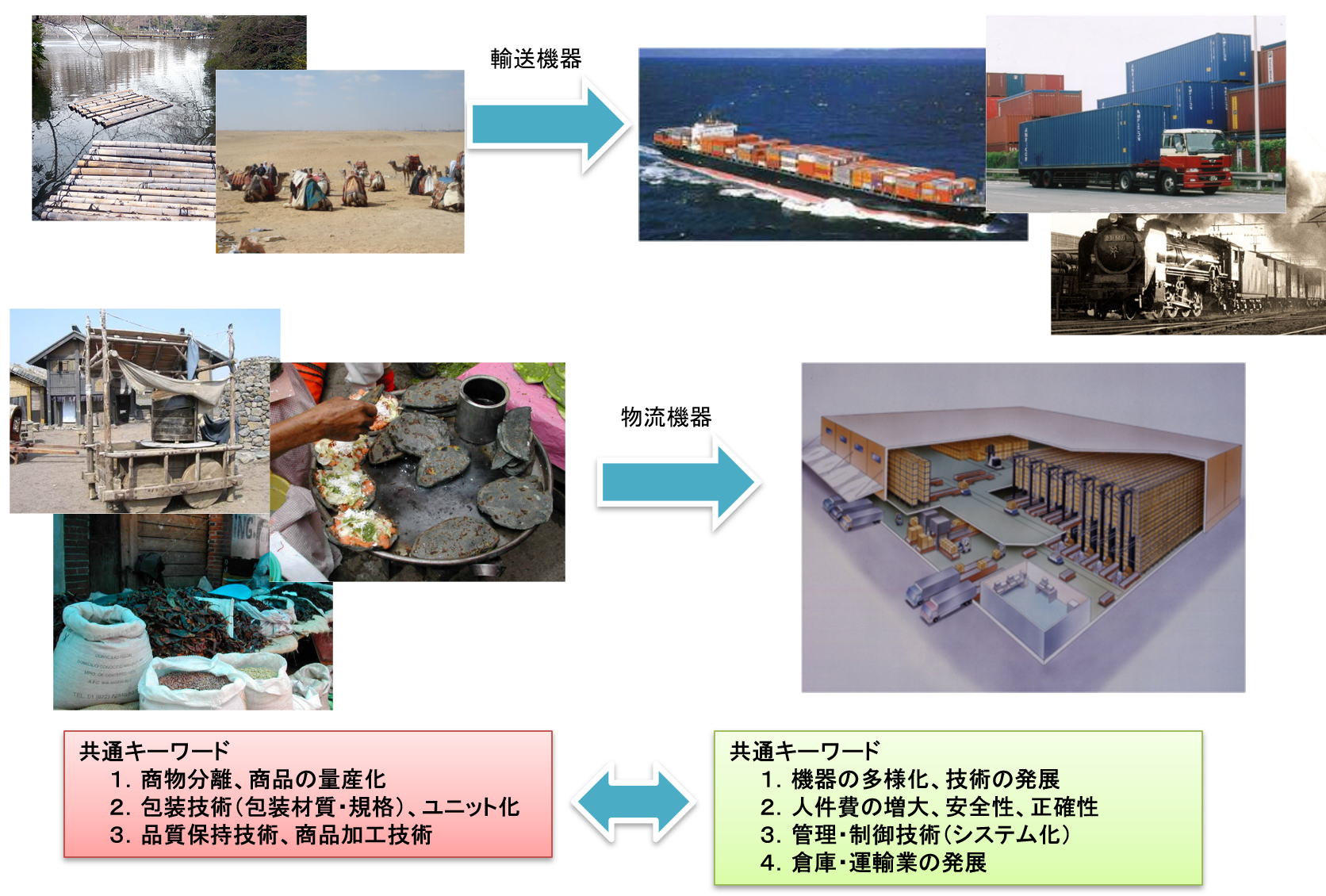
Unraveling the history of logistics, we can see that from ancient times to the present day, humanity has continuously tackled the major challenge of how to transport goods efficiently. In ancient times, logistics relied on hand delivery by people, livestock (such as horses and camels), or small boats, and the transport volume was extremely limited. Reaching a destination took enormous amounts of time—often measured in months—and was constantly exposed to climate and security risks. However, in modern times, with the dramatic evolution of transportation equipment such as large trucks, huge container ships, and aircraft, the transport volume has increased dramatically beyond comparison with ancient times, and transport time has been drastically reduced.
Furthermore, the decisive difference between ancient and modern logistics lies in the "evolution of containers" and the "capture and control of transport volume." Ancient containers were mostly irregularly shaped items unsuitable for stacking, such as hemp sacks, pots, and wooden boxes. In contrast, modern logistics has standardized "containers that maintain a cubic shape and can be stacked regularly," such as cardboard boxes and plastic containers (placons) premised on palletization. The emergence of this "standardized cube" made it possible to maintain a constant cargo shape, which became the strongest driving force behind the development of labor-saving and mechanization, such as automated transport by conveyors and automated storage and retrieval systems (AS/RS).
Moreover, modern logistics networks are not merely aimed at transporting "faster and in larger quantities." Key priorities include accurately grasping (capturing) massive volumes with systems (such as WMS), "high-level quality maintenance" to protect products from vibration and temperature changes during transport, and "strict assurance of safety" to guarantee the peace of mind of personnel involved in operational management and society as a whole. The precise combination of points (highly automated logistics facilities) and lines (safe and optimized transport routes) constitutes today's advanced logistics networks.
In this work, we will provide a more practical and detailed explanation of the volume calculation and facility scale calculation (Tera calculation) for "distribution centers (logistics facilities)" that handle incoming goods packaged in standardized cardboard cases and support store deliveries and mail-order shipments.
Commercial flow (the flow of commercial transactions) refers to all commerce activities that provide products from supply (producers or manufacturers) to demand (consumers or end-users), transfer their ownership, and collect payment. This includes the "movement of information and rights" such as contracts, ordering, and settlement. On the other hand, logistics (physical flow) is the essential operational force to complete commerce, referring to "all operations that actually physically handle products," such as product transportation, storage, sorting, distribution processing, packaging, and delivery.
When consumers choose a company among products with the same value and price, the final deciding factor for purchase is "how fast, accurately, and without damage the product is delivered while maintaining quality after ordering (logistics superiority)." Therefore, in modern business, logistics is not merely a cost center but is positioned as a critical corporate strategy (profit center) that drives sales. Furthermore, in response to severe labor shortages, correction of long working hours, and environmental issues such as CO2 emission reduction (ESG compliance), labor-saving and automation (introduction of robots, AI-based route optimization, use of AGVs, etc.) are progressing at an unprecedented speed today.
Logistics is broadly categorized into the following segments based on the flow direction of goods and the industry phase involved. The required lead times and quality standards for logistics facilities vary significantly across these areas.
This is the "forward-moving" logistics from raw materials becoming final products until they reach the consumer's hands.
This is the logistics where products that have been consumed or remained unsold "flow backward," and is viewed as extremely important in a circular economy.
With the explosive expansion of electronic commerce due to the widespread use of the internet and smartphones, EC logistics such as BtoB (business-to-business), BtoC (business-to-consumer), and even CtoC (consumer-to-consumer) via flea market apps are rapidly growing. Optimizing "last-mile delivery" to individual homes has become the biggest challenge, making advanced information systems like WMS indispensable. Furthermore, the enhancement of logistics outsourcing (3PL: Third-Party Logistics) services has enabled emerging businesses without their own logistics facility functions (like warehouses and trucks) to easily develop large-scale commerce.
In the history of logistics, the development of larger and faster transportation equipment (trucks and ships) is in an inseparable, interdependent relationship with the advancement of transport containers supporting it (the evolution from hemp sacks, barrels, and wooden boxes to modern pallets, cardboard, and resin containers).
The establishment of the "Unit Load System" can be called a revolution in the logistics industry. By optimizing (module calculation) the length, width, and height dimensions of cardboard to fit standard pallets (e.g., Type 11 in Japan) or truck bed dimensions without waste, dead space is eliminated, dramatically improving loading and cargo handling efficiency, thereby realizing massive labor-saving. This made bulk transport by forklifts possible.
Cardboard is cheap and lightweight, but it has the weakness of easily collapsing and becoming unstable in shape when the contents decrease during piece picking. Foldable resin containers (Oricon) or placons compensate for this. Being sturdy and retaining their shape, they enable extremely stable automated operational management on automated transport machines (conveyors, etc.) using sensors, barcodes, and RFID, as well as in automated warehouses. Furthermore, because they are reusable, they contribute to reducing environmental impact.
Modern advanced logistics facilities (distribution centers) function not merely as "places to put things," but as giant information processing factories. Mainly, the following three systems operate in close coordination.
Known as a Warehouse Management System (WMS). It receives scheduled receipt and shipping instruction data in real-time from the upper host (corporate core systems or ERP), and immediately feeds back confirmed data once the on-site operational management is completed. It performs strict centralized management by SKU (Stock Keeping Unit: per expiration date, manufacturing lot, color, size) to ensure inventory visibility and traceability.
This includes hardware such as storage racks, automated storage and retrieval systems (AS/RS), high-speed transport conveyors, direction-based sorting sorters, and picking systems using voice or lamps. Recently, WCS (Warehouse Control System) has been introduced to comprehensively control these, managing traffic so that each device coordinates smoothly without congestion, thereby promoting labor-saving.
No matter how excellent the hardware and WMS are, managing the humans operating them is indispensable. It is a human and organizational management method where administrators properly arrange workers (pickers and forklift operators), sequence tasks, and detect progress delays in real-time (KPI management) to eliminate bottlenecks and reliably secure the planned operational management (throughput).
As labor shortages become severe, investments to reduce "reliance on people" in operating logistics facilities are unavoidable. However, blind implementation leads to overinvestment, so a precise study through the following steps is required.
When launching a new logistics facility from scratch or executing a large-scale renewal, haphazard layout design invites fatal failure. Stepping through the following 10 phases systematically is a requisite for project success.
We explain specific analysis methods and the thought process of operational management when designing layouts and systems inside logistics facilities in actual field operations.
Ideally, the movement of goods within the center should follow a continuous stroke without backtracking.
Receiving Berth (Truck docking/unloading) ➔ Receiving Inspection (Strict verification of quantity and exterior quality using handy terminals, etc.) ➔ Storage Area (Storage in AS/RS or fixed racks, management by free location, etc.) ➔ Retrieval/Replenishment (Bulk allocation in pallet/case units, or replenishment to flow racks for piece picking) ➔ Picking/Sorting (Digital picking, direction-based sorter, or assorting to roll box pallets) ➔ Shipping Inspection (Weight or image inspection) & Storage by Shipping Direction ➔ Shipping Berth (Loading/Dispatch)
Quantitatively analyze the form in which the handled cargo currently moves. This is a method to accurately discern the volumes and ratios of cargo in the states of P (Pallet: large-volume movement in pallet units), C (Case: medium-volume movement in case units), and B (Bara/Piece: small-lot movement in piece units), and assigning the most efficient material handling equipment and operational management to each (e.g., forklifts and automated warehouses for P, picking carts or shutter assorting for B). Tools like Tera Calculation 1 extract and aggregate C and B quantities from EIQ analysis data, logically leading to optimal storage equipment selection and area calculation.
💡 Item 3: Considerations on System Design (Trial & Error and Pursuit of Optimal Solutions)
In logistics system design, there is no "one and only correct answer common to all companies." Therefore, a process of repeating "trial and error" by creating multiple layout plans and comparing them through desktop simulations to brush them up is essential.
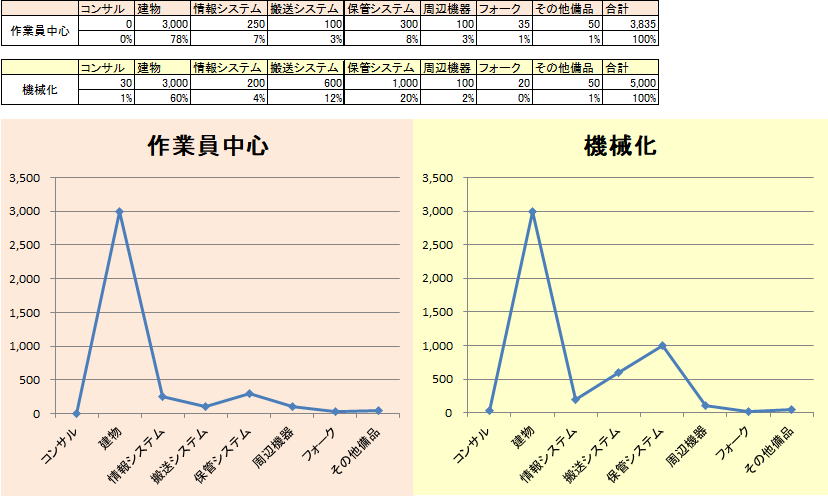
For example, it is crucial to compare a standard "fixed pallet rack + manual work with forklifts (Plan 1)" with a cheap initial investment, against labor-saving by "introducing electric mobile pallet racks / automated warehouse systems (Plan 2)" with a high initial investment but drastic labor cost reductions, to derive the layout that offers the most superior return on investment (labor reduction costs vs. equipment investment and maintenance costs) over a span of several years (the optimal solution for the company).
Furthermore, no matter how superior in efficiency and cost, "Safety First (compliance with laws like the Fire Service Act and Industrial Safety and Health Act, clearing internal safety standards)" and "Maintenance of the Work Environment (reducing physical burden on workers = ergonomics, maintaining hygiene and product quality through proper temperature/humidity control)" on-site must never be sacrificed. A sustainable logistics facility system design is only achieved when these are secured.