3-4.1 Changes in PL, 2PL, and 3PL and the next generation of “shared logistics”
In modern business management, it has become extremely difficult to maintain increasingly complex supply chains using only one company's resources.Therefore, the latestLogistics facility planningWhen planning a project, the first step in a project is to decide how much equipment to own and how much to outsource to external specialized companies (outsourcing strategy).
This chapter starts with in-house logistics.1PL/2PL/3PLWe will unravel the history of the evolution of outsourcing, and further explain how it is currently becoming the most important issue in the logistics industry."Sharing logistics"How does it work and how does it work?Logistics facility planningUsing illustrations, we will thoroughly explain the impact on
Section 1 What is 1PL, 2PL, and 3PL (forms of logistics outsourcing)?
Depending on how a company operates its logistics operations and to whom it is outsourced, the form of logistics has largely evolved from ``1PL'' to ``3PL'' to ``4PL.''For each type, the person responsible for building the system and the scope of responsibility for the work differ.
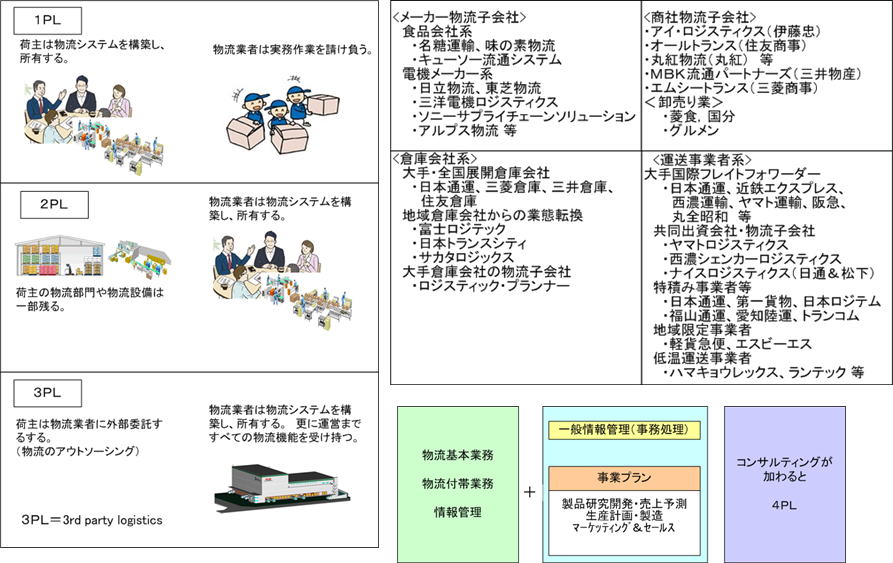
■ 1PL (first party logistics / in-house logistics)
form:This is the most traditional form in which shippers (companies themselves such as manufacturers and retailers) construct and own logistics systems such as warehouses using their own capital.Logistics companies (such as transportation companies) will only undertake "practical work (such as transportation by truck)" under the established system.
assignment:While there is the advantage of being able to accumulate unique know-how, the fixed costs (depreciation costs) of building and maintaining a huge warehouse in-house put pressure on management.In addition, it is difficult to respond flexibly to fluctuations in volume (differences between off-peak and busy seasons), which is increasingly becoming a burden in today's fast-paced business development.
■ 2PL (Second Party Logistics)
form:Going one step further from 1PL, this is a form in which logistics companies (warehousing companies and transportation companies) use their own funds to construct and own logistics systems such as warehouses.However, this does not mean that the entire system is outsourced, and the shipping company's logistics department and some logistics facilities remain in-house.
assignment:Business areas tend to overlap between shippers and logistics companies, and systems and responsibilities tend to become unclear.It can be said to be a transitional model.
■ 3PL (Third Party Logistics/Complete Outsourcing of Logistics)
form:This is the current mainstream model.Shippers are reducing or abolishing their own logistics departments and hiring logistics companies (3PLWe comprehensively outsource all logistics to a provider.3PLBusinesses not only build and own the optimal logistics system themselves, but also take over all logistics functions from day-to-day center operations to transportation and delivery management.
merit:Since shippers do not need to have huge fixed assets such as warehouses (off-balance sheet), they can focus their freed-up management resources on their core business (product development and sales).Launch a new baseLogistics facility planningEven in3PLBy leveraging the specialized know-how of our contractors, we can quickly build advanced centers equipped with the latest automation equipment.
💡 What is “4PL” that will further evolve?
3PLIn addition to "basic logistics operations," "ancillary logistics operations," and "information management," which are provided byConsulting functionThe form in which ``4PL'' is added is called ``4PL.''We are the ultimate partner who leads the optimization of the entire supply chain from the same perspective as management.
Section 2 Diverse origins and classifications of 3PL operators
in one word3PLHaving said that, the fields in which a company excels will differ depending on what kind of business it originally developed from (origin).
- Manufacturer logistics subsidiary:We have know-how specialized in the characteristics of our parent company's products.There are food companies (Meito Transport, Ajinomoto Logistics, Kyuso Distribution System, etc.) and electronics manufacturers (Hitachi Transport System, Toshiba Logistics, Sanyo Electric Logistics, Sony Supply Chain Solutions, Alps Logistics, etc.).
- Trading company/wholesale logistics subsidiary system:Our strength is our extensive network connected to global commercial distribution.These include i-Logistics (Itochu), Alltrans (Sumitomo Corporation), Marubeni Logistics, MBK Ryutsu Partners (Mitsui & Co.), MC Trans (Mitsubishi Corporation), and wholesaler-based companies such as Ryoshoku, Kokubu, and Gourmen.
- Warehouse company:We are good at making proposals based on strong storage facilities (assets).These include major companies (Nippon Express, Mitsubishi Logistics, Mitsui-Soko, Sumitomo Warehouse), regional warehouses (Fuji Logitech, Nippon Transcity, Sakata Logix), and logistics subsidiaries of major warehouse companies (Logistic Planner).
- Transportation company:Our strength is our nationwide truck transportation network.Major international freight forwarders (Nippon Express, Kintetsu Express, Seino Transport, Yamato Transport, Hankyu, Maruzen Showa), special cargo carriers (Daiichi Freight, Nippon Logitem, Fukuyama Transport, Aichi Rikuun, Trancom), as well as Hamakyo Rex and Rantech, which specialize in low-temperature transport, fall into this category.
Section 3 What is the ultimate efficiency “shared logistics”?
3PLAlthough the spread of ``2024 problem'' (serious driver shortage) and the ``demand for carbon neutrality (reducing CO2 emissions)'' are social issues that cannot be solved by the efforts of a single company alone.Therefore, the industry is currently promoting“Joint logistics (joint delivery)”is.
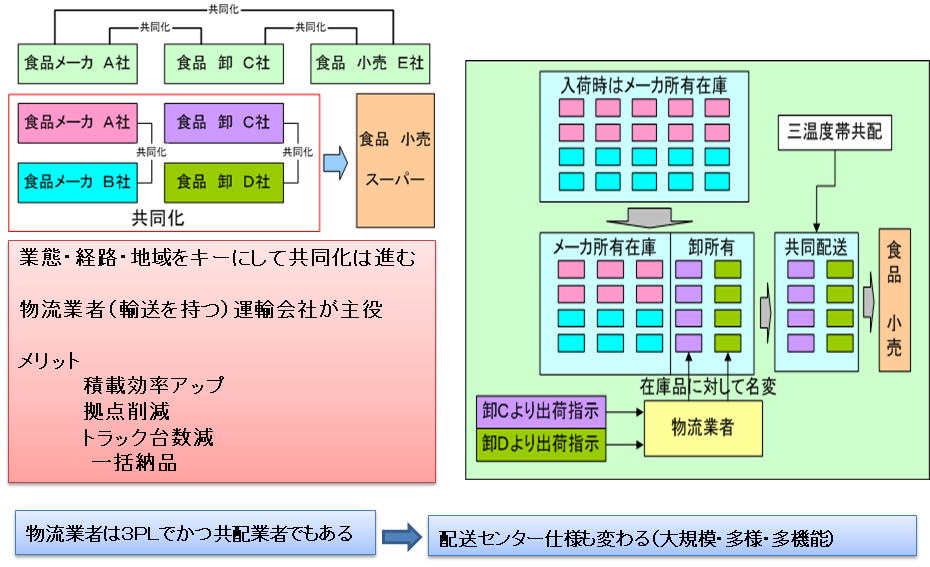
■ Collaboration mechanism that transcends business type barriers
In conventional logistics, each manufacturer or wholesaler would build their own trucks and individually deliver goods to stores such as retail supermarkets.However, in this case, many trucks with empty cargo beds arrive at the same store, causing traffic jams (waiting time problems) as they wait to unload their cargo.
Joint logisticsIn this system, multiple companies such as ``food manufacturers A and B'' and ``food wholesalers C and D'' consolidate their parcels into one system (joint distribution center) using each other's ``business type, route, and region'' as keys.The system then consolidates these packages and delivers them all together on one truck to "Food Retail Company E (supermarkets, etc.)".
■ The leading role in driving collaboration
The main role in coordinating the interests of this complex stakeholder and running the actual operation is theLogistics companies (transport companies, etc.) that actually own transportation means (truck networks)is.They were not just carriers, they had advanced information systems.3PLWe will play a strong role as both a provider and a "co-distributor (co-distributor)".
Section 4 Overwhelming benefits and operational flow brought about by joint logistics
■ Four major benefits of collaboration
- 1. Increased loading efficiency:By combining cargo from multiple companies like a puzzle, we can reduce the amount of empty space (air) in the truck bed and allow the truck to operate at near full capacity.
- 2. Reduction of bases:By canceling the small warehouses that each company had separately and consolidating them into one huge joint distribution center, we can significantly reduce overall storage costs and fixed costs.
- 3. Decrease in number of trucks:Since the absolute number of trucks on the road will be reduced, this will not only help address the serious driver shortage, but will also directly lead to a significant reduction in CO2 emissions (contributing to the environment).
- 4. Bulk delivery:For the receiving retail stores (supermarkets, etc.), the burden of inspection and receiving work is dramatically reduced because trucks, which used to arrive separately, only need to come once.
■ Inventory and ownership flow within the joint center
Inside the joint distribution center, in addition to physically moving packages, ``transfer of ownership'' of data takes place in real time.
- Upon arrival:When delivered to the center, the product is still stored in the area as "manufacturer-owned inventory."
- Change of name (movement in bookkeeping):Wholesalers (Wholesale Company C and Wholesaler D) send shipping instruction data to the logistics company stating, ``We want you to ship this product.''At this moment, even if the product is not physically moving, the inventory undergoes a "name change (transfer of ownership)" in the data and switches to "wholesale-owned inventory."
- Joint shipping and three temperature zones:Regardless of whether the goods are owned by the manufacturer or wholesaler, we pick and consolidate the goods that ultimately go to the same retail store.At this time, the products are loaded onto the same truck while adhering to the quality standards of "three temperature zones": room temperature, refrigerated, and frozen, and delivered in bulk (joint delivery) to food retail stores.
💡 Impact on new logistics facility plans
In this way, logistics companies can3PL, and when it comes to function as a co-distributor, the nature of the base will fundamentally change.futureLogistics facility planningis not just a storage facility, but a facility for processing multiple companies' packages and information at the same time."Large scale, diverse, and multifunctional"A design with appropriate distribution center specifications is an essential requirement.