Updated: 2026-09-12
1. Background of Data Analysis
1-1. Why Data Analysis is Necessary
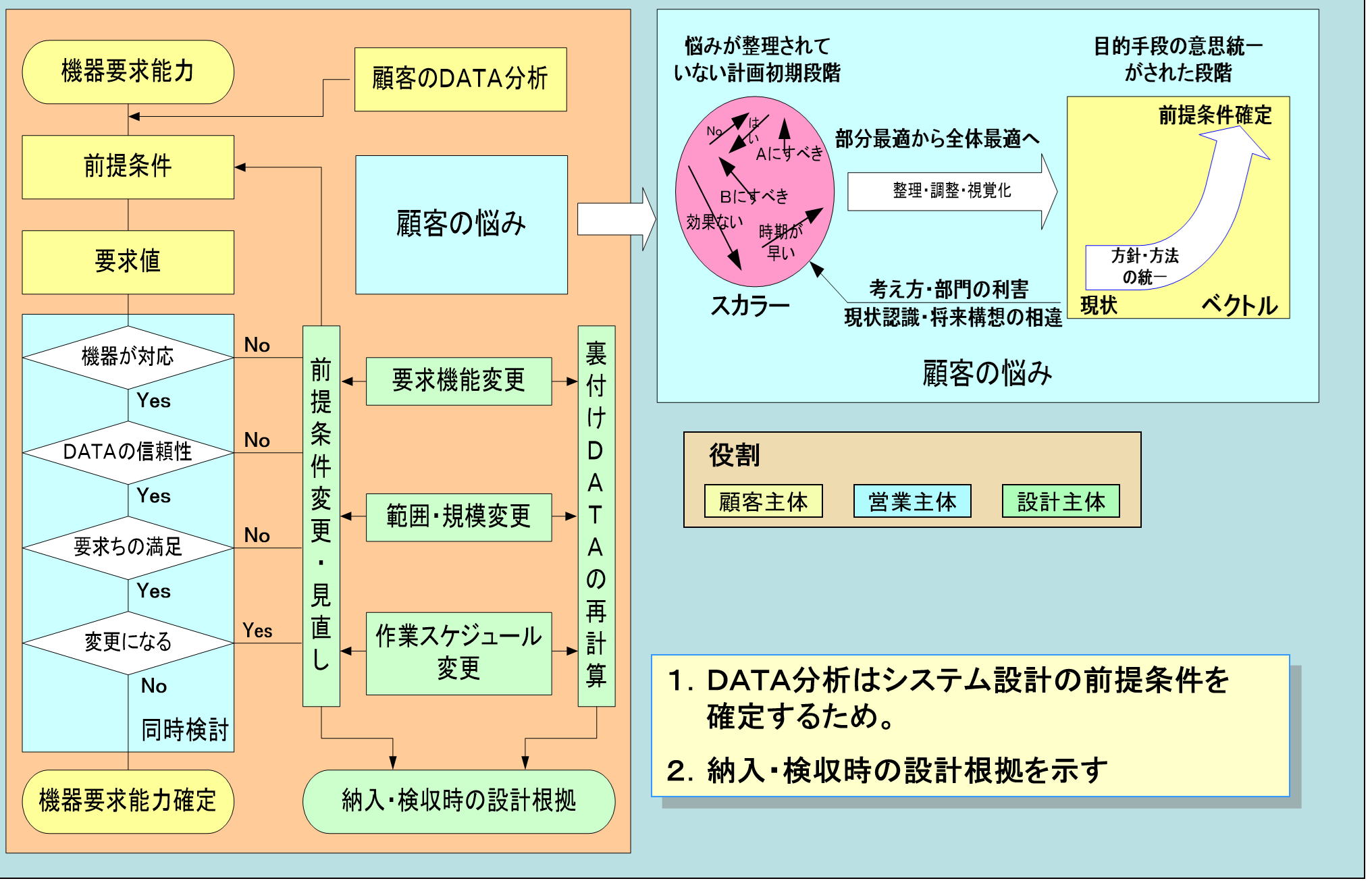
Diagram Structure and Process Details
- Initial Planning Stage (Scalar State): Customer concerns and opinions (e.g., "Should do A," "Should do B," "Ineffective," "Too early") point in scattered directions and lack organization.
- Unification of Purpose & Means (Vector State): By organizing, adjusting, and visualizing information to move from local optimization to overall optimization, policies and methods become aligned, establishing the prerequisites for system design.
- Requirements Judgment & Revision Flow: If conditions fail to meet required equipment capacity or specified values (No)—such as equipment applicability, data reliability, or satisfaction of requirements—prerequisites are revised or reconsidered.
- Recalculation of Supporting Data: Whenever prerequisites change, leading to modifications in required functions, scope/scale, or work schedules, supporting data must be recalculated.
- Establishment of Design Basis: Ultimately, when requirements are met, required equipment capacity is finalized, serving as the design basis upon delivery and acceptance inspection. These processes proceed through designated roles: customer-driven, sales-driven, and design-driven.
Necessity of Data Analysis in the Early Stage of a Project
As clearly shown in the diagram, data analysis of customer operations is necessary during the initial stage for two primary reasons:
- To establish prerequisites for system design
- To provide a design basis upon delivery and acceptance inspection
[Explanation]
In the early planning stages when stakeholders' opinions vary, conducting data analysis to gain an objective understanding of the current state creates unshakeable prerequisites for system design and establishes clear evaluation criteria (design basis) upon project completion.