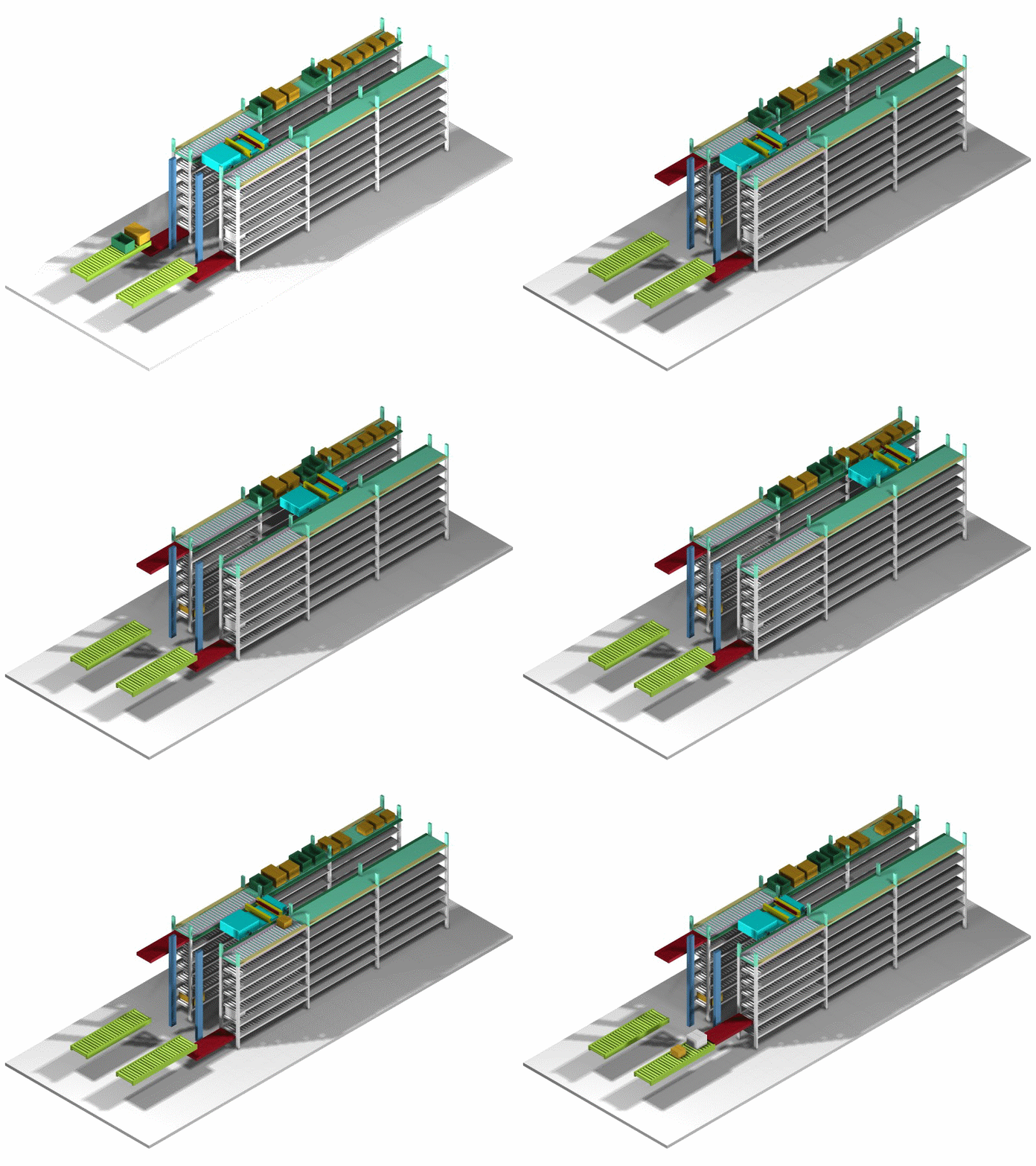
Case AS/RS Operation (Shuttle Vehicle Movement)
Transfers inbound cases from internal feed conveyors, transports them to rack opening slots, and deposits cases.
For outbound retrieval, the shuttle vehicle moves to the target rack opening, loads the case, transports it to the internal rack conveyor, and transfers it onto vertical lifts connecting to external dispatch conveyors.
Each shuttle vehicle executes 50 to 60 storage/retrieval cycles per hour.
Section 5 Design Calculation & Picking Optimization for Shuttle Automated Storage (SAS Case AS/RS)
Overview and Characteristics of Shuttle Automated Storage (SAS Case AS/RS)
Shuttle Automated Storage (SAS Case AS/RS) is a proven, highly reliable material handling system with over 700 installations since its introduction in 1985. Expiration of original patent restrictions in recent years has led numerous material handling manufacturers to enter the market, triggering renewed global interest.
1. Advanced Sorting and Outbound Sequencing Functions
- Individual Unit Management: Manages 1,000 distinct SKUs individually within a 1,000-case storage capacity.
- Outbound Sequencing & Sorting: Features robust sequencing and sorting functions capable of retrieving cases in exact delivery route order specified per destination.
2. Exceptional Throughput Performance
Because autonomous shuttle vehicles travel independently across individual rack tiers, system throughput far surpasses conventional crane-based AS/RS solutions.
- Single Shuttle Vehicle Throughput: Performs 50 to 70 storage/retrieval cycles per hour.
- Total System Performance: In a 15-tier configuration, for instance, 60 cycles × 15 tiers delivers 900 cycles/hour system capacity.
3. Dramatic Picking Productivity Improvements
Compared to manual picking, picking speeds at SAS outbound retrieval stations accelerate dramatically:
- Flow Racks (Manual Picking): Approx. 1 pick every 12 seconds (300 picks/hour).
- SAS Outbound Station: High-speed picking reaching 1 pick every 5 seconds (720 picks/hour).
Optimizing Low-Velocity Destinations and Slow-Moving SKUs
SAS solves complex operational challenges in low-velocity (slow-moving) SKU categories, which historically presented the greatest automation difficulties in distribution centers.
Seamless Mixed-Mode Processing for Full Cases and Piece Items
- Eliminating Downstream Order Consolidation: Its primary advantage lies in seamlessly processing full-case dispatches and piece picking operations sequentially.
- Practical Example: When a low-velocity account orders 1 full case and 15 piece units across 3 SKUs, SAS processes both modes sequentially in a single automated stream. Cases and piece totes emerge pre-sorted and pre-sequenced, eliminating manual order consolidation completely.
Engineering Dimensions and Practical Considerations
Tera Calculation provides high-precision simulations incorporating the following engineering parameters:
- Storage Capacity: Accommodates case dimensions from 150 mm to 600 mm (W/D/H); 1 system block (2 rows × 15 bays × 13 tiers) holds approx. 2,000 cases.
- Maintenance Features: Maintenance walkways installed every 2,000 mm in height allow manual emergency retrieval during system stoppages.
- Structural Clearances: Because shuttle vehicles overhang below rail tracks, dimensional clearances around maintenance walkways require careful verification.
- Statutory Virtual Floor Codes: Top-tier elevations exceeding 5 m trigger statutory "virtual floor" area additions under fire codes.
Calculation Interface
Low-velocity accounts and slow-moving SKUs (indicated in the red highlighted area below) are stored in SAS and dispatched as consolidated, pre-sequenced orders per destination.

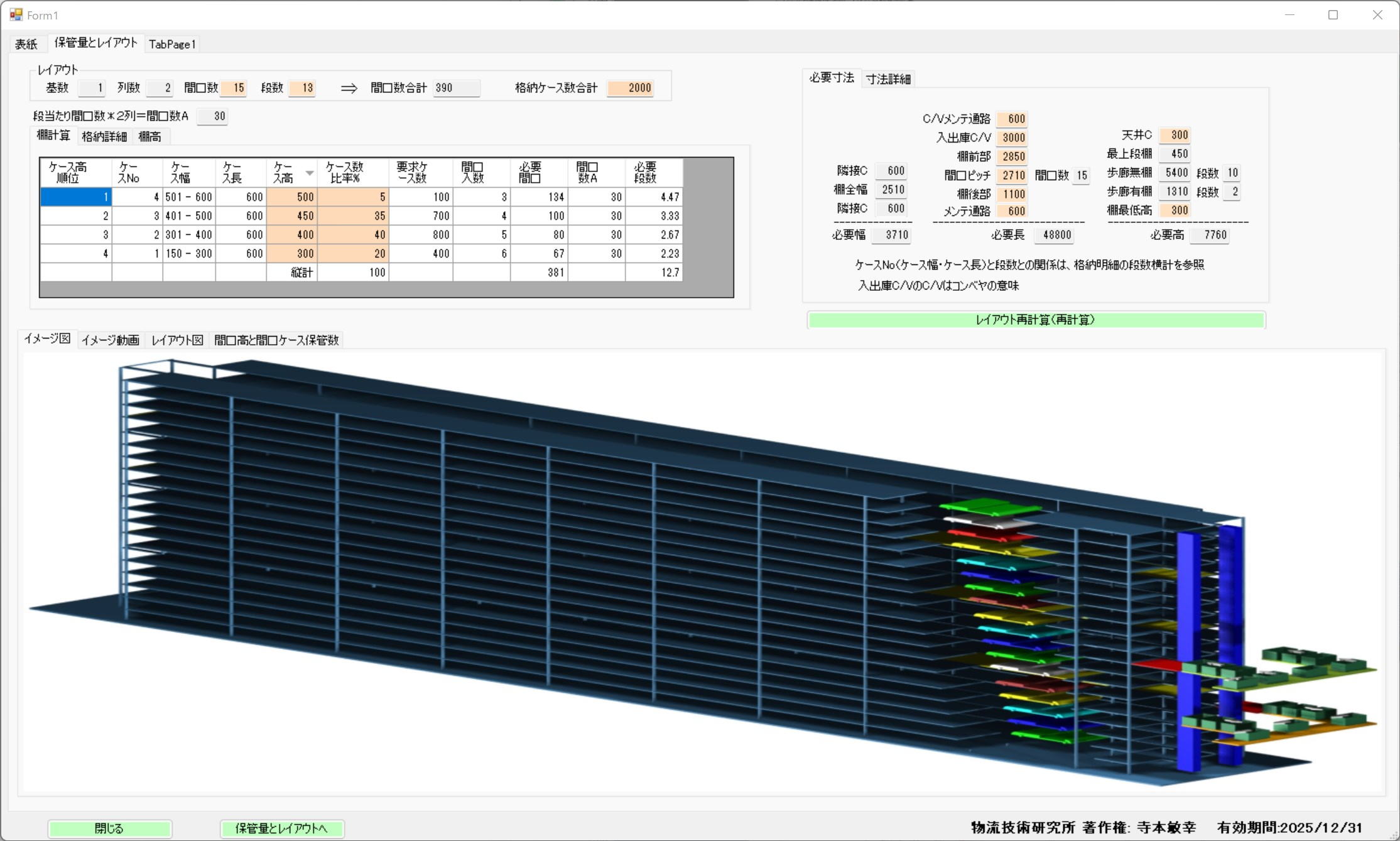
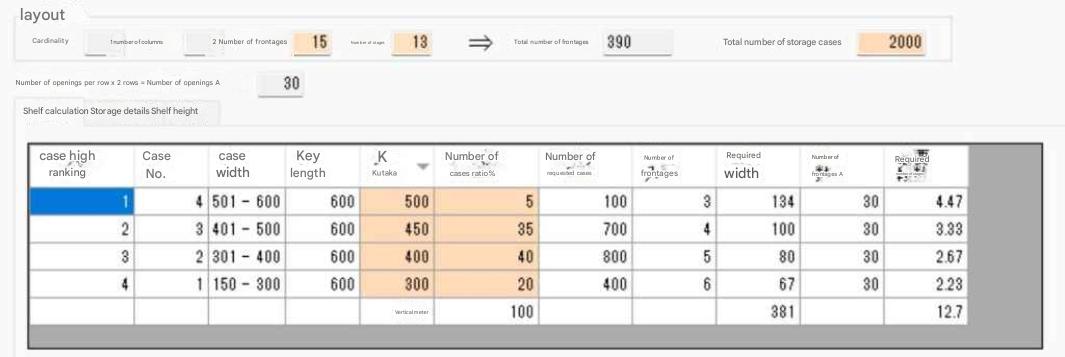
Case Dimensions and Storage Capacity
Calculations accommodate any case size with length, width, and height between 150 mm and 600 mm based on standardized parameter conditions.
Under parameters shown in the table above, 1 block (2 rows × 15 bays × 13 tiers) yields 2,000 cases storage capacity.
Modify parameter settings in the table above to evaluate changes in storage capacity.
Plan Layout
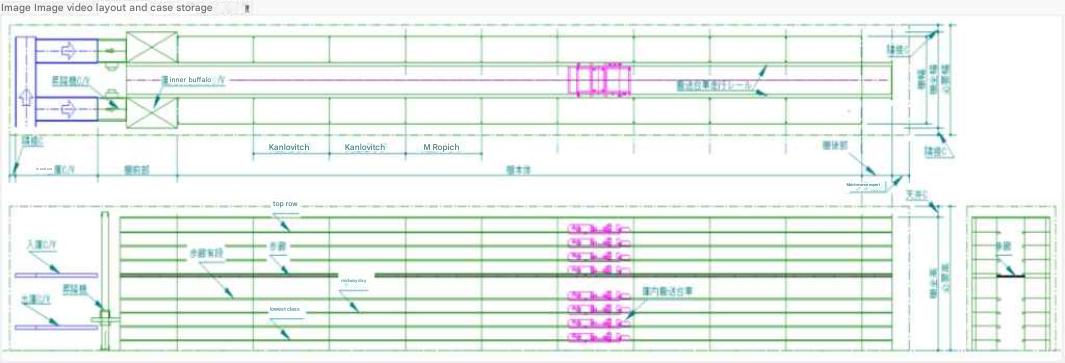
Inbound and outbound conveyors can be installed at both front and rear ends of rack blocks (the layout above shows front-end installation only).
Maintenance walkways installed at 2,000 mm vertical pitch intervals enable manual picking during emergency stoppages.
Virtual floor area additions are calculated for every 5 m increment exceeding top-tier elevations.
Shuttle Vehicles, Shelf Opening Heights/Widths, and Case Capacity
Bay pitch = 2,710 mm; storage capacity per opening:
300 mm width cases = 6 cases; 400 mm width cases = 5 cases; 500 mm width cases = 4 cases; 600 mm width cases = 3 cases.
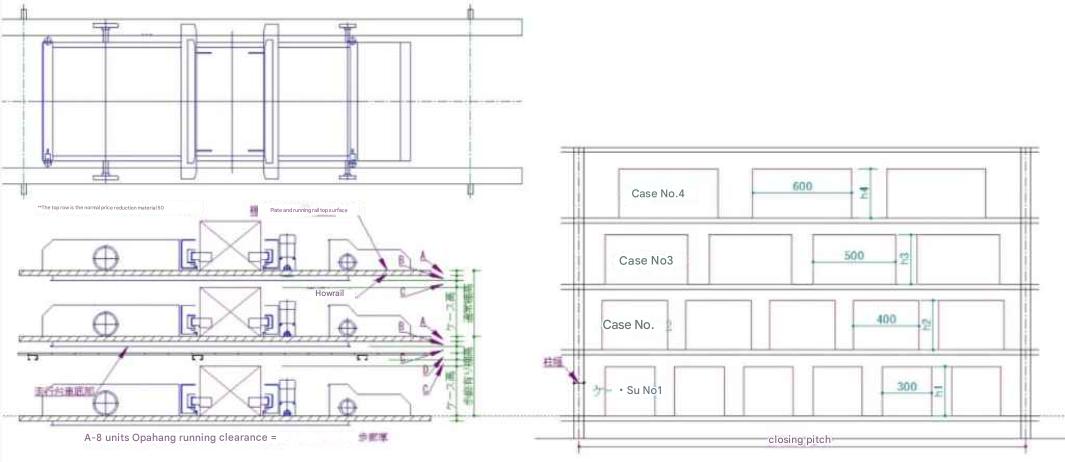
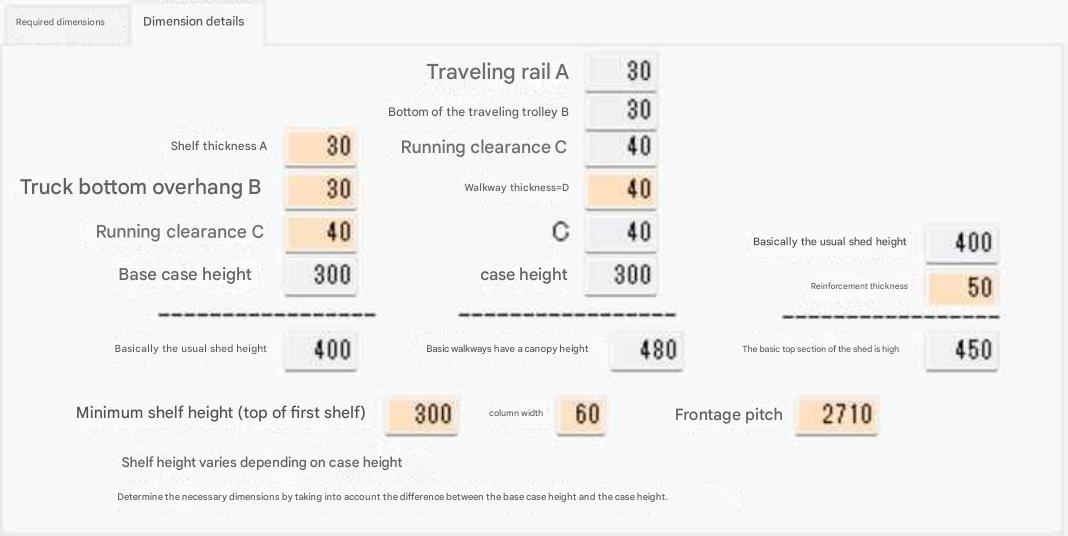
Shuttle vehicles overhang below guide rails. Pay careful attention to dimensional clearances between walkway-equipped tiers and standard tiers.
Tera Settings parameters can be customized freely.