Shelving Specs, Rows, and Bays
Shelving Width: Selectable from 1,800 / 2,100 / 2,400 mm
Shelving Depth: Selectable from 300 / 450 / 600 / 900 mm
Shelving Height: Selectable from 1,800 / 2,100 / 2,400 mm
Tiers: Selectable from 3 / 4 / 5 / 6 Tiers
Openings: Selectable from 2 / 3 / 4 / 5 / 6 / 7 / 8 Openings
Section 7 Medium-Duty Shelving Calculation: Outbound Operations & Days of Inventory Simulation for Medium/Low-Velocity Items
Basic Specifications and Installation Area Calculation for Medium-Duty Shelving
Floor installation area for medium-duty shelving is automatically calculated by specifying dimensional specifications (width, depth, height) and configuration layouts (rows and bays).
- Selectable Dimension Settings:
- Shelving Width: 1,800 / 2,100 / 2,400 mm
- Shelving Depth: 300 / 450 / 600 / 900 mm
- Shelving Height: 1,800 / 2,100 / 2,400 mm
- Tiers: 3 / 4 / 5 / 6 Tiers
- Shelf Openings: 2 / 3 / 4 / 5 / 6 / 7 / 8 Openings (SKU divisions per tier)
- Setback Clearances: Large-scale high-bay systems exceeding 3,000 mm height (automated warehouses or selective pallet racks) require 200 mm clearances, whereas medium-duty shelving and flow racks under 3,000 mm height require only 100 mm setback clearance to building structures.
Volumetric Fill Rates and High-Efficiency SKU Management
To maximize medium-duty shelving storage density and streamline manual outbound operations, flexible opening design and proper SKU management matched to item velocity (medium-velocity and low-velocity) are essential.
- Opening Optimization: SKU counts stored per tier level do not need to be uniform. Combining small-volume SKUs with large-volume items reduces dead air space, boosting volumetric fill rates.
- Split Storage Zones & SKU Management: Active inventory is managed across two distinct zones: "Reserve Bulk Storage Area" and "Outbound Work Area (Medium-Duty Shelving)".
Simulating Days of Inventory and Replenishment Cycles
Based on inventory volume estimation calculations, Tera Calculation determines target days of inventory to be maintained in medium-duty shelving zones for outbound operations.
Calculation Example (Deriving Shelving Inventory Days)
Under the following simulation parameters, the target days of inventory maintainable in medium-duty shelving equals 14 days:
- Total Center Days of Inventory: 40 days
- Usable Storage Volume in Medium-Duty Shelving (after 70% fill rate): 35 m³
- Total Center Inventory Volume: 100 m³
- Calculation Formula: (35 m³ / 100 m³) × 40 days = 14 days
Practical Implementation Point: Factoring in labor workloads for replenishing stock from bulk storage into medium-duty shelving (outbound work area), optimal facility designs aim to maintain 20 days or more of days of inventory in active picking zones.
Estimating Medium/Low-Velocity SKU Distribution (Empirical Rules)
Estimates SKU distribution across bulk storage and active outbound work areas for medium-velocity and low-velocity items (Rank B, C, and D SKUs) based on dispatch frequency.
- Active Outbound Work Area (Shelving) SKU Count: 1,000 SKUs (targeting medium/low-velocity items)
- SKU Reduction Count in Bulk Reserve Storage: 210 SKUs
- Calculation Example: (14 Days (Shelving Inventory Days) / 20 Days (Ideal Inventory Days)) × 1,000 SKUs × 0.6 = 210 SKUs
- Resulting Outcome: Bulk reserve storage will configure 790 SKUs.
Simulation Calculation Interface
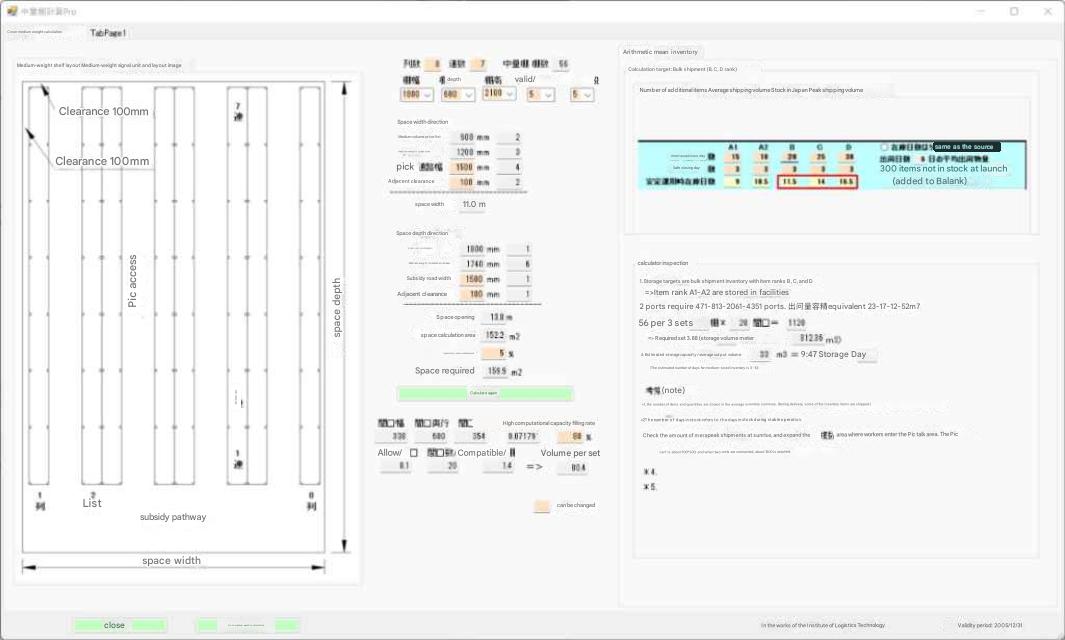
After configuring medium-duty shelving specifications, rows, and bays, required floor installation area is calculated automatically.
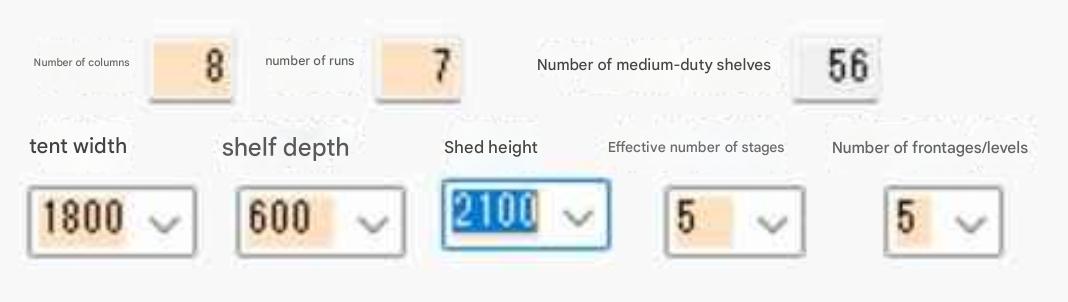
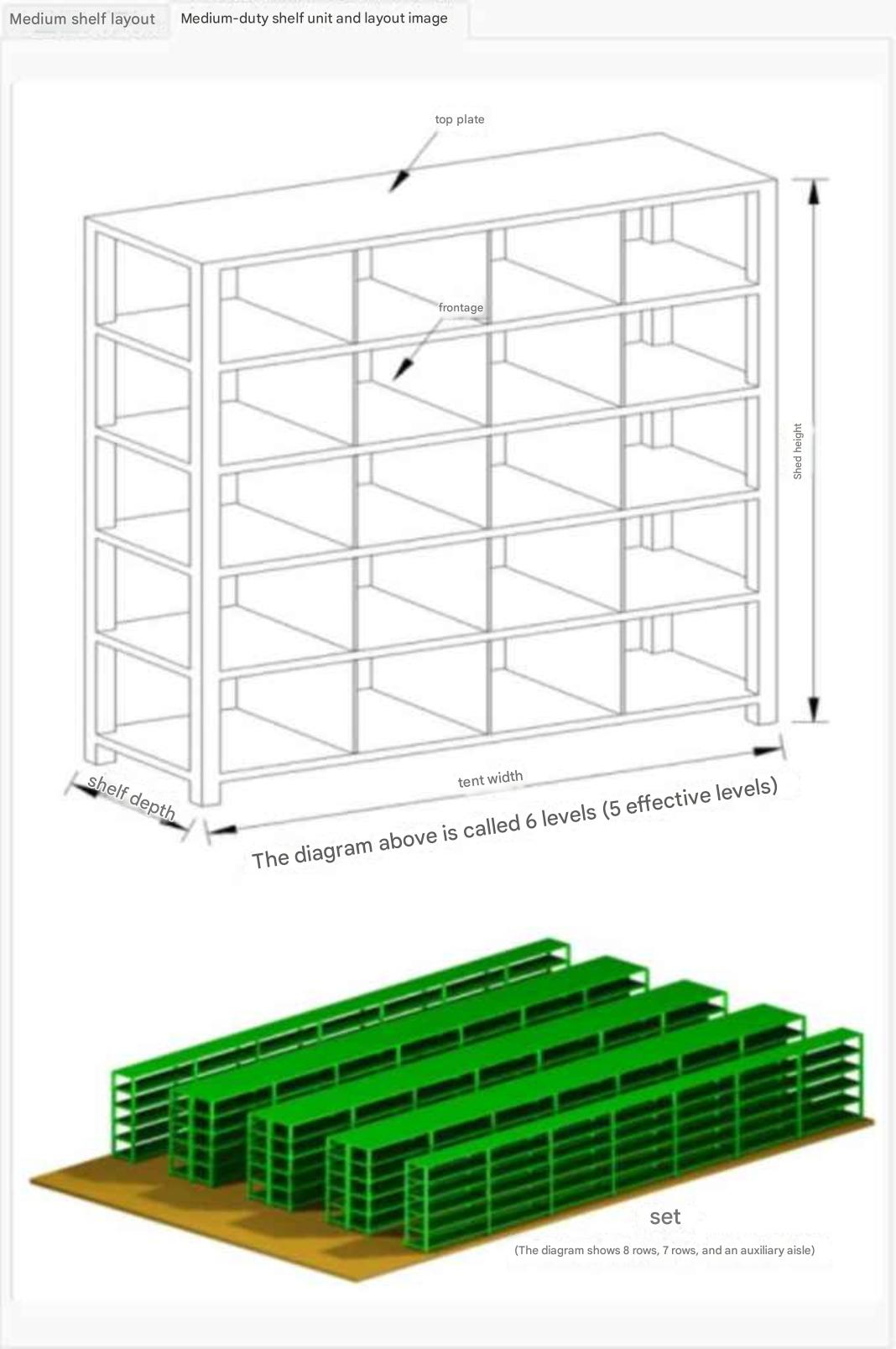
Shelf Openings and SKU Management
The number of SKUs stored per tier determines total SKUs held in medium-duty shelving. Because opening widths do not need to be uniform, combining small-volume SKUs with large-volume items raises fill rates, optimizing SKU management.
Target SKUs are stored split across two locations: "Reserve Storage Area" and "Outbound Work Area (Medium-Duty Shelving)".
For 1,000 target SKUs (medium/low-velocity items):
Total Center Days of Inventory = 40 days; Total Center Inventory Volume = 100 m³
Shelving Usable Volume = 50 m³; Fill Rate = 70%
Shelving Net Storage Volume = 35 m³
Days of Inventory in Shelving = (35 m³ / 100 m³) * 40 days = 14 days.
Results in 26 days in reserve storage and 14 days in outbound work area.
Considering replenishment labor from reserve storage, days of inventory in the outbound work area (medium-duty shelving) should ideally maintain 20 days or more.
How are SKU counts distributed between reserve storage and active work areas during above calculations?
Work Area SKUs = 1,000 SKUs
Reserve Area SKUs = 790 SKUs
Reserve Area SKU Reduction = (Shelving Days of Inventory / Ideal Days of Inventory) * Total SKUs * 0.6
Reduction Count = (14 / 20) * 1,000 * 0.6 = 210 SKUs.
This represents an empirical calculation model.
While selective pallet racks and automated warehouses exceeding 3,000 mm height require 200 mm setback clearances, flow racks and medium-duty shelving under 3,000 mm height require only 100 mm setback clearance.
Total facility inventory volumes are derived from the following table view:
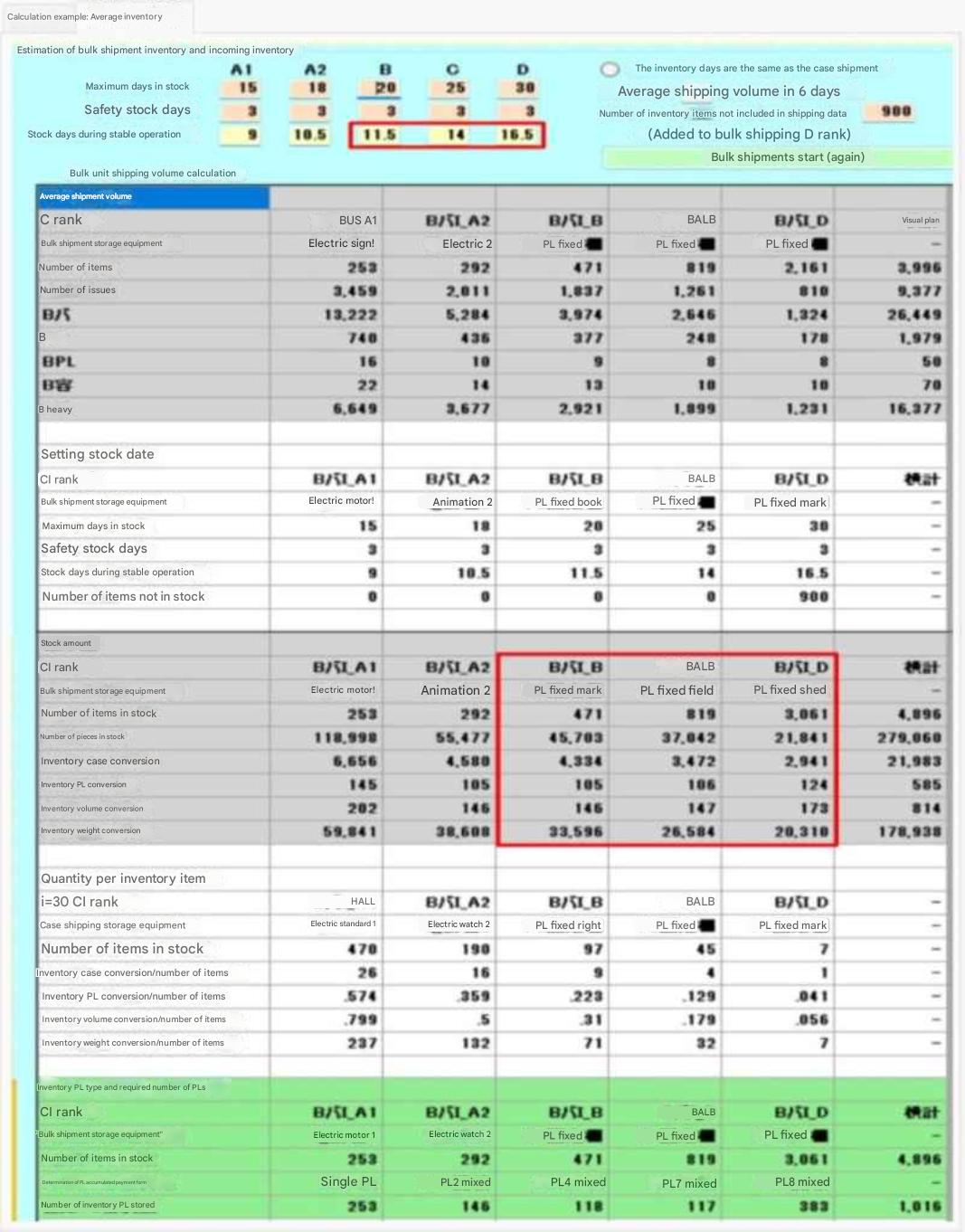
The table above is derived from Inventory Estimation Calculations.
Target SKUs for medium-duty shelving correspond to medium-velocity and low-velocity items ("BバI_B", "BバI_C", "BバI_D").
Refer to Inventory Estimation Calculations for detailed table interpretations.