Section 6 Shipping Space Calculation
This document explains calculation logic for "Shipping Area" in distribution center design along with operational constraints to consider during planning.
Shipping Space functions not merely as storage floor area, but as a "temporary staging location" where inspected and packed outbound goods await truck loading.
1. Smoothing Outbound Throughput and Peak Hours
- Peak Shipping Hour Volume Ratio: Refers to the ratio of outbound volume during the single busiest hour relative to total daily shipping throughput.
- Design Target Benchmark: To optimize equipment utilization rates, keeping this volume ratio at 25% or lower is recommended.
- Avoiding Over-Investment: If the ratio exceeds 30%, operational improvements (such as pre-shipment order picking) must be implemented to lower the ratio; otherwise, equipment specifications become oversized (over-engineered).
2. Selecting Shipping Trucks and Transport Equipment
- Truck Characteristics: Considering delivery site constraints at customer locations (stores or homes) and street parking limitations, smaller truck types (such as 2-ton or 4-ton trucks) are favored compared to inbound receiving vehicles.
- Types of Transport Equipment: To minimize unloading/loading times, calculations select from 7 equipment types matched to cargo profiles (roll-box pallets, pallets, dollies, 6-wheel carts, etc.).
3. Packaging and Containers by Shipping Category
Operational differentiation between "In-house Dedicated Fleet" and "Consolidated / Commercial Express Delivery" based on destination impacts floor space calculations:
| Shipping Category | Packaging Format | Return of Transport Equipment & Containers |
|---|---|---|
| In-house Dedicated Fleet | Reusable Shipping Containers (Totes) | Possible; collected collapsed/folded. |
| Consolidated / Express Delivery | Cardboard Box Packaging | Not Possible; one-way delivery dispatch. |
- Accounting for Fractional Loads: Unfilled "fractional tote containers" or "fractional roll-box carts" reduce overall load efficiency (fill rate) and are explicitly included in calculations.
4. Calculating Empty Container Storage Space
- Collapsed Container Operations: Returned empty shipping totes are calculated under the assumption that they are folded and stacked typically 5 tiers high.
- Calculation Example: For Size-40 tote containers, storage space per unit is incorporated as 0.0118 m² in calculations.
5. Calculating Effective Area via Floor Expansion Multipliers
Theoretical calculated values (cargo volume) alone do not account for physical operational needs; therefore, an area expansion multiplier of 120% to 130% is applied to derive final required shipping area footprints covering:
- Inter-cargo Clearance Gaps
- Worker Traffic Aisles and Flow Lines
- Material Handling Operations within Shipping Space
Shipping Space Calculation Interface (Area and Bay Counts)
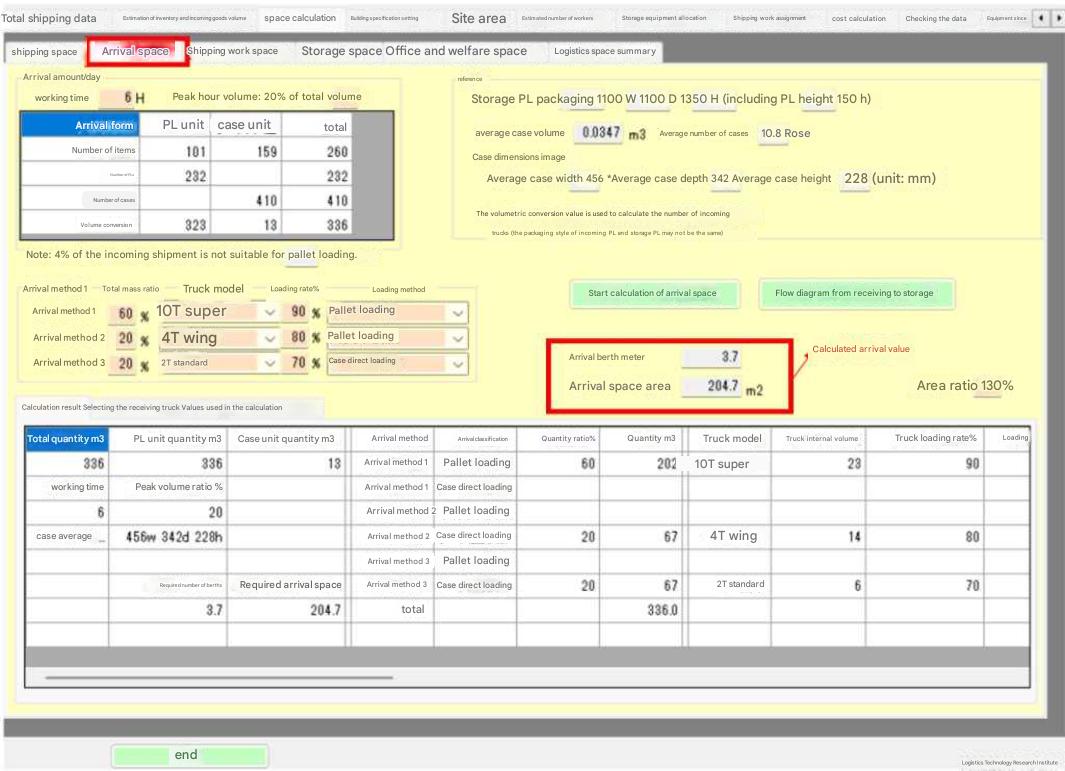
Subsection 1 Calculation of Shipping Area and Number of Shipping Bays
Hourly shipping volume, truck load capacity volume.
Subsection 2 Peak Shipping Hour Volume Ratio
Tera Calculation 2 analyzes shipping data in advance and displays Peak Hourly Volume Ratio % = (Peak Hourly Volume / Total Daily Volume) * 100. Enter the target volume ratio while comparing this displayed ratio with individual tables.
To increase equipment utilization efficiency, the volume ratio benchmark should ideally be kept at 25% or lower.
If the ratio exceeds 30%, while 30% may be accepted during preliminary rough-scale estimation in Tera Calculation 2, operational countermeasures (such as advancing schedule timelines) must be implemented during detailed design to lower the ratio; otherwise, equipment will be specified to over-engineered capacities.
Subsection 3 Shipping Methods and Total Volume Allocation Ratios
Up to 3 patterns of shipping truck vehicle types can be calculated for outbound shipping. Total volume ratio represents percentage allocation across each pattern when total daily shipping volume equals 100%.
Shipping Truck Vehicle Types and Load Factors:
11 truck types are supported (2T Standard, 2T Long, 2T Long Wide, 4T Wing, 4T Aluminum Truck, 4T Aluminum Van, 4T Wing, 10T Super, 14T G-Cargo, 20ft Container, 40ft Container).
Considering narrow customer unloading yards and street unloading constraints, smaller shipping truck types are selected relative to inbound receiving trucks; containers or heavy vehicles over 10T are rarely selected for outbound retail delivery. Load factors using outbound tote containers or transport equipment are lower than inbound receiving load factors.
Shipping Loading Methods and Transport Equipment:
Transport equipment such as roll-box pallets is frequently used to minimize unloading times. 7 equipment types are selectable (Direct Loose Stacking, Pallet 1100*1100, Roll-Box Cart 850*650, Roll-Box Cart 1100*800, Container Dolly, 6-Wheel Cart with End Frames, Standard Dolly with End Frames). Cases frequently use roll-box carts; loose tote containers frequently use dollies or 6-wheel carts.
Subsection 4 Piece-Unit Shipping Containers
Dedicated fleet deliveries making regular scheduled shipments to large accounts permit returning transport equipment and tote containers. Conversely, small account deliveries or home deliveries utilize consolidated commercial carriers or parcel express services; consolidated/express delivery is one-way, making tote/equipment returns impossible.
In-house dedicated fleets can utilize transport equipment and shipping tote containers, whereas consolidated/express deliveries must be shipped in cardboard box packaging.
In terms of operational process flow, both streams utilize shipping tote containers through inspection after picking; based on the shipping data classification (Tote Container vs. Cardboard Box), tote containers are dispatched directly, while cardboard box orders are re-packed into cardboard boxes prior to dispatch.

Shipping tote containers can be configured across 4 sizes: Type-30, Type-40, Type-51, and Type-60 (numbers preceding "Type" represent volume capacity in liters).
Fill Rate = Product Volume / Internal Container Volume; benchmark upper threshold is 90%, dropping to around 70% when products are bulky or require cushioning materials. Furthermore, low shipping volume items that fail to fill a tote container, or fractional tote containers occurring during multi-tote shipments, reduce overall fill rates. A "fractional tote container" refers to shipping 2.5 totes of product across 3 tote containers, where the 3rd container holds 0.5 tote volume. "Fractional pallets" or "fractional roll-box carts" carry identical meanings.
Standard shipping totes are collapsible to save volume; calculations for empty container staging areas assume returned empty totes are folded and stacked 5 tiers high on dollies. Storage footprint for a Type-40 empty tote is calculated as 0.0118 m² per unit. Dollies refer specifically to dedicated wheeled bases for tote containers.
Subsection 5 Shipping Space Area Multiplier Ratio
Theoretical shipping area calculations do not account for clearance gaps between cargo stacks, worker movement flow aisles, or material handling work within shipping space. Applying an area multiplier calculates true required operational floor space. Target benchmark multiplier is 120% to 130%.
Explanation of Tabbed Screen Interface Tables:
The Calculation Results tab displays calculation progress and summary results in table views.
Other tabs display Shipping Truck Specifications, Transport Equipment Specifications, Equipment Capacity per Truck Type, Tote Container Capacity per Equipment Type, 2-Tier Tote Container Capacity per Truck Type, and raw parameters used in calculations, structuring calculation details for complete table review.