Section 4 Receiving Volume Calculation

This document explains the concepts and calculation logic of receiving volume calculation in a distribution center. It presents methodologies for deriving efficient replenishment schedules and inbound volume from shipping data while considering inventory replenishment cycles.

Key highlights are organized and detailed below:

1. Fundamental Logic of Receiving Volume Calculation

Receiving volume is fundamentally considered equal to shipping volume over time. However, not all items arrive daily; rather, replenishment arrives in consolidated shipments based on inventory replenishment cycles (receiving cycle).

2. Criteria for Determining Receiving Unit Formats

Based on per-item inbound volume, receiving formats are categorized into "Pallets (PL)", "Cases", or "Pieces".

Receiving Volume per Item Receiving Unit Applicable Rank (Example)
0.5 PL or More Pallet Unit GPLI_A1, A2, B
Under 0.5 PL to Over 0.5 Cases Case Unit GPLI_C, D
0.5 Cases or Less Piece Unit -

3. Operational Differences Between Receiving and Shipping

In distribution center operations, understanding the following contrast is essential:

4. Calculation Example and Important Considerations

In the reference calculation example, daily inbound volume is derived as follows:

【Note】

Because these calculated figures stem from raw conversions, practical application requires adjusting for "actual stacking density per pallet" and facility operational multipliers (such as designated inbound day schedules).

Subsection 1 Executing Receiving Volume Calculation

T810_All Case & Piece Data IQ is derived from overall shipping data averages.

Inventory fluctuates between maximum inventory and safety inventory.
Fluctuating Inventory = Maximum Inventory - Safety Inventory.
When Fluctuating Inventory Days = 6 days, receiving occurs on a 6-day cycle. Inventory reaches maximum on receiving day and drops to 0 fluctuating stock immediately before next receiving confirmation.
(Theoretically leaving only safety inventory on hand).
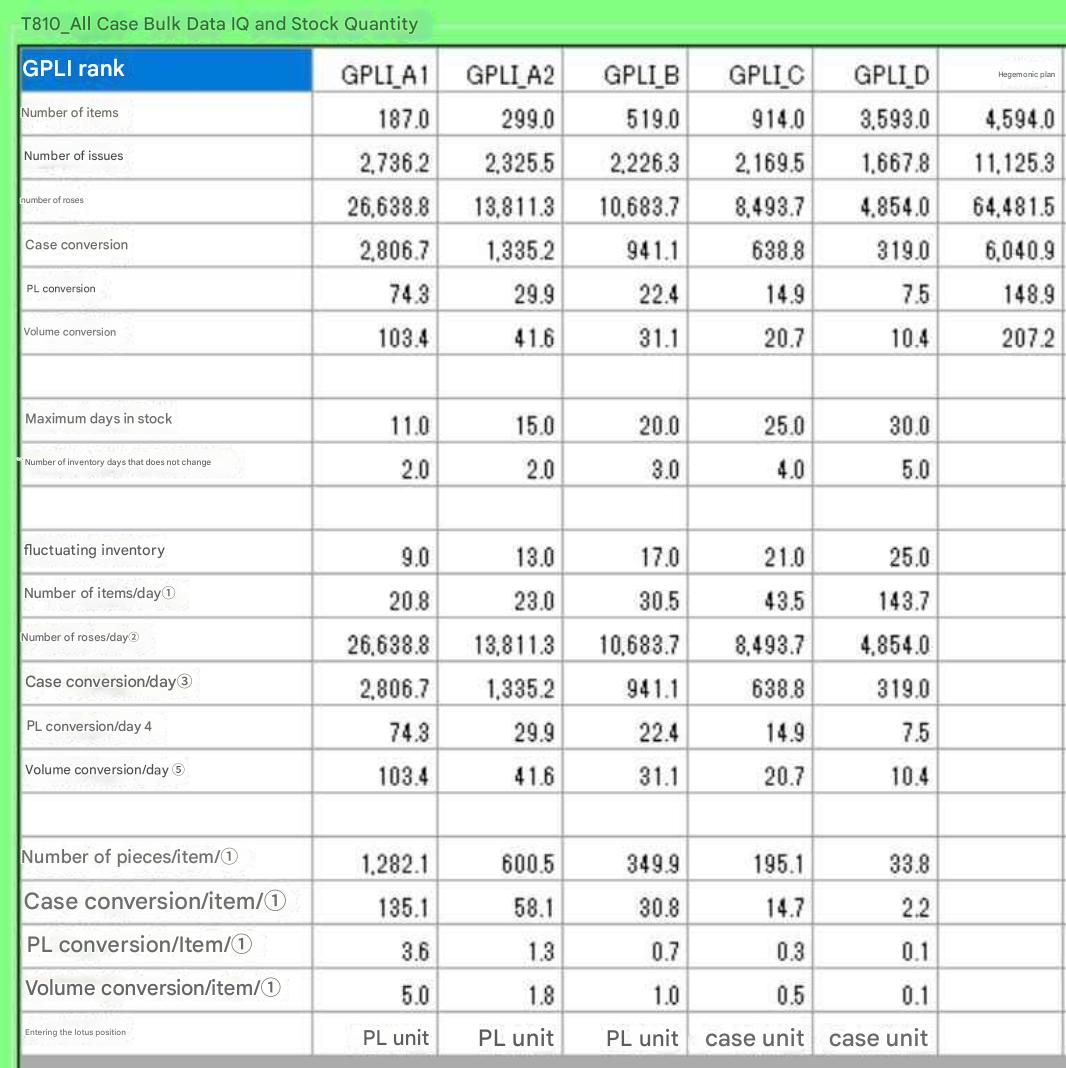
Receiving Volume Calculation Screen

Receiving Volume = Shipping Volume

Receiving Cycle = Maximum Inventory Days - Safety Inventory Days

Receiving Item Count = Item Count ÷ Receiving Cycle


Items with inbound volume of 0.5 PL or more arrive as pallet units.
Items under 0.5 PL arrive as case units.
Items of 0.5 cases or less arrive as piece units.

Ranks GPLI_A1, GPLI_A2, and GPLI_B arrive as PL units,
while GPLI_C and GPLI_D arrive as case units.
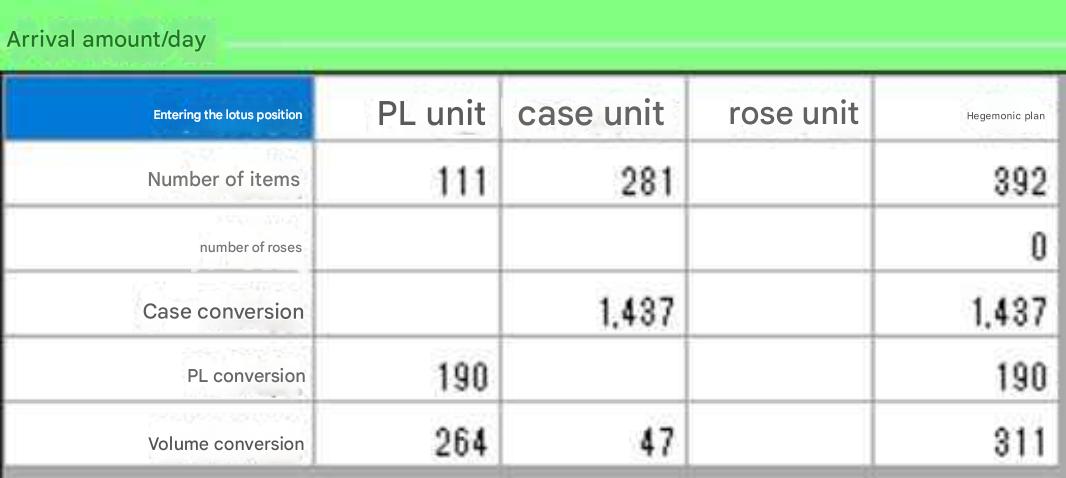
Receiving Volume Calculation Results and Daily Inbound Volume

Receiving Volume Calculation Results Diagram

Daily Inbound Volume:
111 items arrive in pallet (PL) units totaling 190 pallets,
and 281 items arrive in case units totaling 1,437 cases.

Total 392 items (190 PL + 1,437 cases) arrive daily.
Corresponding cubic volume equals 311 m³.

Note:
This calculation aggregates raw PL conversions from shipping data.
Actual loading capacity density per pallet must be considered in facility design.