Section 3 Relationship Between Shipping Data, Receiving, and Inventory
This section explains fundamental concepts and calculation logic for deriving inventory quantities and receiving volumes directly from shipping data.
1. Fundamental Relationship Between Shipping, Receiving, and Inventory
Material flow balance within a distribution center is expressed by the following mathematical formula:
Cumulative Receiving - Cumulative Shipping = Inventory Quantity
- Characteristics of Shipping: Because it is driven by customer orders, the distribution center cannot directly control shipping quantities or delivery deadlines.
- Characteristics of Receiving: It represents operational replenishment to secure inventory, allowing the distribution center to instruct suppliers regarding quantities and delivery dates/times.
- Objective of Inventory: Against daily fluctuating shipping demand, inventory must maintain sufficient volume to prevent stockouts while being compressed as much as possible to reduce holding costs.
2. Logic for Estimating Inventory Quantity (Storage Volume)
In Tera Calculation, stable-operation inventory volume is calculated using the following formula:
Calculation Formula
* Fluctuating Inventory = Maximum Inventory - Safety Inventory
- Daily Shipping Volume: Uses the overall average value derived from full shipping dataset.
- Concept of Inventory Days: Managed based on "Average Daily Shipping Volume × Days of Inventory".
- Practical Application: Because this calculated value represents theoretical average storage volume, if operational safety margins are required in real-world practice, an "Allowance Margin Ratio" is added post-calculation.
- Supplementary Note: "Reorder Point" is not considered when calculating storage inventory volume. Reorder point serves purely as a timing indicator to initiate purchasing orders guaranteeing inventory during replenishment lead times.
3. Handling "Dead/Dormant Inventory" Not Appearing in Shipping Data
Not all inventory items move during the specific time window covered by analyzed shipping data. Low-velocity items in particular may exhibit zero shipping records.
- Addition to Rank Categories: Tera Calculation adds inventory items not appearing in shipping data (unallocated items) to D Rank of Piece Shipping during inventory and receiving calculations.
- Scope Limitation: This addition process applies exclusively to piece shipping items and is not applied to case shipping items.
Through these steps, preparations are complete for estimating overall distribution center volume from shipping data, covering not only "active moving volume" but also "dormant dead inventory."
Subsection 1 Shipping, Receiving, and Inventory
Receiving, shipping, and inventory relationships can be expressed by "Cumulative Receiving - Cumulative Shipping = Inventory".
Because shipping represents customer orders, the distribution center cannot arbitrarily alter shipping volumes or delivery deadlines for its own convenience.
Inventory must secure sufficient volume to prevent stockouts against daily fluctuating shipping demand.
On the other hand, to reduce inventory holding costs and respect physical distribution center scale constraints, inventory volume should be kept as low as possible.
Inventory is managed per item using the calculation: Average Shipping Volume × Days = Maximum Inventory Quantity.
Receiving is the operation of placing purchase orders with suppliers to deliver goods to the distribution center in order to secure inventory. The distribution center can instruct quantities and delivery dates/times (is that really true in all cases?).
For methods of calculating receiving and inventory from shipping data, refer to Inventory Volume Estimation and Receiving Volume Estimation in Tera Calculation.
Subsection 2 Inventory Items Not Included (Unshipped) in Shipping Data
There are inventory items not contained in the full shipping dataset (spanning multiple shipping dates).
While high-velocity items appear in shipping data, low-velocity items may not appear in shipping records.
In Tera Calculation,
items with zero allocation across the full shipping dataset
are calculated by adding them to D Rank during inventory and receiving computations.
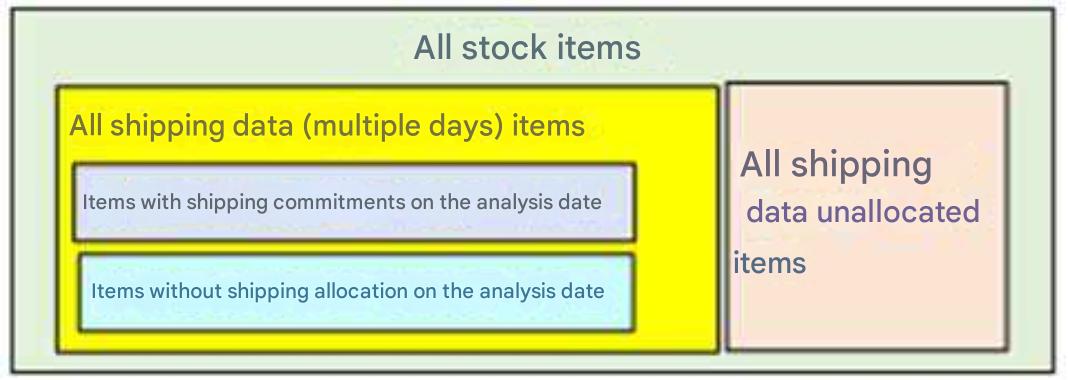
Note: Added specifically to Item D Rank of Piece Shipping; not added to Case Shipping.
Subsection 3 Calculating Inventory Quantity (Storage Volume)
There are inventory items not contained in the full shipping dataset (spanning multiple shipping dates).
Inventory can be expressed by the relationship: "Cumulative Receiving - Cumulative Shipping = Inventory".
Because shipping represents customer orders, the distribution center cannot adjust shipping volumes or delivery dates for its own convenience.
Inventory must secure sufficient volume to prevent stockouts against daily fluctuating shipping demand.
On the other hand, to reduce inventory holding costs and respect physical scale constraints of the facility, inventory volume should be minimized as much as possible.
Inventory is managed per item using the calculation: Average Daily Shipping Volume × Days = Maximum Inventory Quantity.
Receiving is the operation of issuing purchase orders to suppliers to deliver goods to the distribution center to maintain inventory levels.
While shipping dates and volumes cannot be altered, receiving allows the distribution center to specify quantities and delivery schedules.
Based on the above premises,
Tera Calculation performs inventory volume estimation and receiving volume estimation from shipping data.
Daily Shipping Volume uses the average value across all data records.
The method Tera Calculation uses to determine inventory storage volume is:
Stable-Operation Inventory Volume (Storage Volume) = Safety Inventory + (Fluctuating Inventory / 2)
Fluctuating Inventory = Maximum Inventory - Safety Inventory
For example:
Suppose there are 18 items with Maximum Inventory Days = 11 days, Safety Inventory Days = 2 days, and Fluctuating Inventory Days = 9 days.
If these 18 items are received at a rate of 3 items per day,
Fluctuating Storage Inventory Volume = (Fluctuating Inventory / 2).
If calculating Stable-Operation Inventory Volume (Storage Volume) is considered practically unviable in field operations, an allowance margin ratio can simply be added after the above calculation.
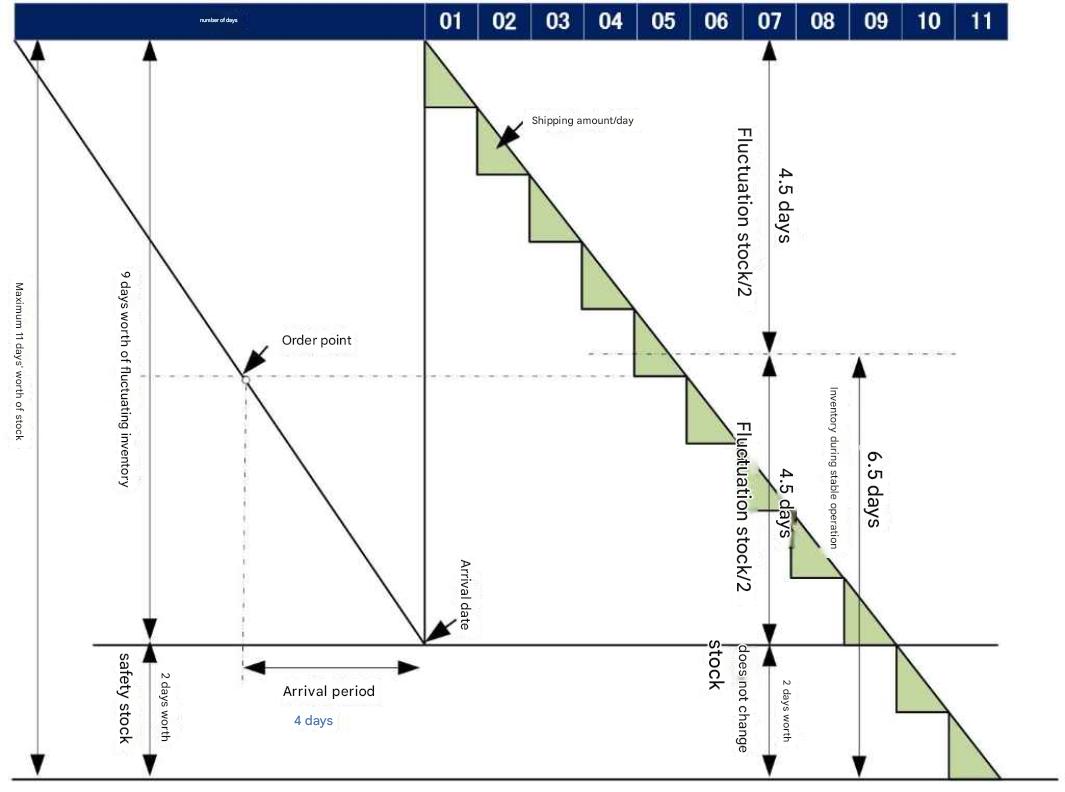
Note: Reorder Point is unrelated to storage inventory volume calculation; Reorder Point is the inventory threshold for issuing purchase orders at a timing that guarantees stock availability during lead time until receiving arrives.