Logistics AI "TCalc EIQ_AI (EIQAI)" and the Mechanics of Logistics Simulation
1. Overview and Purpose
TCalc EIQ_AI (EIQAI) is software that explains methods and procedures for incorporating logistics AI (machine learning) into traditional logistics analysis (EIQ analysis) and leveraging fractal theory to perform high-precision logistics simulations[cite: 5].
Main learning topics include the following[cite: 5]:
- Methods for creating model data from shipping data[cite: 5].
- Methods for training machine learning models on model data[cite: 5].
- Methods for executing distribution center logistics simulations (forecasting) using machine learning[cite: 5].
- Methods for verifying errors between machine learning calculations and actual calculations[cite: 5].
We provide free software (TCalc EIQ_AI) designed for learning these concepts[cite: 5].
I. Overview of Logistics AI "TCalc EIQ_AI (EIQAI)" and Fractal Theory
TCalc EIQ_AI (hereafter referred to as EIQ_AI) focuses on the data structure principle that "shipment output fluctuates fractally based on variations in delivery destination count (E) and item count (I)."
By varying E and I, 200 pattern sets of model data aggregating 161 variable items are generated and trained via machine learning (SDCA regression). Through this, users learn a logistics simulation methodology that forecasts 161 variable items under changing E and I values.
II. Benefits as Educational Software
- Using the EIQ_AI software, users can learn methods and procedures for creating logistics AI models using familiar shipping data.
- In practical business operations, calculations complete entirely within the internal company server, completely preventing external leaks of confidential shipping data.
III. Challenges and Observations
- Methods for generating model data are still under exploration and have not reached full maturity.
- The scope of logistics simulation is limited to the specific distribution center that provided the shipping data; other industry sectors require separate model data generation.
- Variances in predicted shipping volumes occur depending on the configuration rules for fluctuating E and I parameters. Currently, the Monte Carlo method is used for logistics simulations.
- We are currently validating errors between simulated values and actual calculated values. Simulations smaller in scale than the original shipping data demonstrate high accuracy, whereas accuracy degrades when scaling to larger volumes.
Glossary (from Google Gemini)
What is a Fractal?
A geometric concept proposed by French mathematician Benoît Mandelbrot, referring to structures possessing the fascinating property of "self-similarity"—where enlarging a portion of a shape repeatedly reveals the exact same shape as the whole. Far beyond pure mathematics, it is a remarkably beautiful and intriguing concept hidden throughout the natural world.
- 💡 The Defining Characteristic of Fractals: "Self-Similarity"
The most crucial keyword in understanding fractals is "self-similarity." This describes a state where, like a Russian Matryoshka doll, "no matter how microscopically you zoom in, shapes nearly identical to the macroscopic whole continuously appear ad infinitum." - 🌿 Examples of Fractals in Nature & Everyday Life
- Romanesco Broccoli: The vegetable that visually embodies fractals most clearly. Small buds gather spirally to form a single head, and zooming in on an individual small bud reveals the exact same spiral pattern.
- Snowflakes: Zooming in on the tip of a hexagonal branch reveals even smaller hexagonal branch structures.
- Tree Branching and Leaf Veins: The structure where thick trunks split into branches, which further split into twigs, looks similar whether viewed as an entire tree or as an individual branch.
- Human Blood Vessels and Bronchial Tubes: Within a limited volume (the body), fractal structures are utilized to maximize surface area for efficient transport of oxygen and blood.
- Rias Coastlines: The shape of a coastline viewed from high altitude and viewed close up within a 100-meter square both display indistinguishably complex, jagged patterns.
What is SDCA Regression (Stochastic Dual Coordinate Ascent Regression)?
An optimization algorithm for linear regression designed to perform fast and efficient training on large-scale datasets. It is a commonly encountered term, particularly as it is provided as a standard and powerful regression algorithm (SdcaRegression) in Microsoft's machine learning framework, ML.NET.
- 💡 How SDCA Works (Origin of the Name)
- Stochastic: Rather than computing across the entire dataset at once, parameters are updated for each randomly selected single data point. This saves memory and accelerates processing.
- Dual: Instead of directly solving the original optimization problem (primal problem) of machine learning, it converts and solves a mathematically equivalent "dual problem." For linear models with L2 regularization, converting to the dual problem makes calculations simpler and more efficient.
- Coordinate Ascent: Rather than optimizing all parameters simultaneously, it rapidly iterates the process of "fixing other variables and optimizing a single variable (coordinate) at a time" to converge toward the correct solution.
- 📌 Advantages of SDCA Regression
- Extremely Fast Training Convergence: Compared to standard Stochastic Gradient Descent (SGD), it reaches an optimal model (low error state) with fewer iterations, especially when data volume is large.
- No Need to Adjust Learning Rate: While hyperparameter tuning of "learning rate" is critical in deep learning and many ML algorithms, SDCA directly calculates mathematically optimal step sizes, minimizing tedious hyperparameter adjustments.
- Strong Performance on Large Data: Highly memory efficient, maintaining high performance even when features (columns) or data rows scale into hundreds of thousands to millions.
- ⚠ Disadvantages & Considerations
- Unsuitable for Complex Non-Linear Data: Fundamentally an algorithm for linear models. When relationships between data are highly complex (such as image recognition or data requiring intricate conditional branching), decision tree-based algorithms (e.g., LightGBM, Random Forest) or neural networks achieve higher accuracy.
- Prerequisite of L2 Regularization: Standard SDCA works paired with L2 regularization (Ridge regression: a mechanism preventing extreme parameter growth). If L1 regularization (Lasso regression) is needed to completely zero out unnecessary features, variants such as Proximal SDCA are used internally.
Summary: SDCA regression is a remarkably powerful and manageable algorithm ideal when you have massive data volumes and want to quickly create a practical prediction model without spending time tuning hyperparameters.
Glossary (from TCalc EIQ_AI)
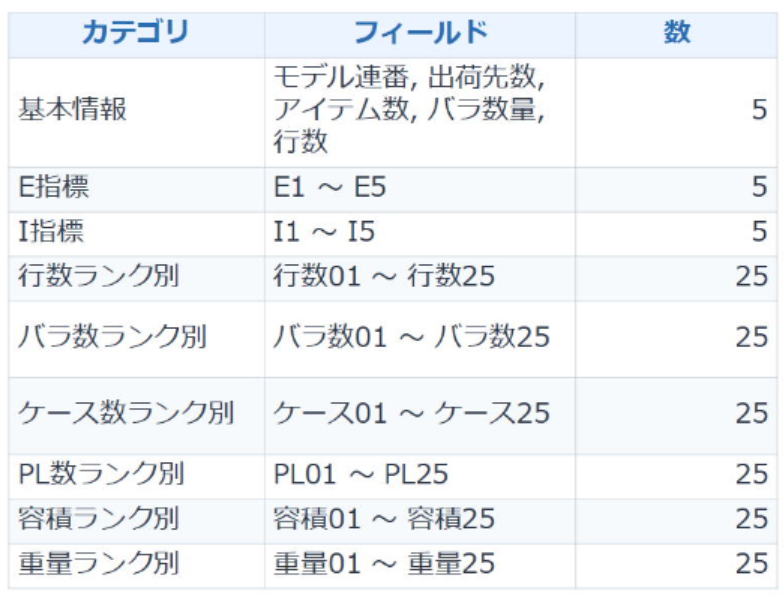
For Reference
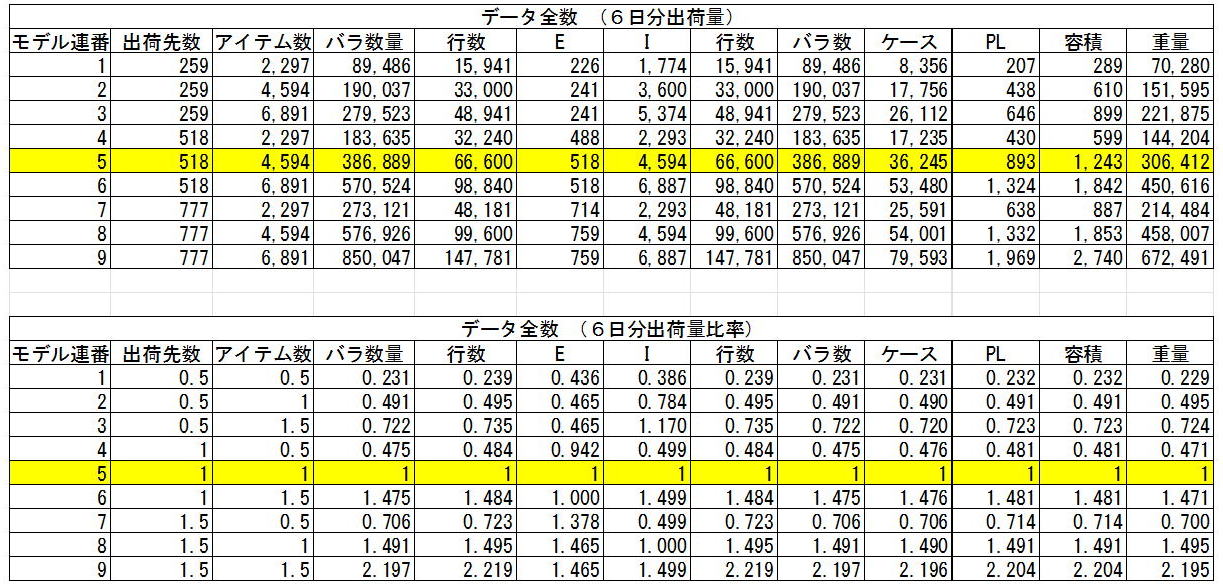
Conventionally, we were taught that "doubling destinations and doubling items doubles the distribution center size," but that appears to be inaccurate.
- "Halving destination count (0.5x) and halving item count (0.5x) reduces the distribution center scale to 0.25x."
- "Doubling destination count (2x) and doubling item count (2x) expands the distribution center scale to 4x."
Note: This occurs because "destinations" and "items" do not hold a simple additive (+) relationship, but rather a multiplicative (×) matrix structure. Occurring work combinations (picking routes, sorting overhead, etc.) increase as 2x × 2x = 4x, demonstrating a critical law in logistics operations where workload increases quadratically (fractal fluctuation).
EIQ analysis is a traditional technique used to understand operational characteristics in logistics centers from three core elements: "E (Entry / Destination Count)," "I (Item Count)," and "Q (Quantity)." By training logistics AI on historical shipping records (EIQ), this system adopts an innovative approach that enables logistics simulations of "how onsite workload and data change if destinations or item counts fluctuate."